Display options

Change how this site looks for you. Your choices are kept in this browser on this device. Settings on your phone or computer, such as reduced motion or more contrast, are followed automatically.

Text size
Reading
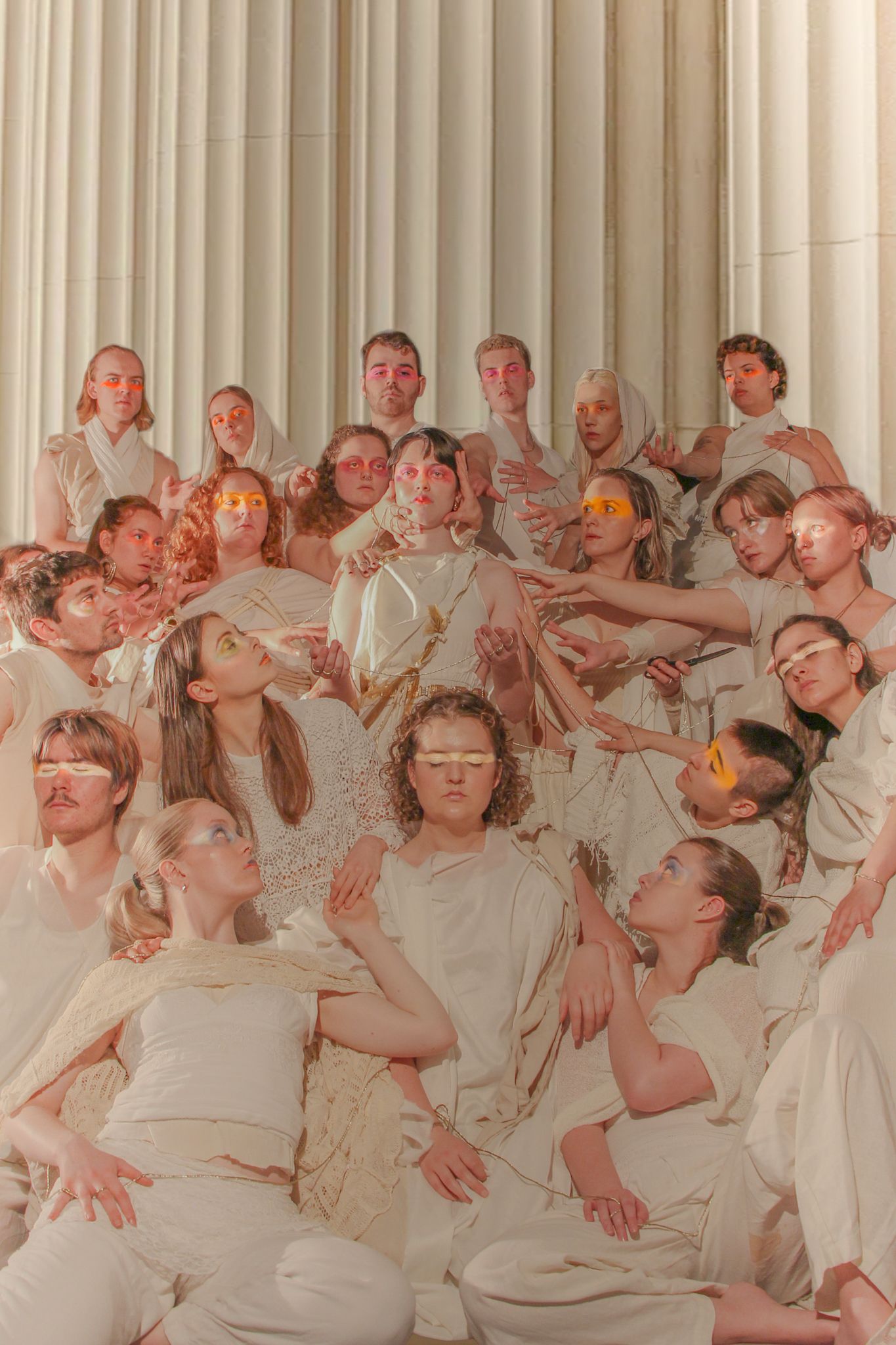
The company in white robes and gold eye paint crowds together on steps in front of fluted columns, tangled in thread, some looking up and some with eyes closed.
The Bacchae, Generator 2026 · Photo: Ethan Thomas
Our Productions

Generator · 2026

The Bacchae

The BPA's 2026 adaptation of Euripides' The Bacchae, adapted and directed by Kyle Morrison.

Acknowledgement of Country

The cast and crew of The Bacchae acknowledge the First People and custodians of the land we meet and perform upon, the Whadjuk Noongar people. We pay deep respect to Elders and community, and we recognise the unbroken cultural practices of caring for the land, waterways, the skies, and all that inhabit this boodja. We extend this respect and acknowledgement to all First Nations people. Always was, always will be, Whadjuk Noongar Country.

Proudly supported by the Bass Family Foundation

Where
Flex Theatre, WAAPA, The Minderoo Centre for Performance Excellence, ECU City
When
12 to 18 November 2026, 7.30 pm
Running time
105 minutes
Ages
recommended for ages 15 and over
Saying it
Bacchae has two popular pronunciations, BACK-eye and back-EYE. We don't mind which one you use.

About the production

Kyle Morrison’s production of The Bacchae posits a contemporary take on a classic. Through shifts in language and the addition of Shakespearean sonnets, Morrison achieves a version of the text that highlights certain themes, and puts forward a different dramatic message.

‘What happens to the children when the adults go out to party?’

The company’s dramaturgical question

Our adaptation

The ensemble. Performers create many of the scenes together as an ensemble, physically and vocally, rather than working as separate individuals.

Shared roles. Quite often, more than one performer contributes to the same character. Roles that are traditionally played by one performer, such as Dionysus, are played by up to six performers at a time.

Text, movement, and sound. This production focuses on movement, music, and sound, and these elements drive the narrative in several moments.

Adaptability. Performers appear to respond to one another in real time. A lot of the performance has been developed through experimentation rather than simply rehearsing fixed decisions; devising and collaboration, rather than director-led work.

The Fates

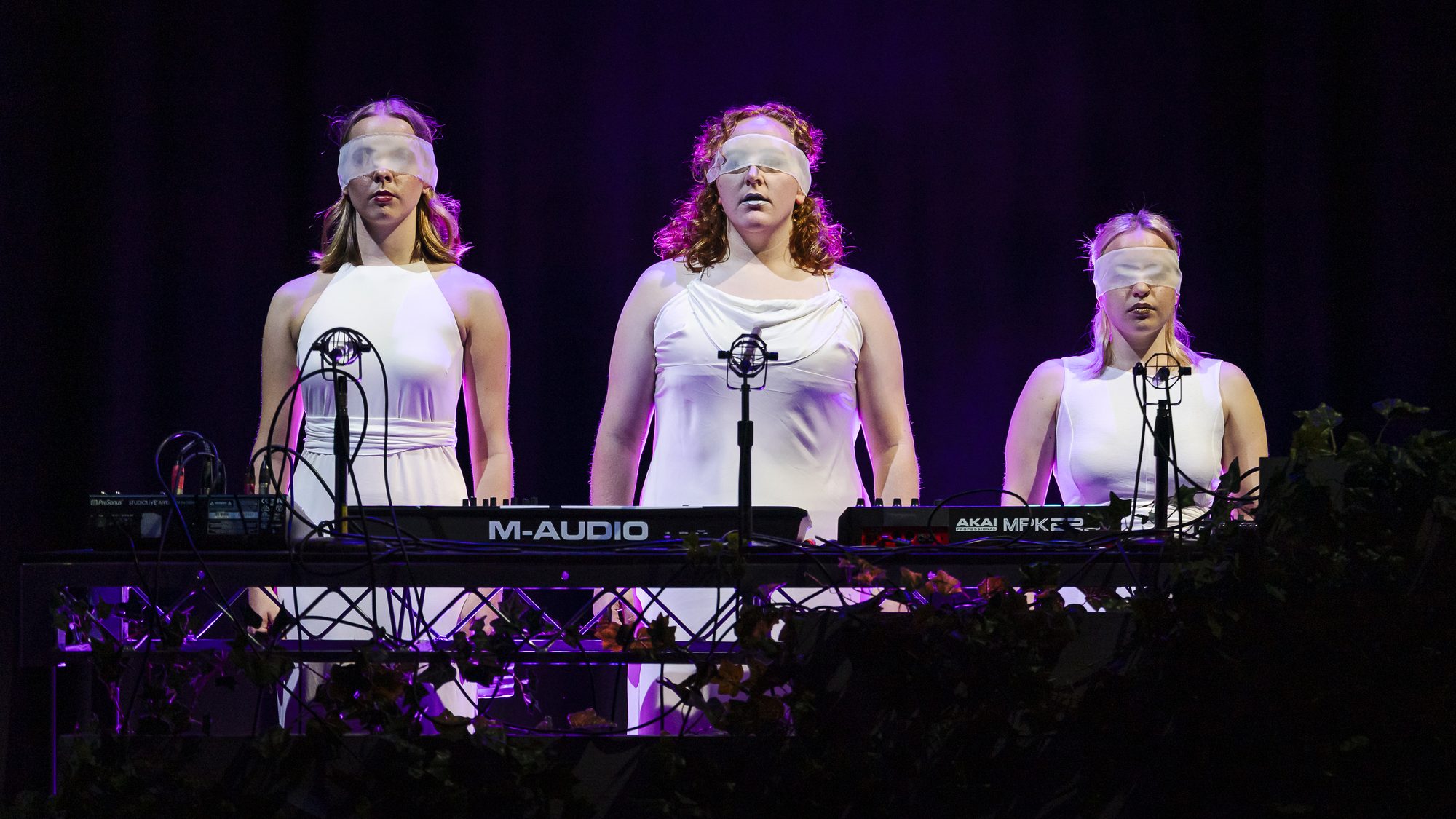
Kyle’s retelling of The Bacchae strays from the original tale with the addition of new characters called The Fates: three spirits connected to Mother Boodja and the history of the land. Throughout the play, The Fates speak sonnets by William Shakespeare. They are connected to the traditional wise seer in the play, Tiresias, but are not mortal. Kyle uses The Fates to represent Country, and their manipulation of sound and movement from a sound desk is a symbol of their inherent care and control of the land and its people.
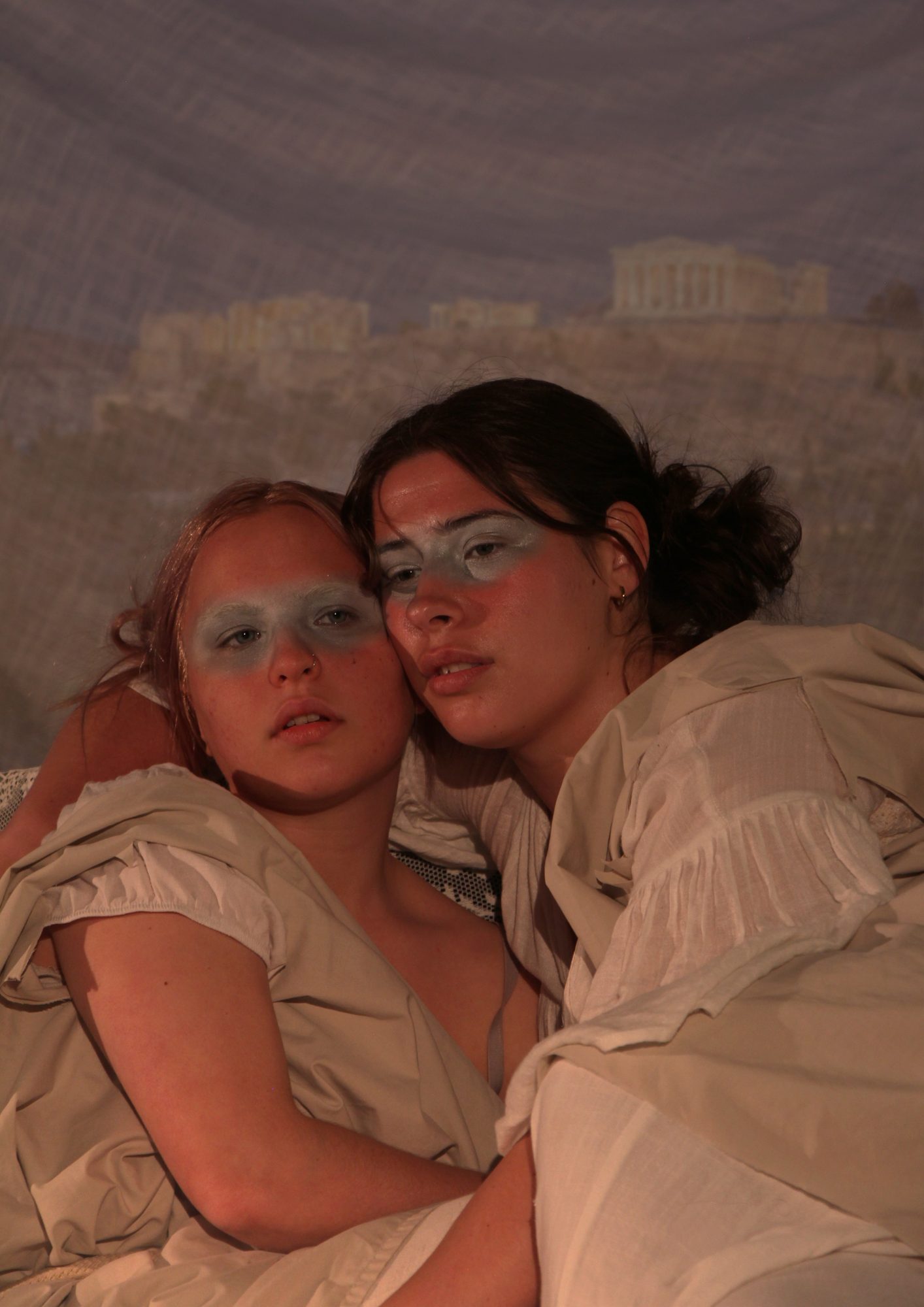
Two performers in pale robes with blue eye paint lean into each other in front of a painted backdrop of a ruined temple on a hill.
The Bacchae, Generator 2026 · Photo: Ethan Thomas

How the company made it

The 2026 Performance Making Company has had a long journey with The Bacchae, commencing work in 2024 with a week-long classical text intensive led by our director, Kyle Morrison. As a predominantly female company, we became interested in how the Maenads could be explored as a collective, non-gendered group, which led to wider conversations about the relationship between our nation’s youth and the adults that guide them.

In 2025 the company returned to classical text with a more experimental approach, joined by Boorloo-based DJ Lord of Dazastah (Darren Reutens). We began incorporating improvised music and soundscapes into scenes while experimenting with multiple actors sharing a single character. Our movement director, Sam Fox, also joined us, and we began developing a movement style as a cohort.

By 2026, the production became a major focus for the company and introduced us to our first formal WAAPA casting process. Shakespearean sonnets were introduced, casting decisions shifted, and some characters ultimately became shared between performers across alternating nights. The final production reflects the company’s three-year development from classical text training towards an adventurous, ensemble-driven approach to Greek tragedy.

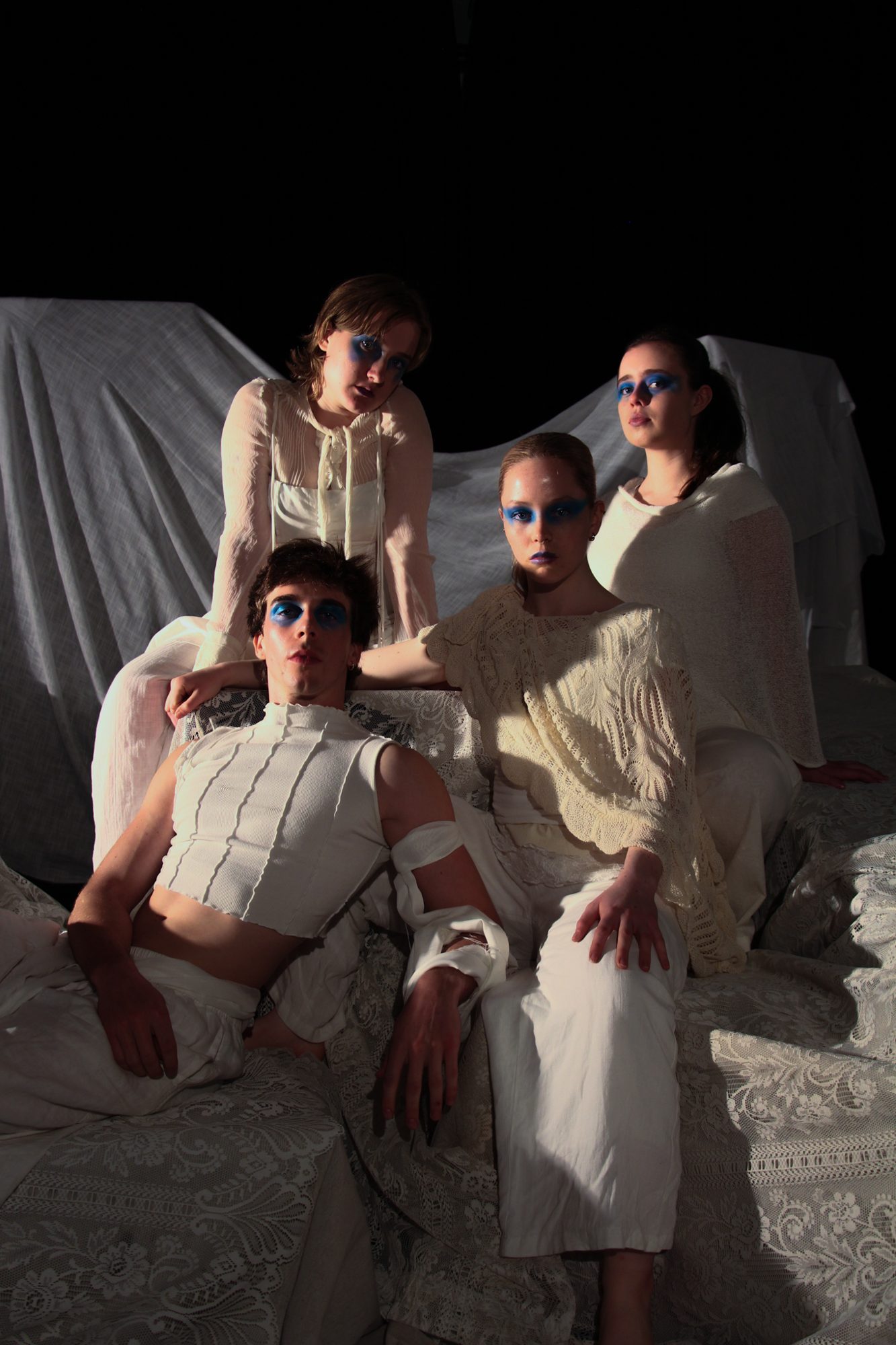
Four performers in white, with blue eye paint, pose on a pile of draped white fabric against black, one reclining in front with a bandaged arm.
The Bacchae, Generator 2026 · Photo: Ethan Thomas

The characters

  • The Fates: the voice of Country and the weavers of fate
  • Dionysus: god of wine and pleasure
  • Tiresias: an old blind prophet and lore keeper
  • Pentheus: the young king of Thebes
  • Cadmus: the old, retired king of Thebes
  • Agave: leader of the Bacchanalians, mother of Pentheus
  • Messengers: working-class labourers and unpossessed citizens of Thebes
  • Soldiers: members of the Theban military

Press

Other roles were played by multiple actors, giving a sense of magic or godliness.

Kimberley Shaw, Stage Whispers
Read the review

Outstanding and graphic group storytelling.

Kimberley Shaw, Stage Whispers
Read the review

Ultimately, this is a fresh and energetic adaptation.

Michael Hollick, Xpress Magazine
Read the review

WAAPA proves the ancient gods still hold electrifying power over the modern stage.

Michael Hollick, Xpress Magazine
Read the review

Creative team

Director
Kyle Morrison**
Associate Directors
Tiahni and Ellien Warden
Dramaturg and Script Editor
Teresa Jakovich*
Movement Director
Sam Fox*
Associate Movement Director
Gryphen Billington
Composer and Sound Mentor
David McEwan**
Intimacy Coordinator
Molly Tipping*
Vocal Coach
Julia Moody*
Associate Voice Director
Hazel Hunt
Acting Coach
Teresa Jakovich*

Design team

Set Designer
Abigail Kruger
Costume Designer
Sofia Trimboli
Lighting Designer
Katharina Brieden
Sound System Designer
Tex Bunce
Sound Effects Designer
Jess Bates

Cast

The 2026 Performance Making Company

The Three Fates
Hannah Blampied, with Ellien Warden and Hazel Hunt, or Elodie Tipton-Akers and Cody Mackinder (alternating)
Dionysus
Gryphen Billington, Lily Moran, Alexia Skipper, Electra Srbinovski, Michael Douthwaite, and Joel Hazzard
Tiresias
Tiahni, Tooi Ng, and Claire McIntosh
Pentheus (alternating)
Gus Patterson and Prince Attwood
Cadmus (alternating)
Cody Mackinder and Hazel Hunt
Agave (alternating)
Ellien Warden and Elodie Tipton-Akers
Messenger
Lara Hodgson, Daniel Monteiro Pais, Julia Nichols, and Jayda Corunna
Soldier
Emily Keys, Ebony Plowman, Sophie Quin, and Ethan Thomas

12, 14 (both shows), and 17 November

The Fates
Hannah Blampied, Ellien Warden, and Hazel Hunt
Pentheus
Gus Patterson
Cadmus
Cody Mackinder
Agave
Elodie Tipton-Akers

13, 16, and 18 November

The Fates
Hannah Blampied, Elodie Tipton-Akers, and Cody Mackinder
Pentheus
Prince Attwood
Cadmus
Hazel Hunt
Agave
Ellien Warden

Stage management

Production Manager
Halee Fedec
Stage Manager
Riley Oliffe
Assistant Stage Managers
Grace Whiteley and Sierra Winter-Spence

Lighting

Head Electrician
Grayson Pepi
Programmer
Caelen Morris
Lighting Crew and Board Operator
Noah Zweck

Sound

Sound Operator and Programmer
Nicholas Connan

Props and scenery

Workshop and Head Mechanist
Will Allison
Head Props
Natalie Willis
Set Crew and Mechanists
Anna Siddell and Erin Pettley
Props Crew
Lewis Cartlidge and Phoebe Mains

Costume

Costume Supervisor
Mei Thomson*

Arts and Cultural Management

Associate Producer (Creative Learning)
Ruby Dobson
Associate Producer (Access and Inclusion)
Jessica Thomas

2025 Creative Development

Composer and Music Director
Lord of Dazastah (Darren Reutens)

Bachelor of Performing Arts

Associate Producer
Teresa Jakovich*
Unit Coordinator, PAM3400 Directed Theatre Production
Teresa Jakovich*

Creative Learning Pack

Compiled and edited by
Teresa Jakovich*
Online resources curated and developed by
Jeremy Neideck*
Access Guide and visual story
Jessica Thomas

** Visiting artist. * WAAPA staff.

Production photos

Three performers in white dresses with gauze blindfolds stand at microphones behind keyboards and a mixing desk on a raised platform, in violet light.
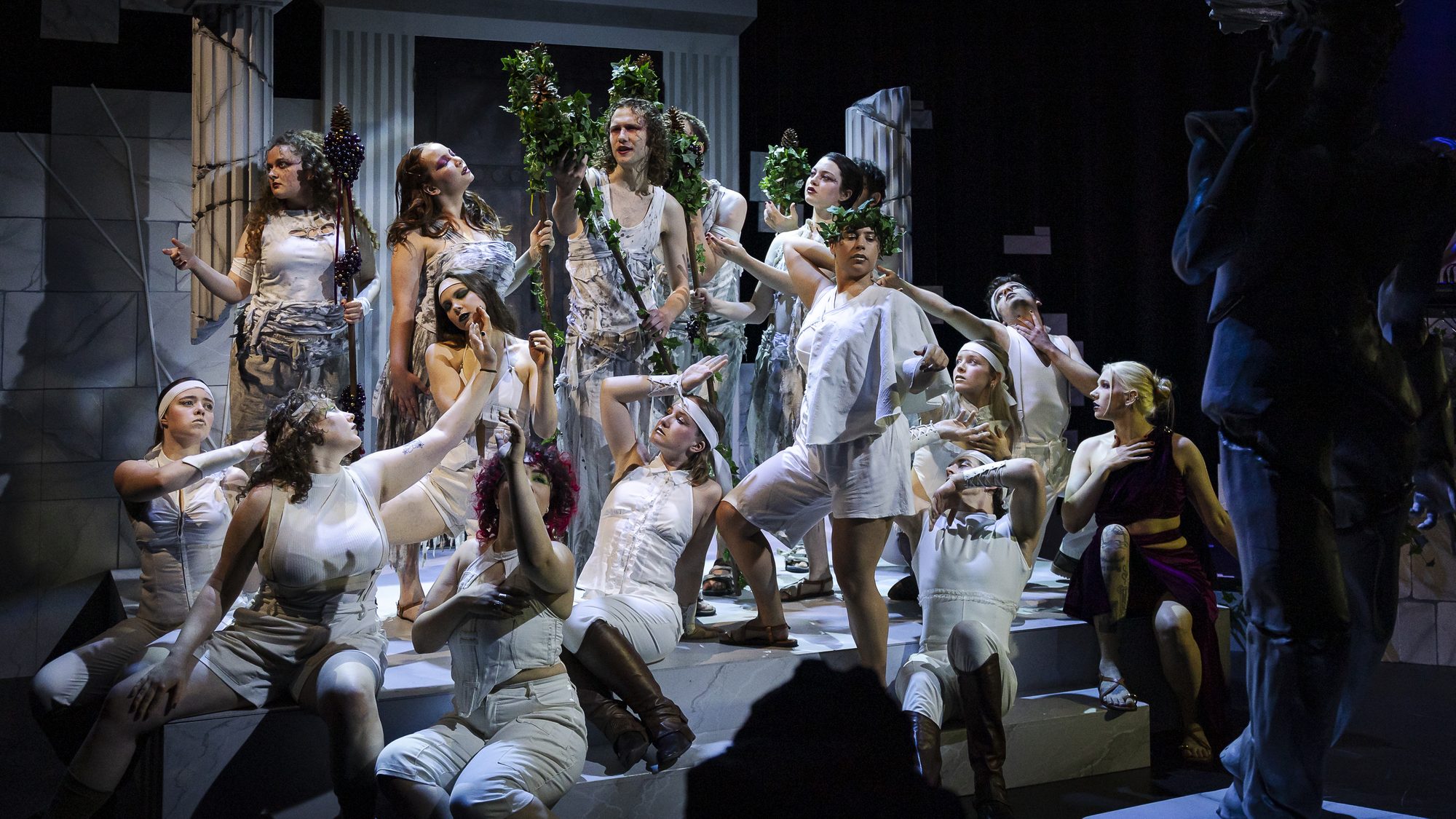
The company crowds the palace steps in white and grey costumes, reaching and leaning in different directions under ivy-wound staffs.
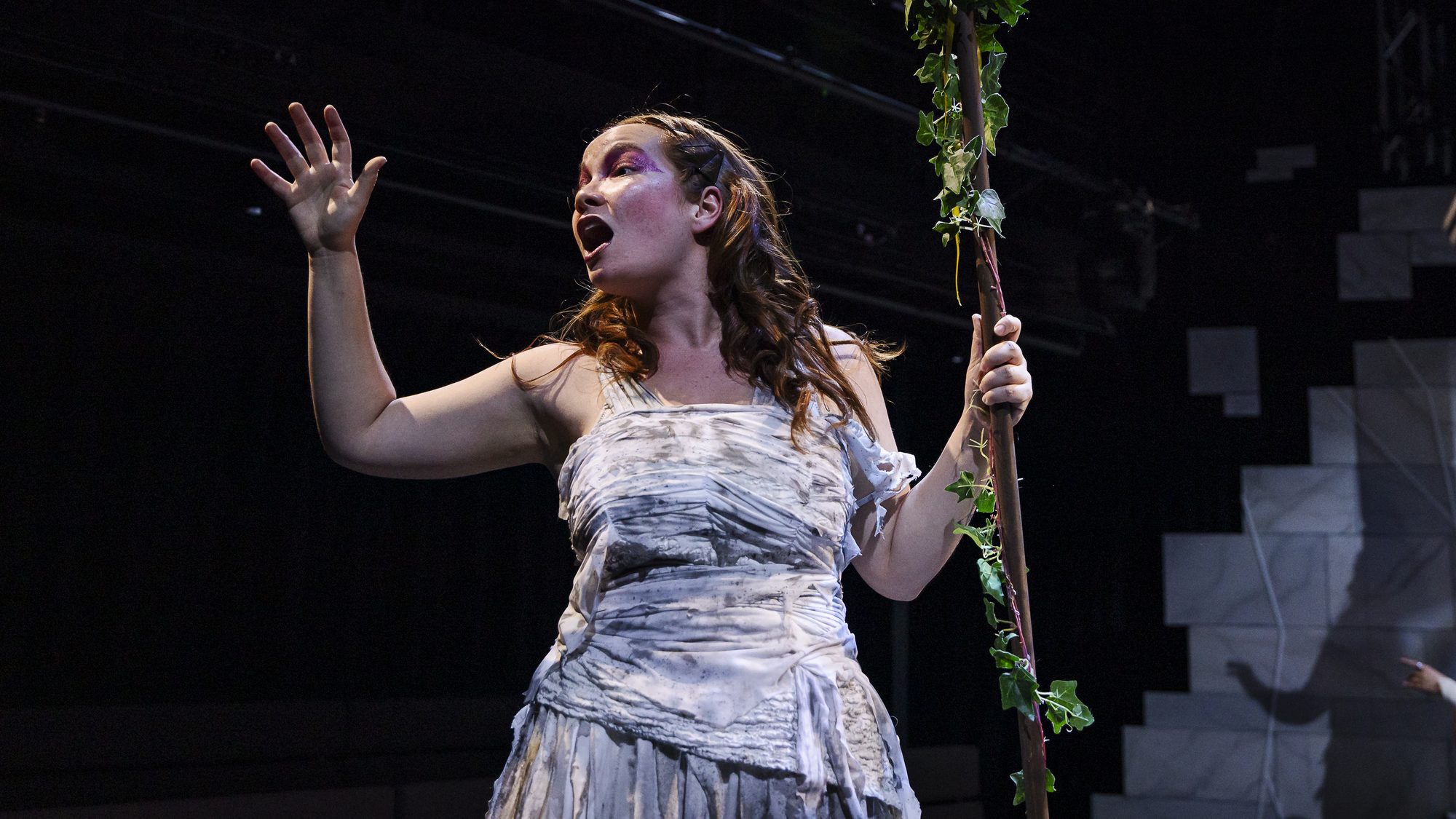
A performer in a ragged grey and white dress calls out with one hand raised, holding a tall staff wound with ivy.
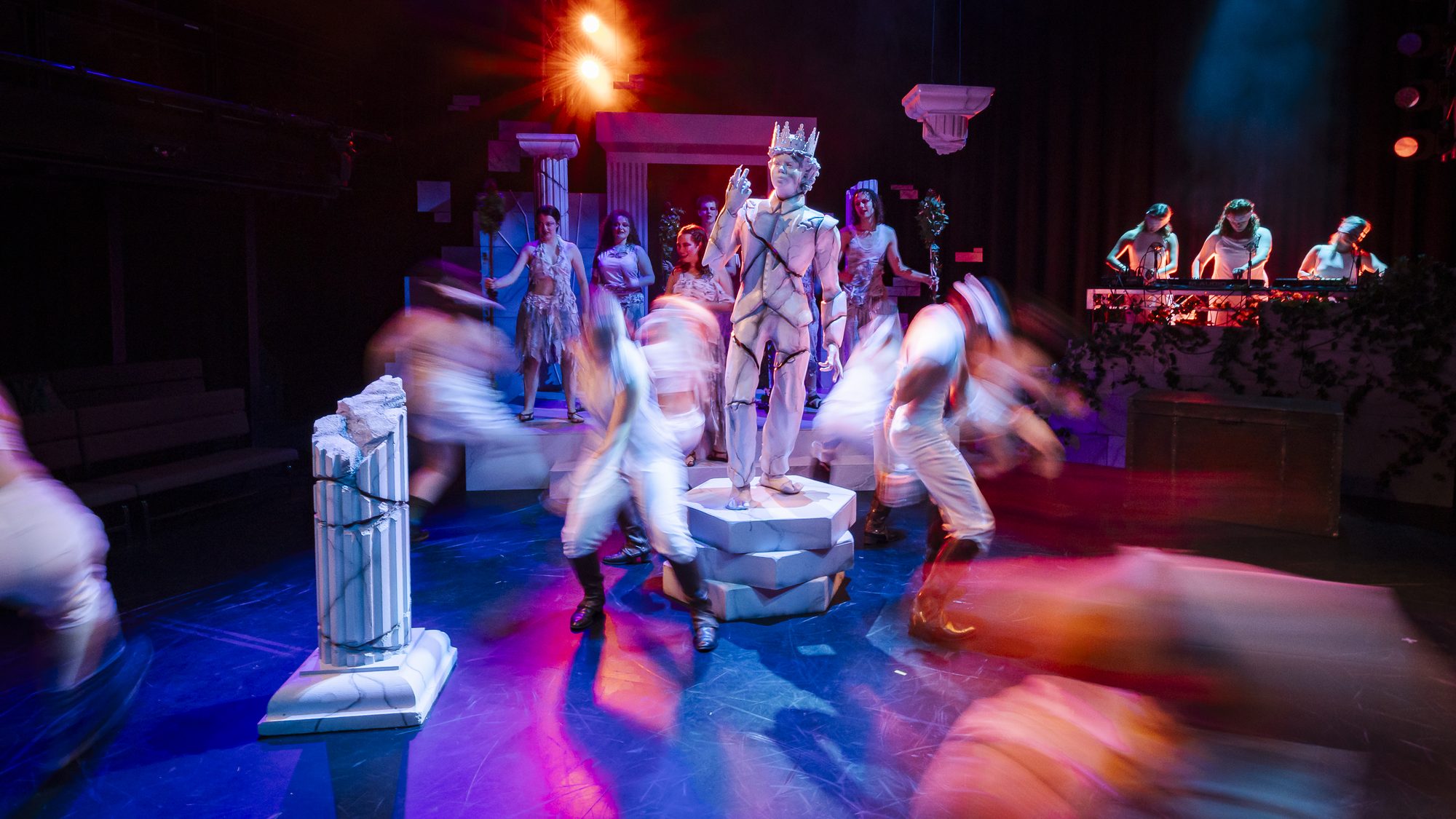
Dancers blur around the statue in red, pink and blue light, with three figures at a DJ platform behind.
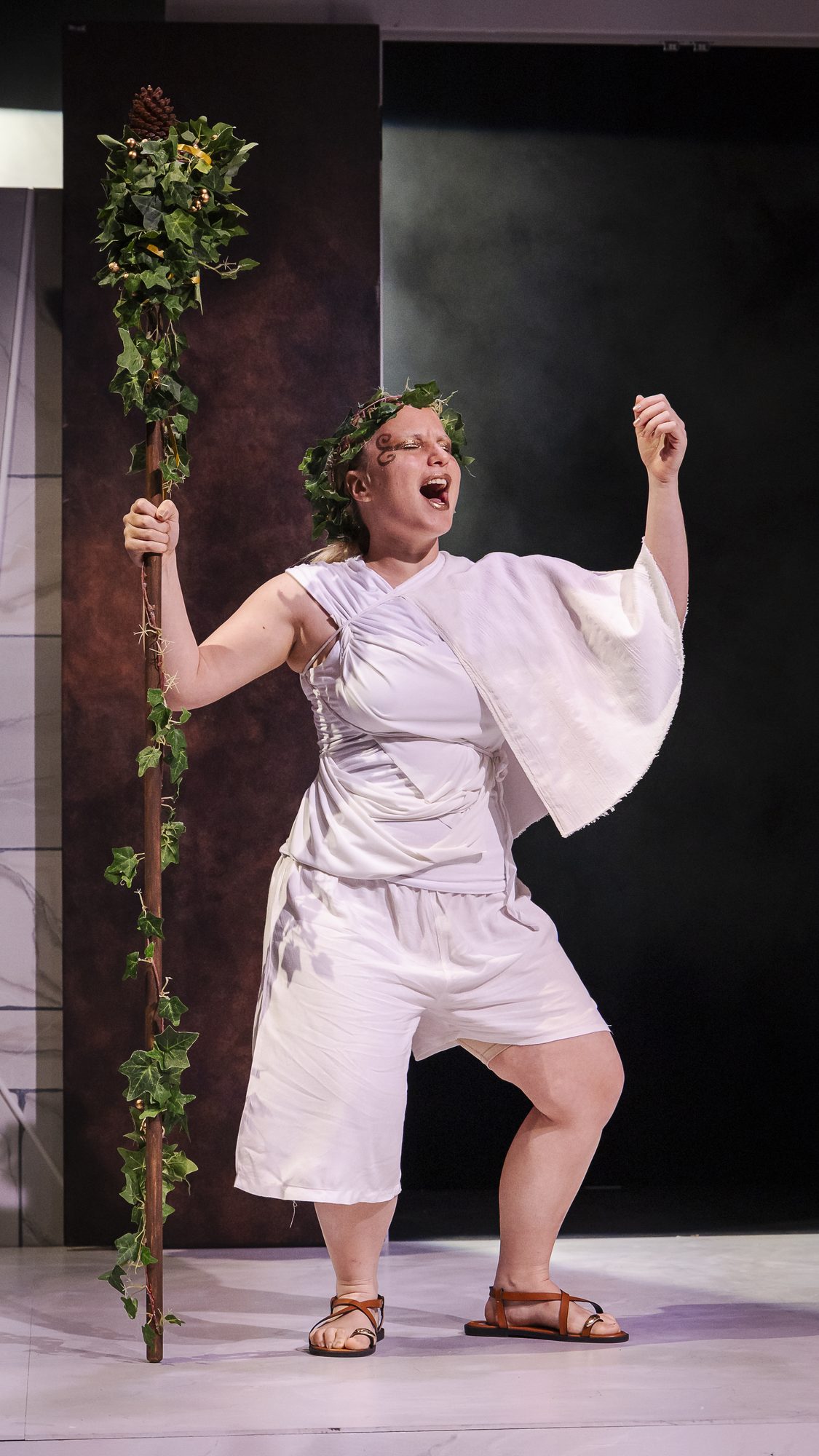
A performer in a white cape, shorts and an ivy crown bends at the knees and shakes a fist in the air, holding an ivy-wound staff.
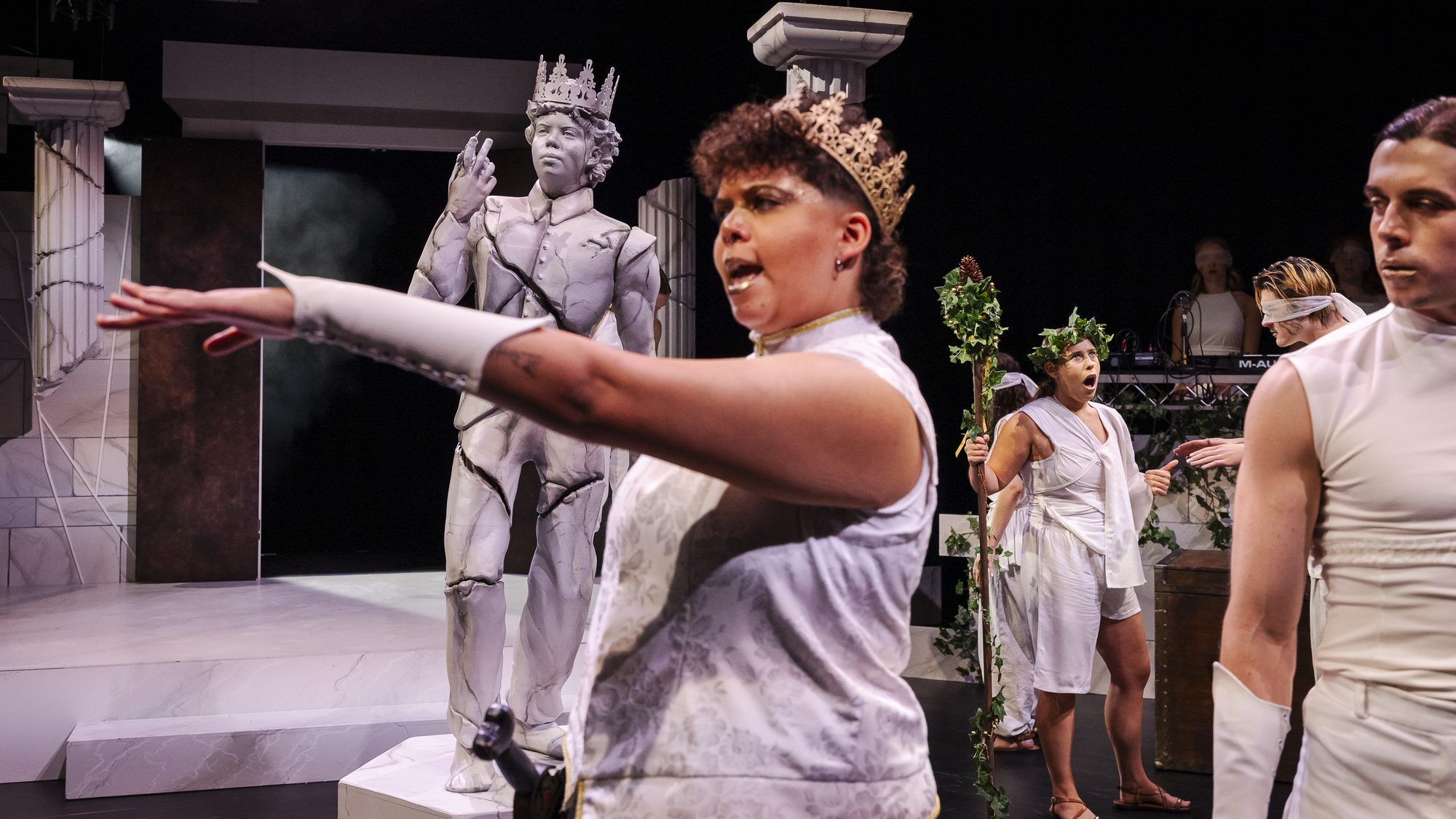
A performer in a gold crown and white vest points an arm across the stage, in front of the statue that wears the same crown.
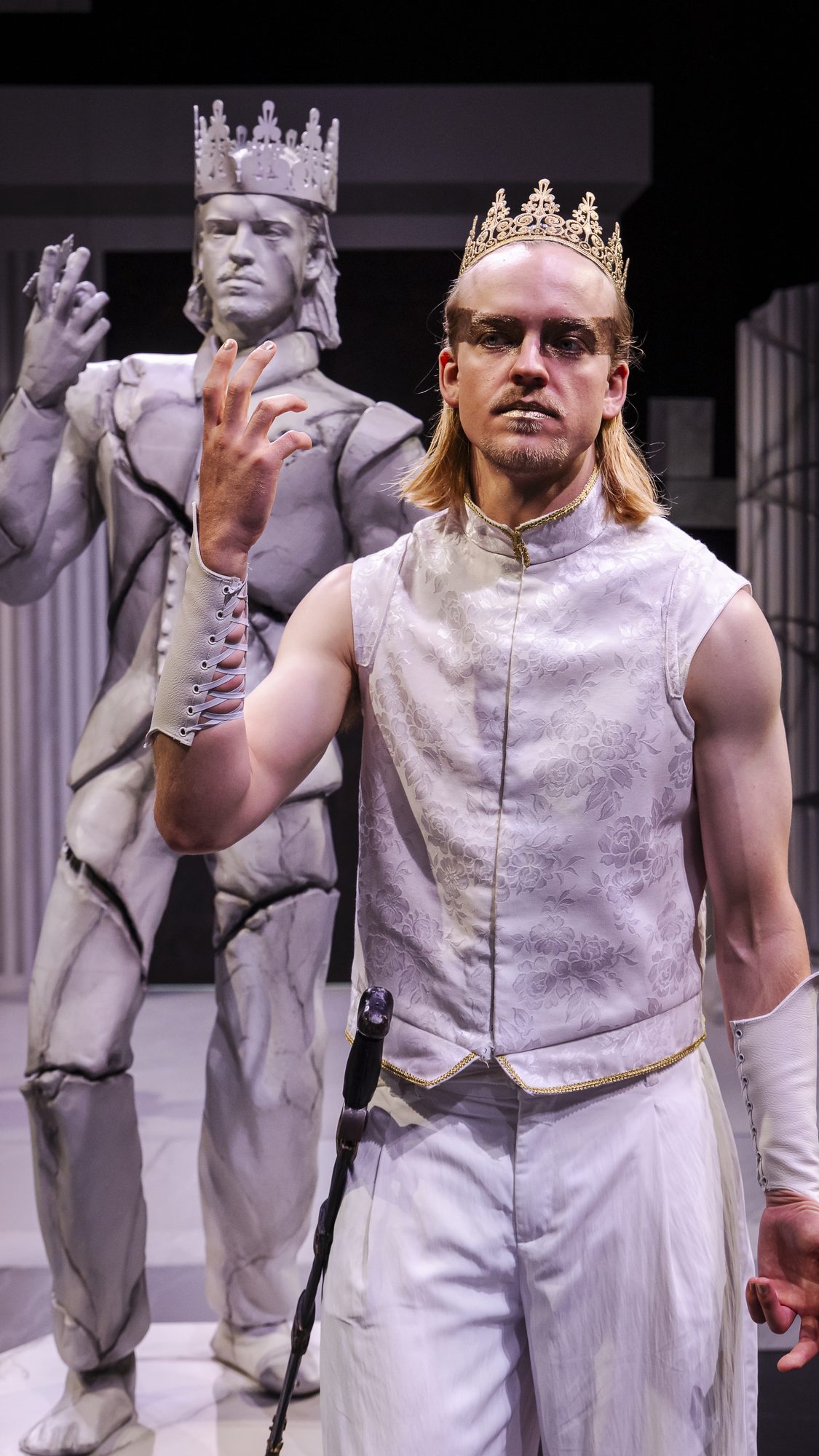
A performer in a gold crown, glasses and white brocade vest raises one hand in the same pose as the statue behind him.
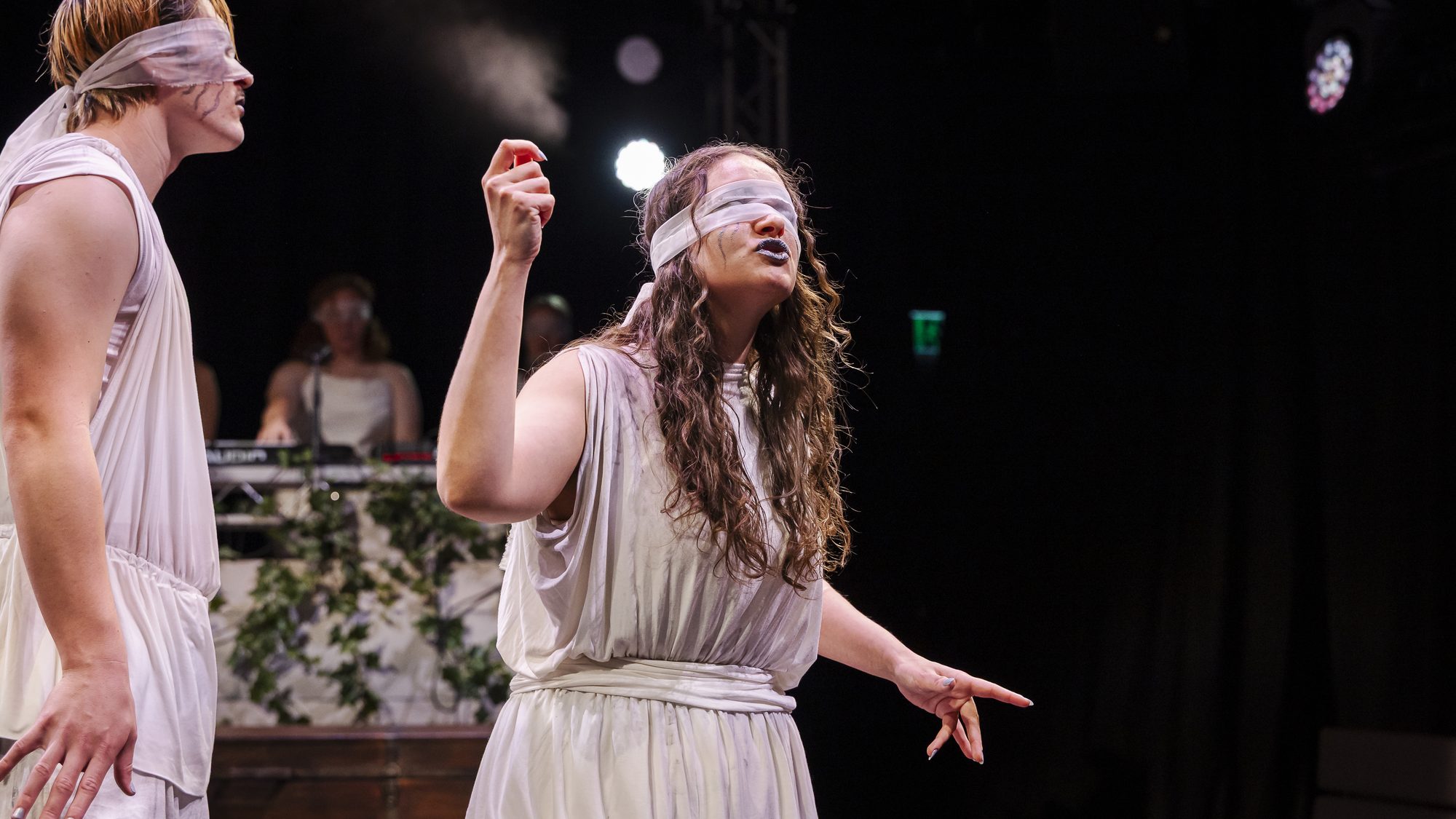
A blindfolded performer in a white draped dress raises one hand and points down with the other, beside a second blindfolded figure.
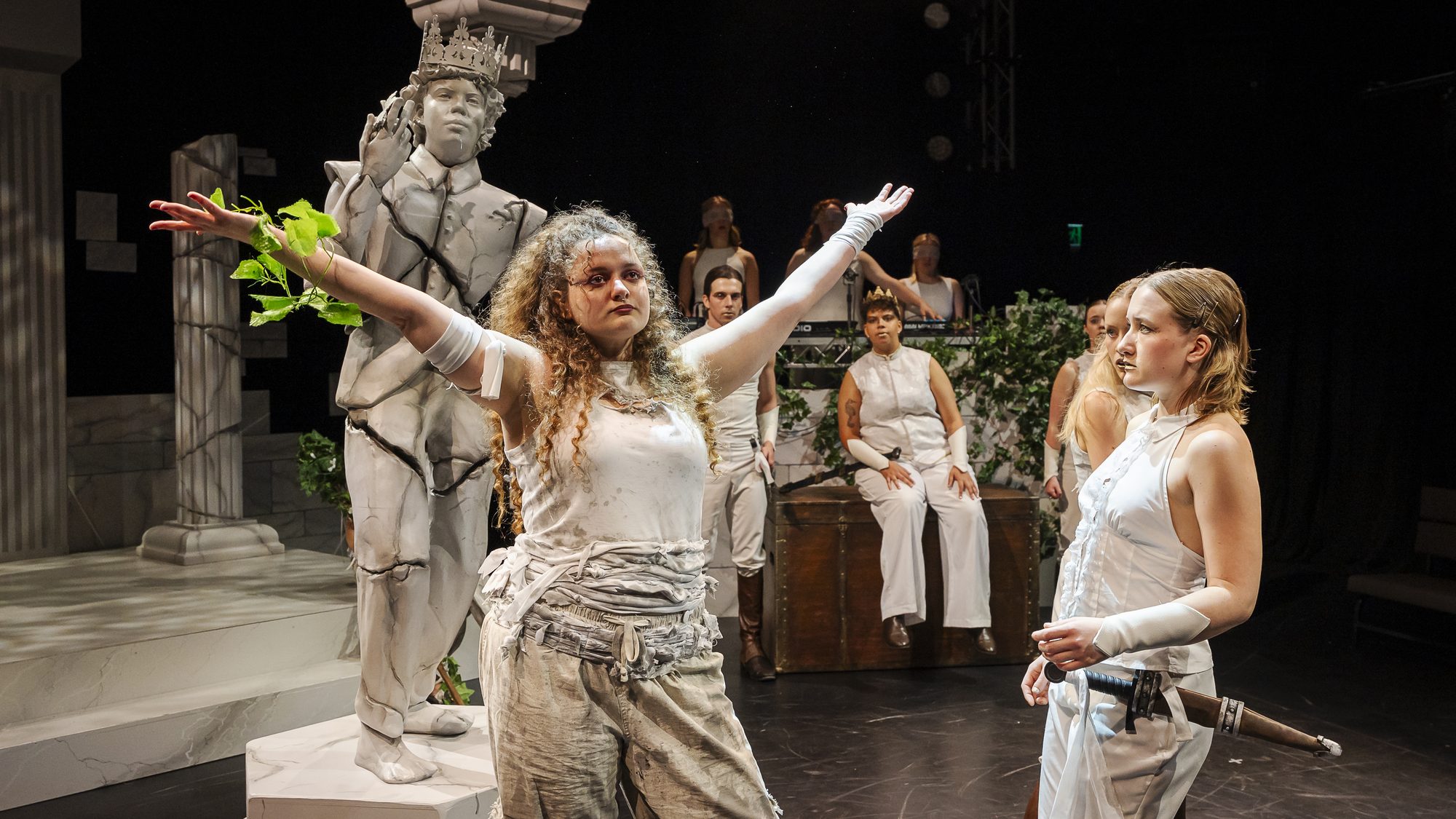
A performer with long curly hair spreads her bandaged arms wide in front of the statue, a soldier in white with a sword beside her and a crowned figure seated behind.
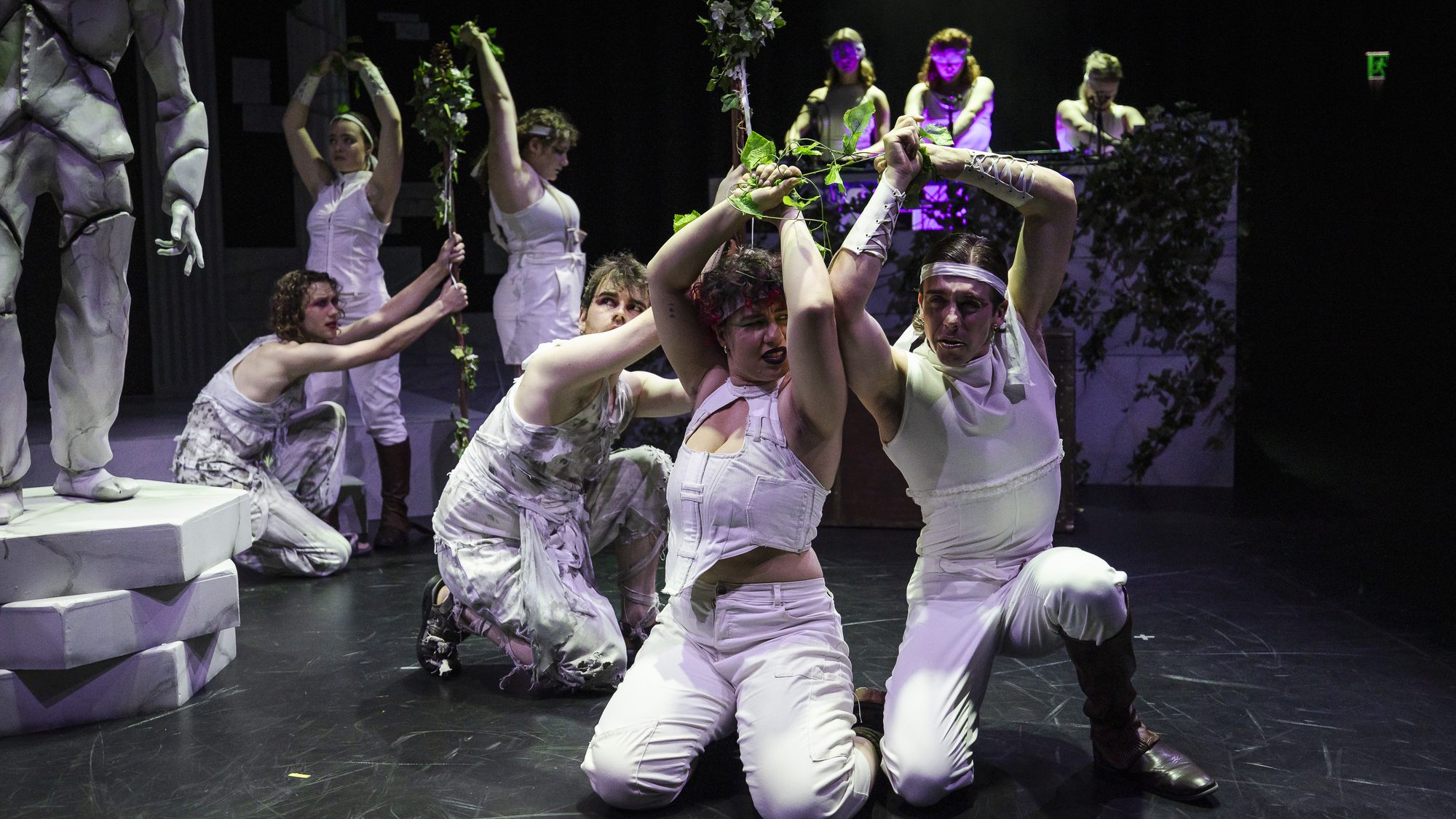
Performers in white kneel with their wrists crossed above their heads, tied with green vines, in front of the statue's legs.
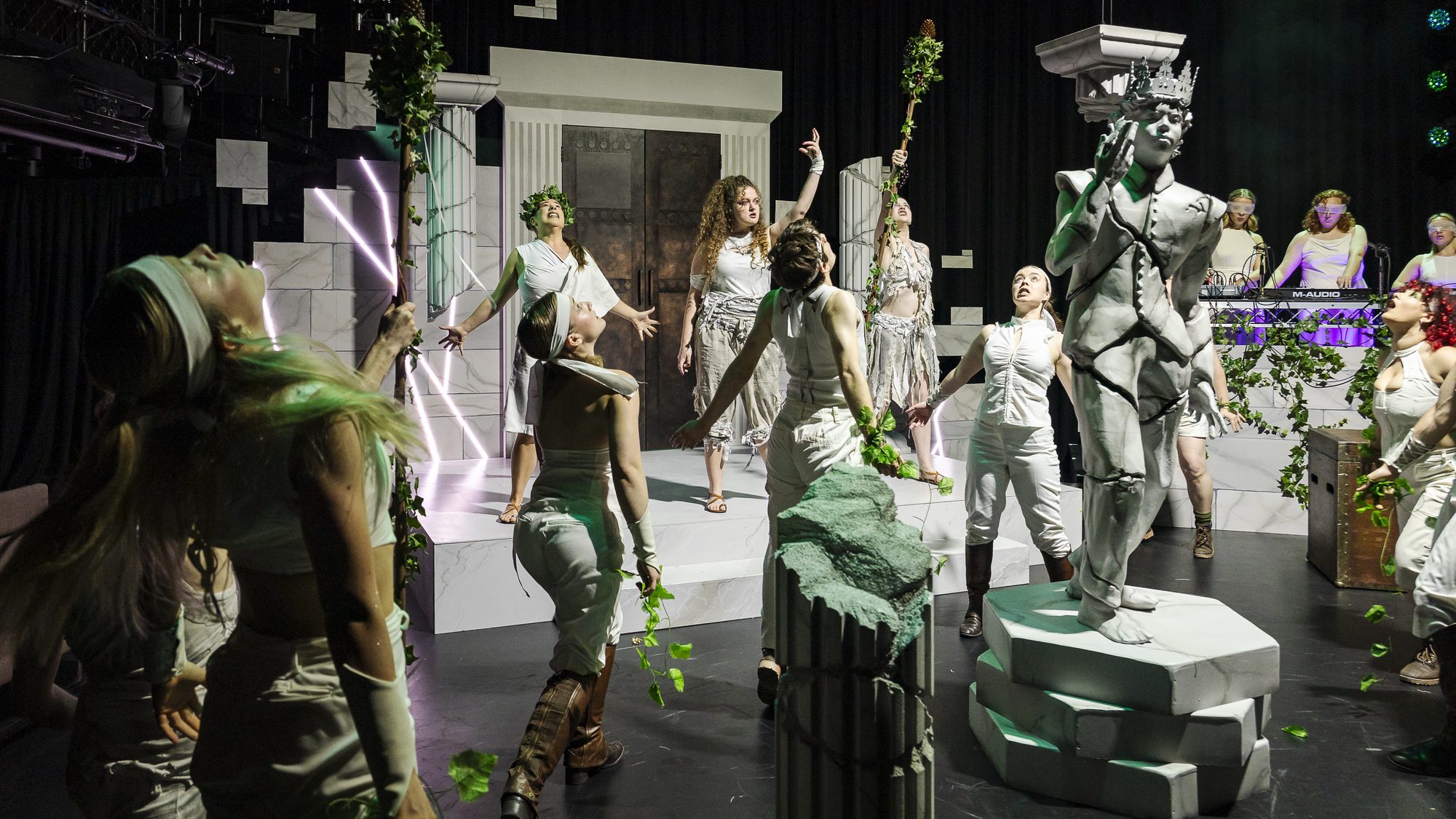
The company reels around the statue, arching backwards and reaching up, with strips of white light on the wall like a lightning strike.
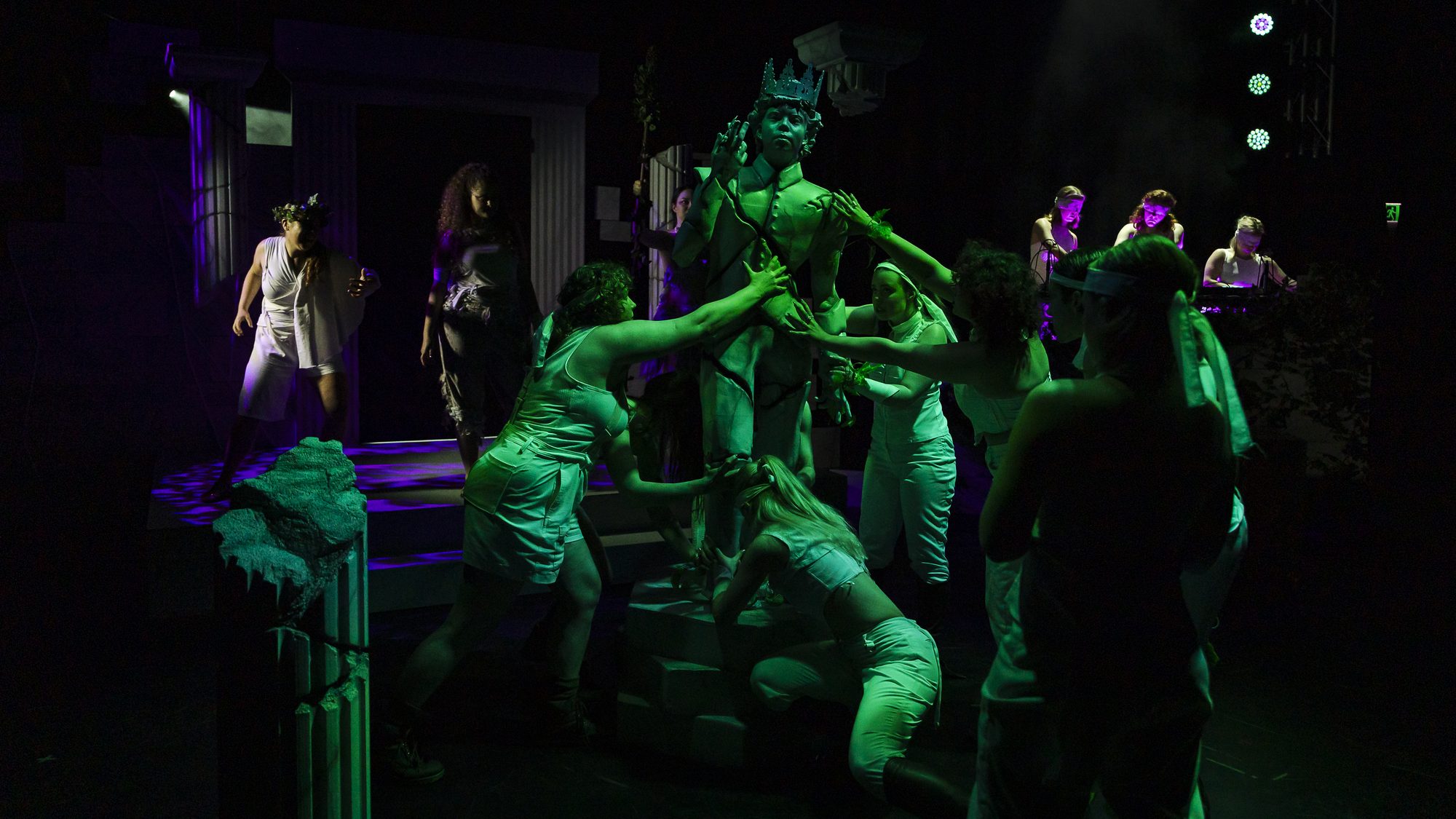
Performers swarm the statue in dark green light, gripping its body and pulling at it.
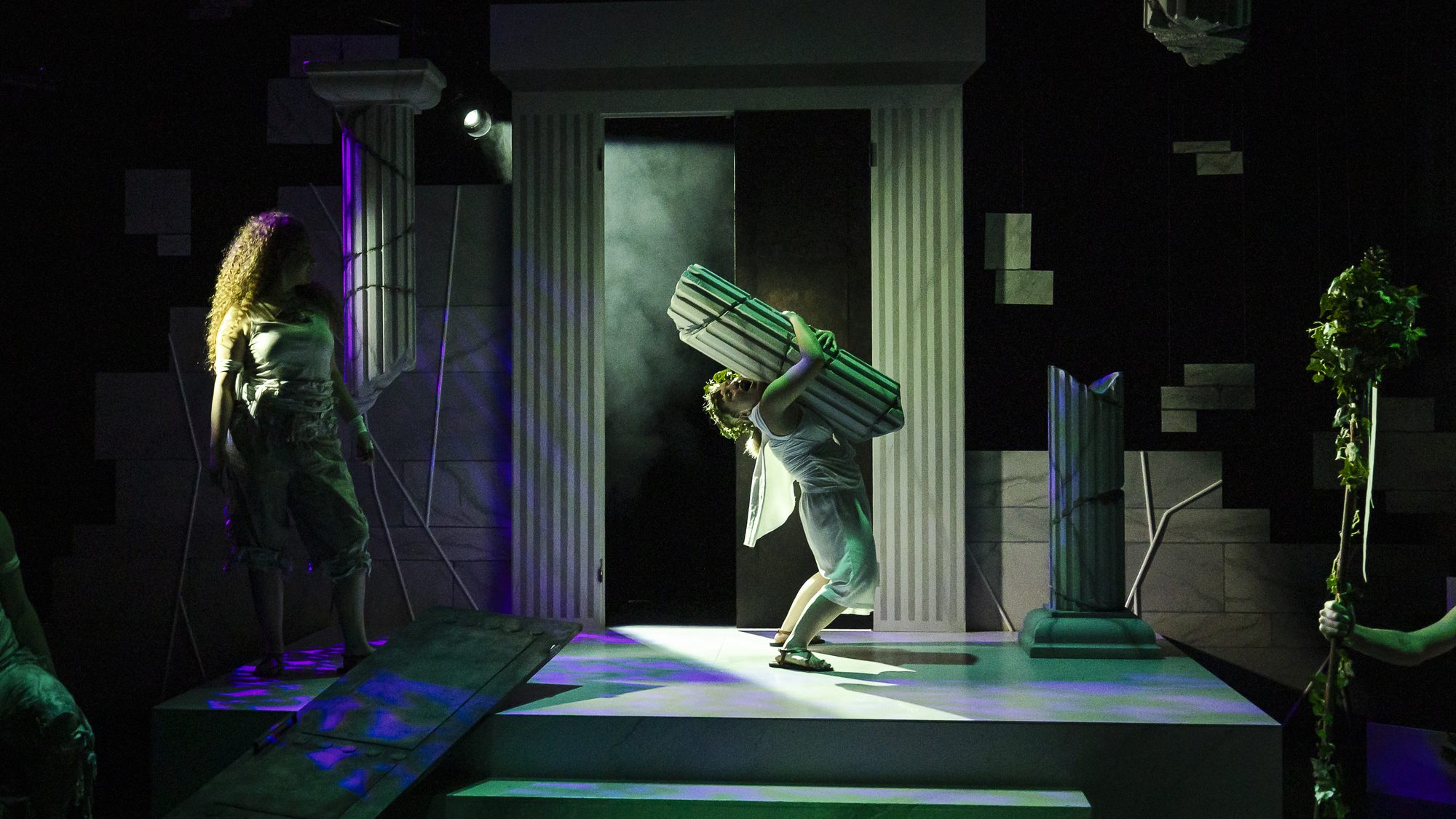
A performer carries a section of fluted pillar on her back through the palace doorway, in green and violet light.
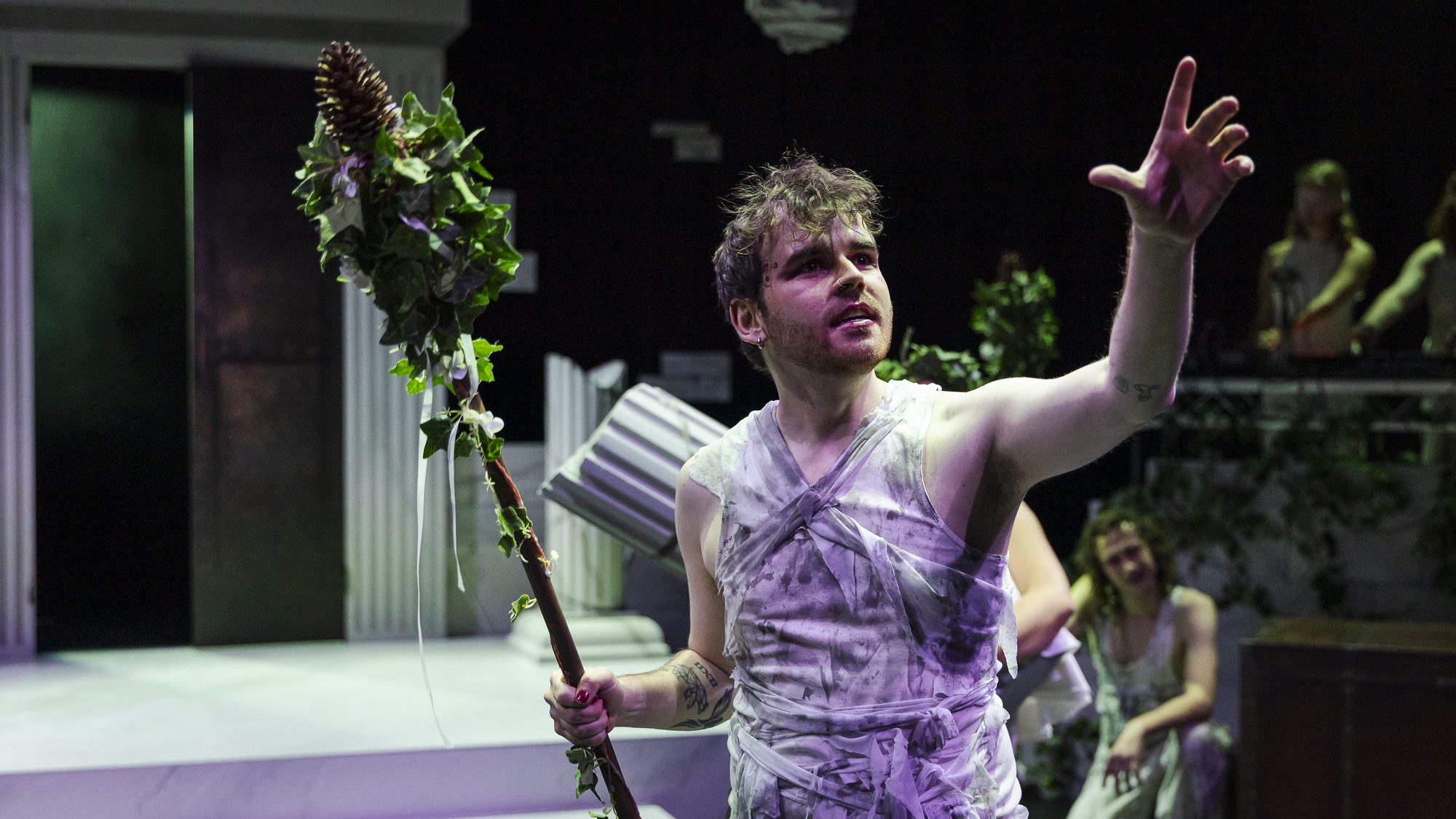
A performer in a ragged grey tunic lifts an ivy-wound staff topped with a pine cone and reaches out with his other hand.
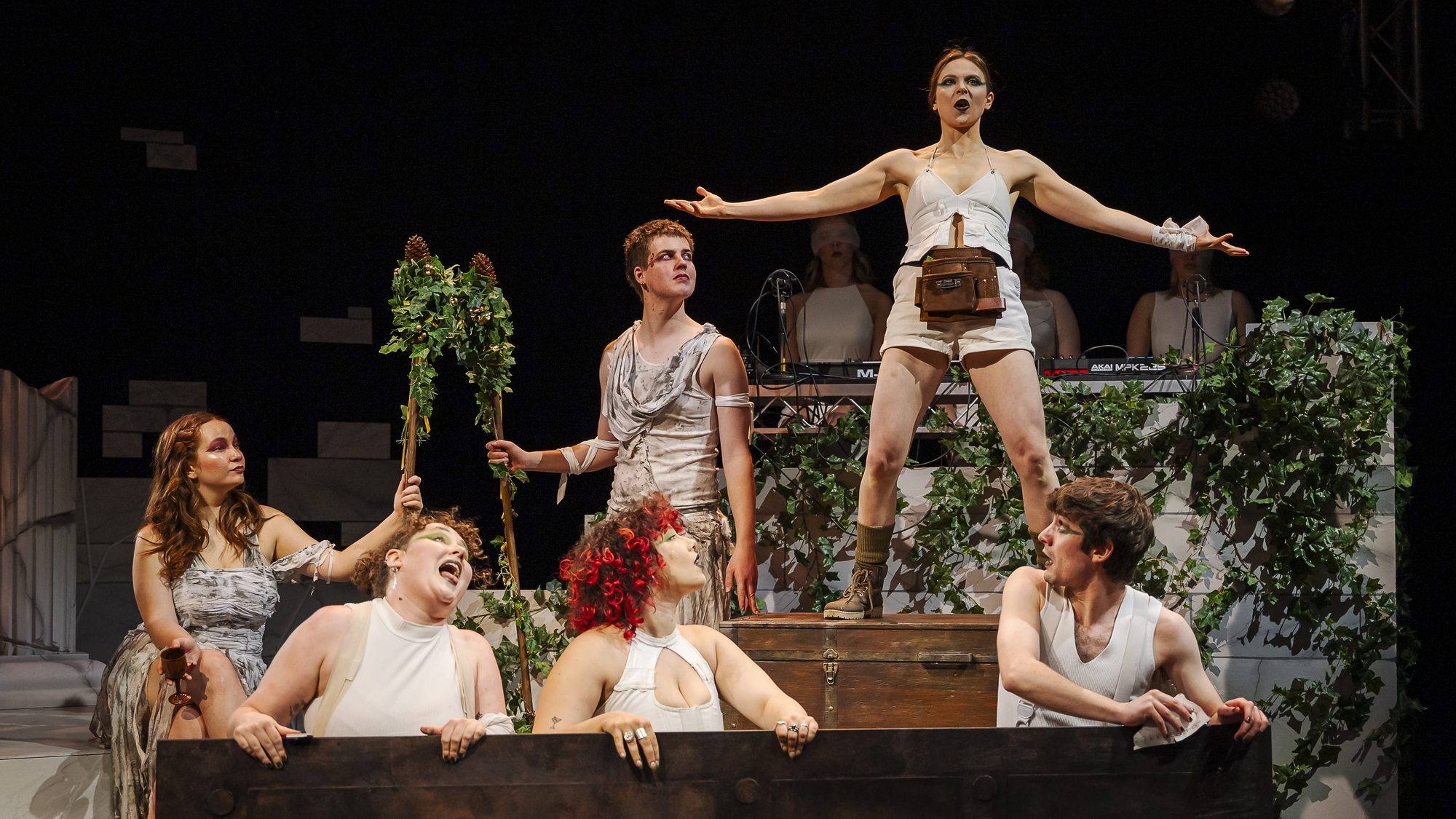
A performer in white stands on a trunk with arms spread wide while others lean on a fallen door below, looking up at her.
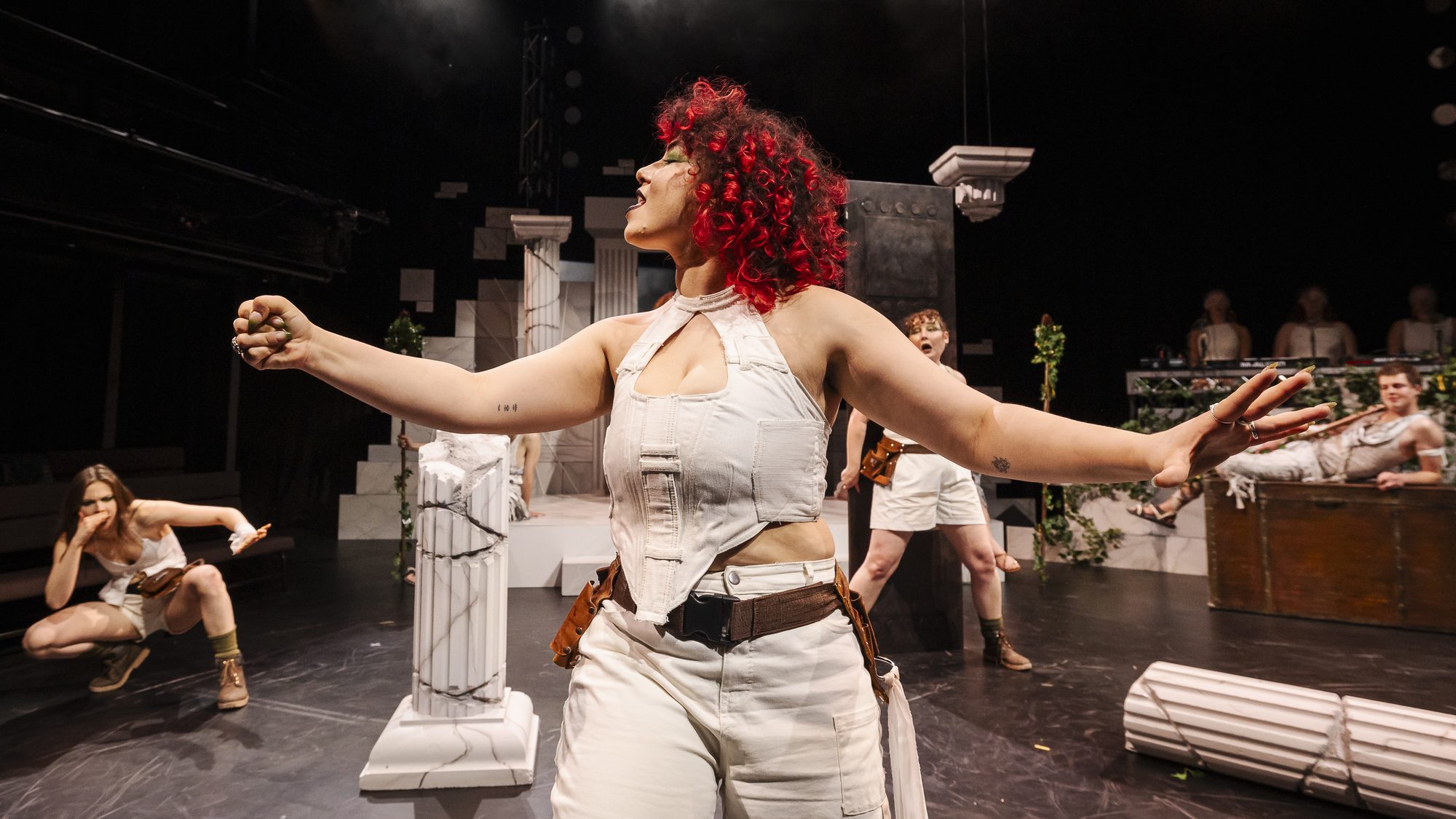
A performer with bright red curls and a tool belt throws her arms wide in profile while another crouches behind a broken pillar.
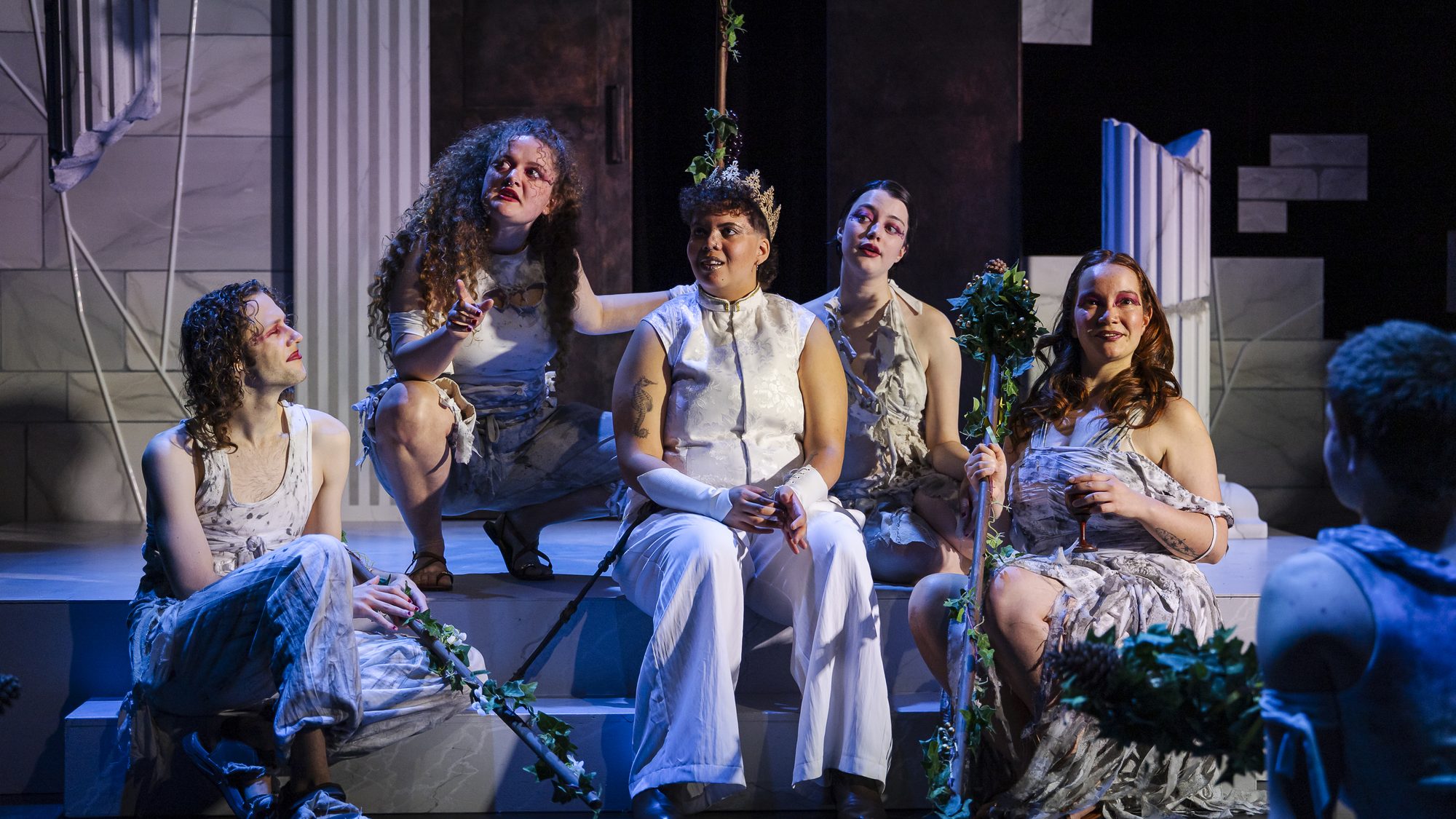
A crowned performer in a white vest sits on the steps with five figures in ragged grey pressed close on every side, one leaning at his shoulder.
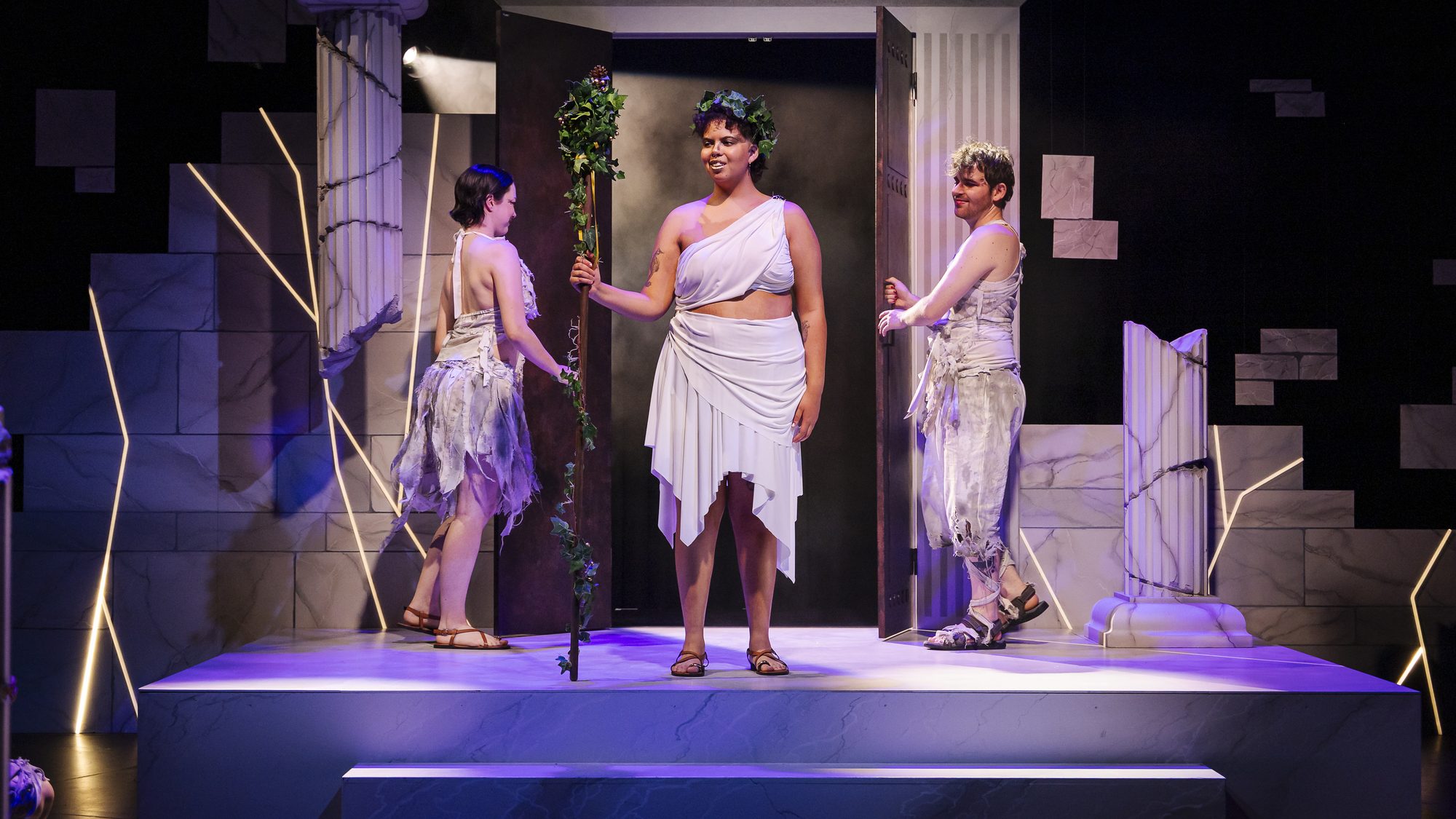
A performer in a white draped top and skirt and an ivy crown stands in the palace doorway holding an ivy-wound staff, with a figure in ragged grey on either side.
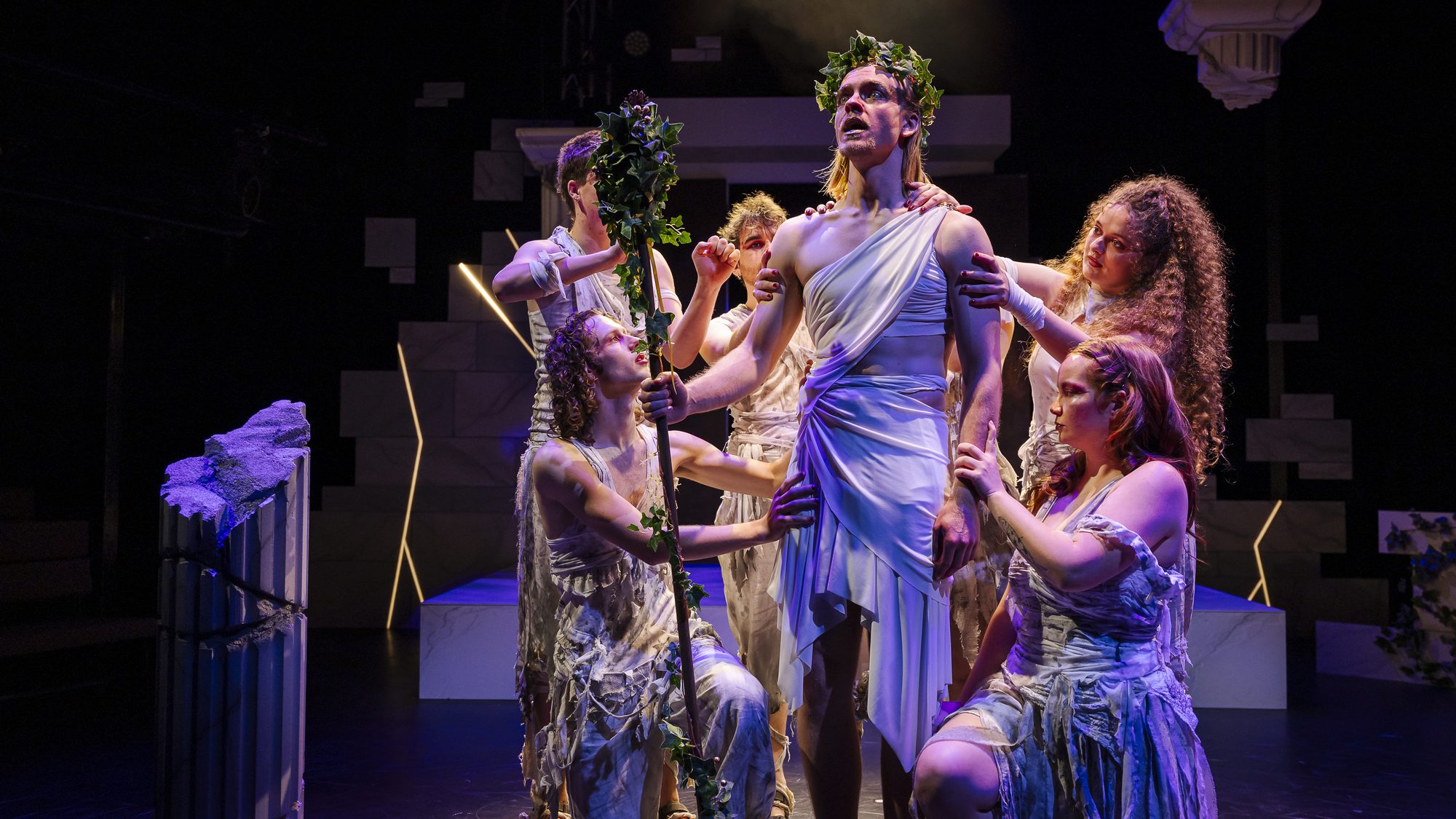
A performer in pale blue drapery and an ivy crown stands looking up while five figures in ragged grey kneel and stand around him, hands on his arms and costume.
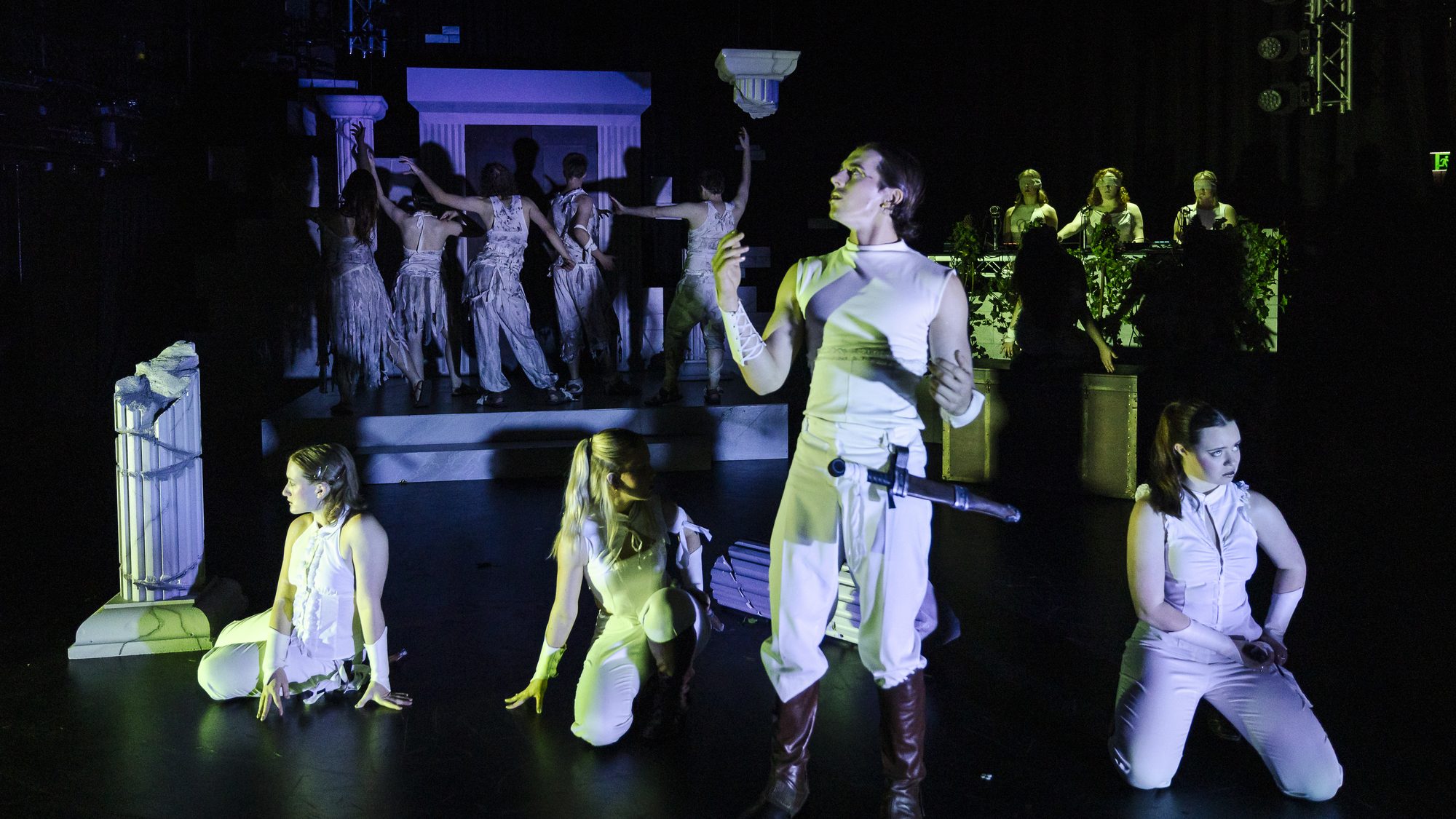
A performer in white with a sword at the hip stands looking up while three others kneel around him, with the chorus dancing on the platform behind.
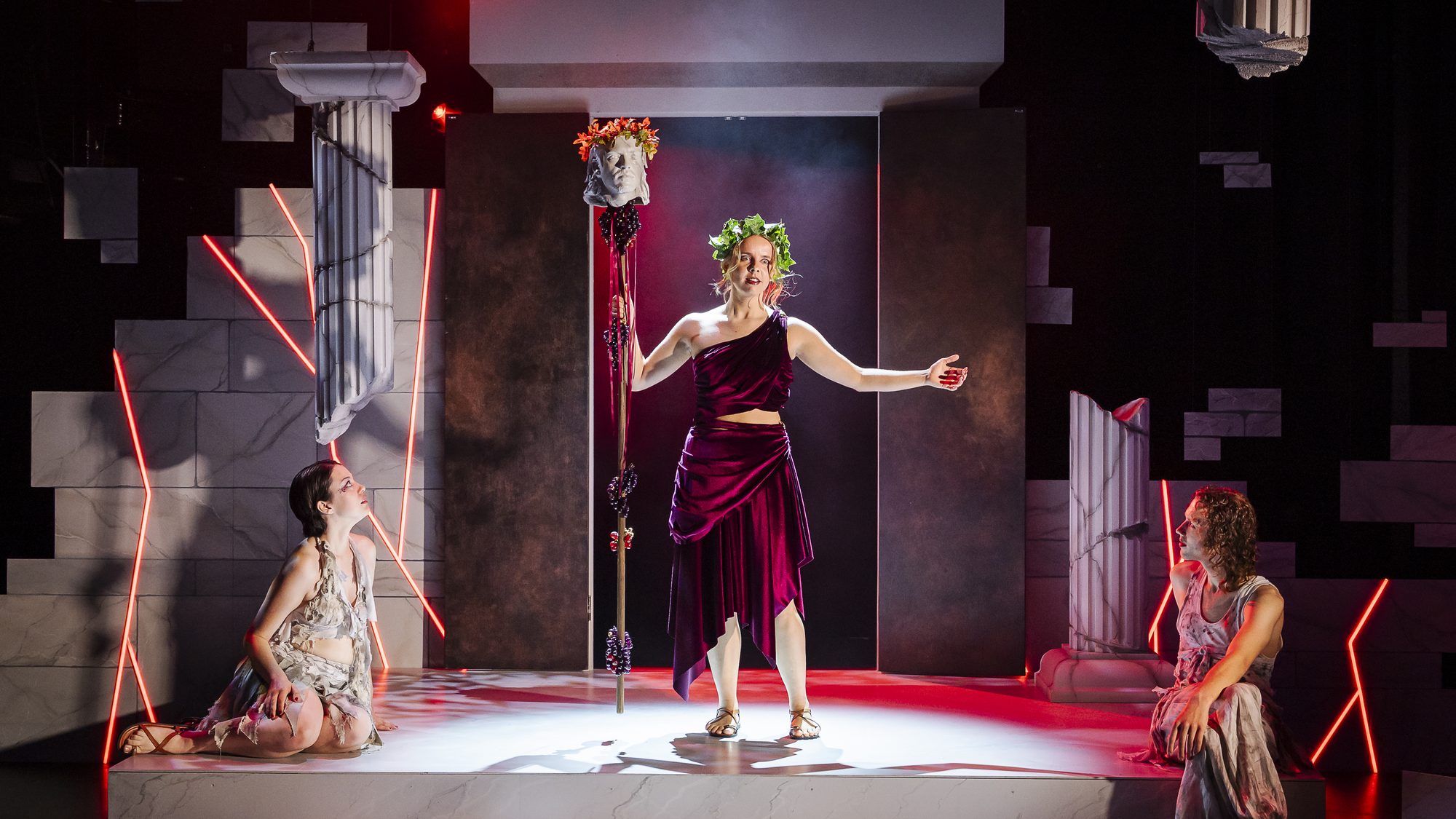
A performer in a magenta velvet dress and ivy crown stands in the palace doorway holding a staff topped with the statue's head, one arm held out, with two seated figures watching.
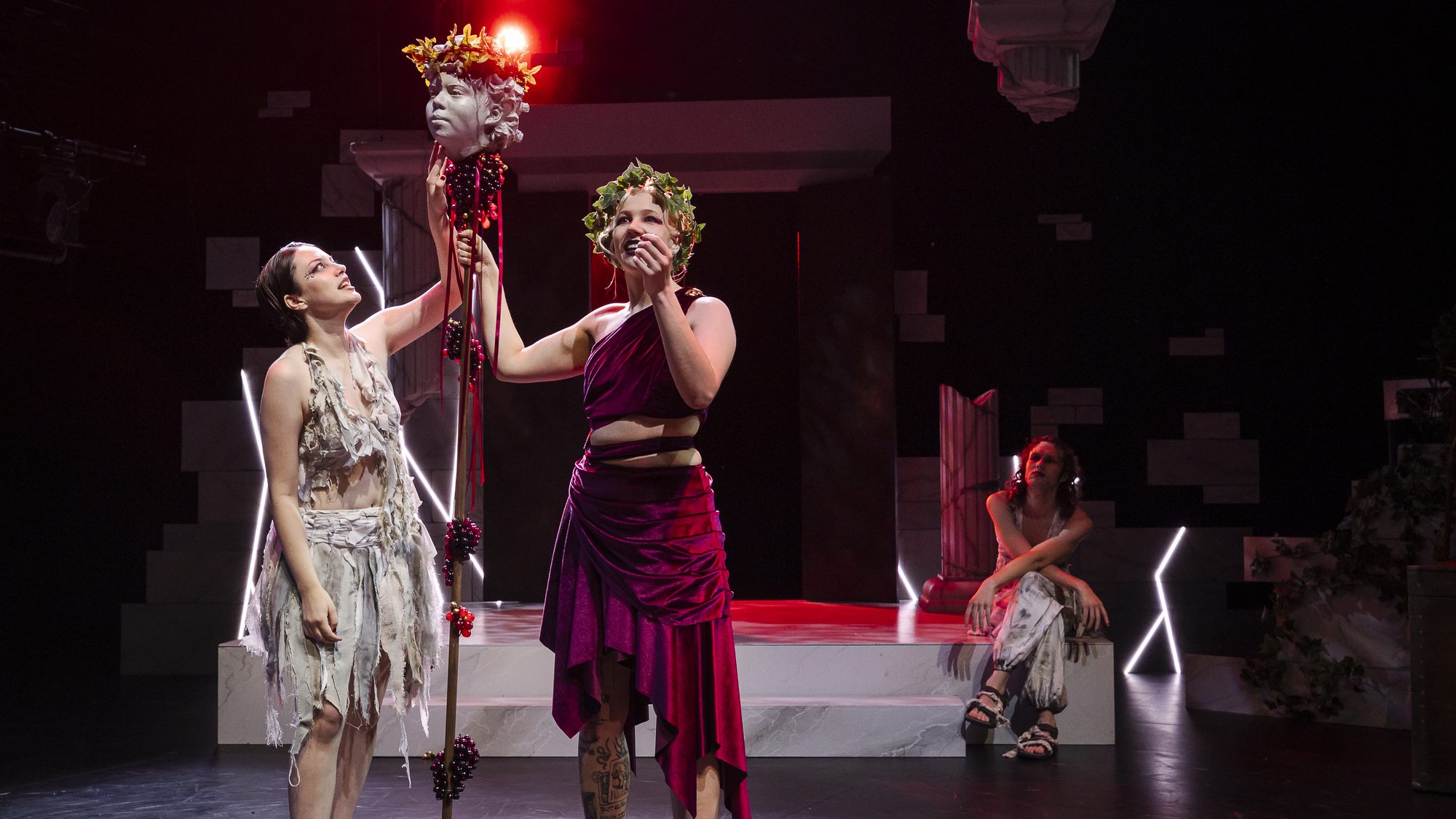
A performer in magenta velvet and an ivy crown lifts a staff topped with the statue's head while another in ragged grey reaches up to touch it.
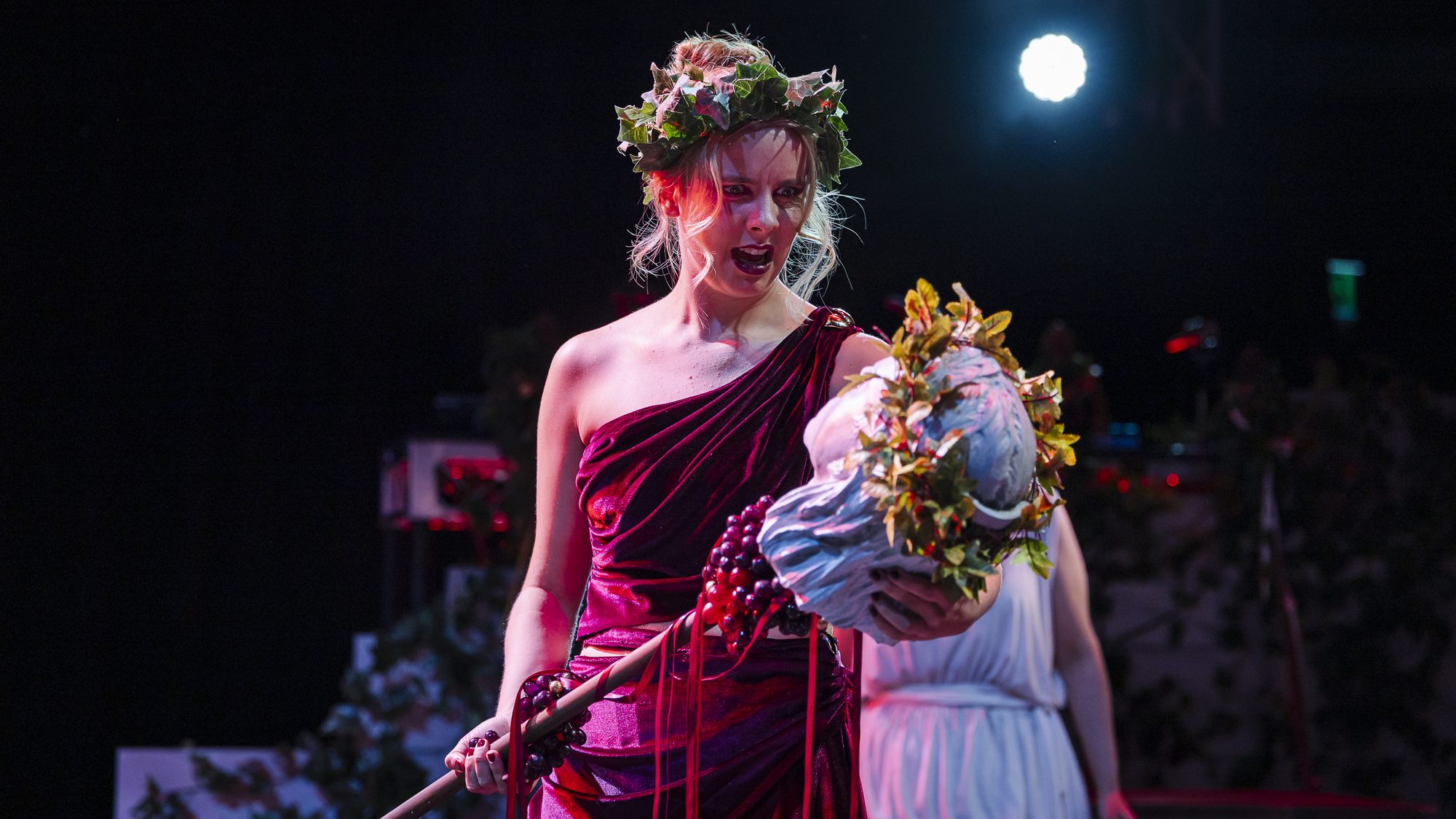
A performer in magenta velvet and an ivy crown looks down, open-mouthed, at the statue's head on her staff, wreathed in leaves and grapes.
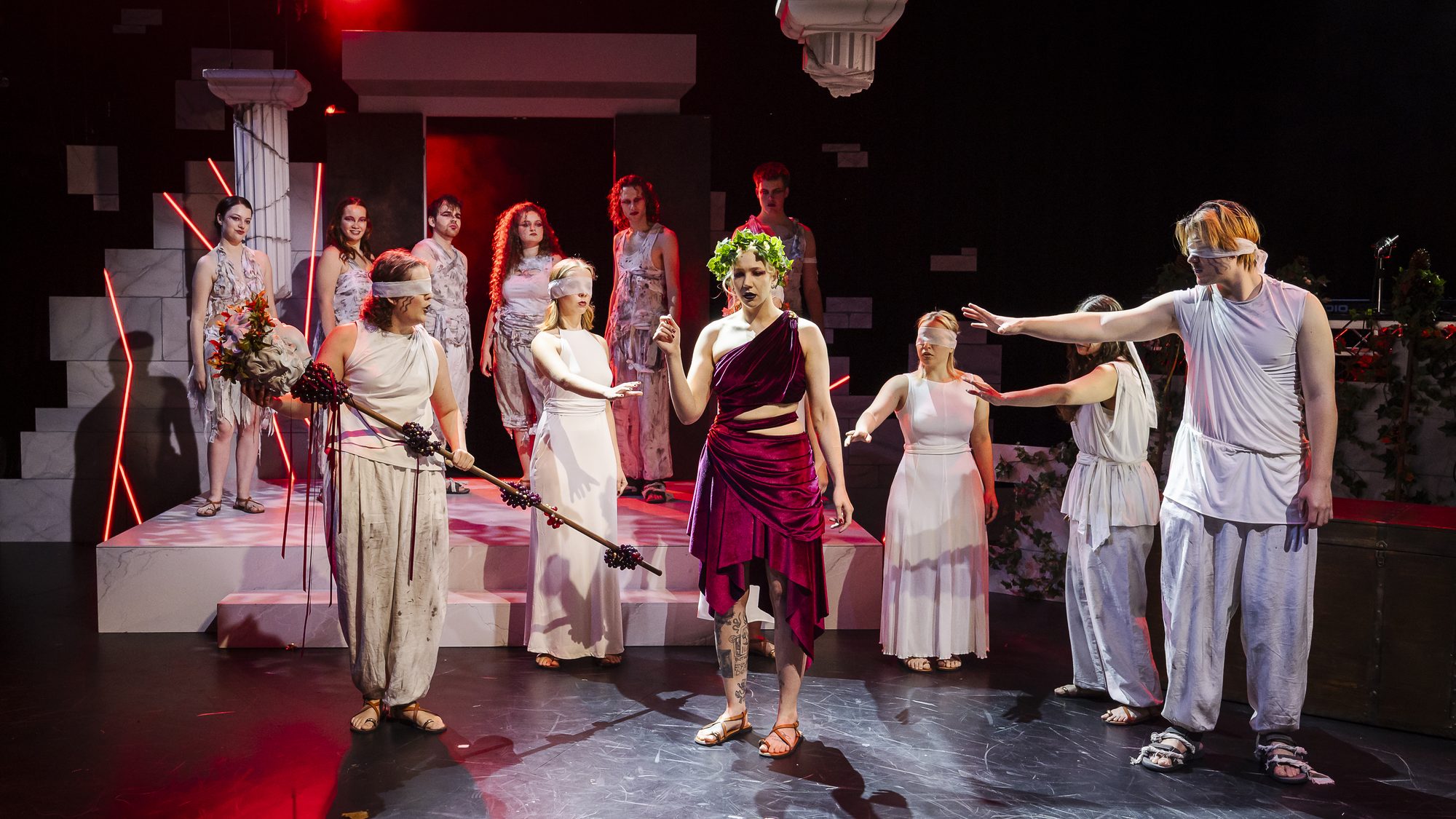
Blindfolded performers in white stand with arms extended, one cradling the statue's head on its staff, around a performer in magenta velvet.
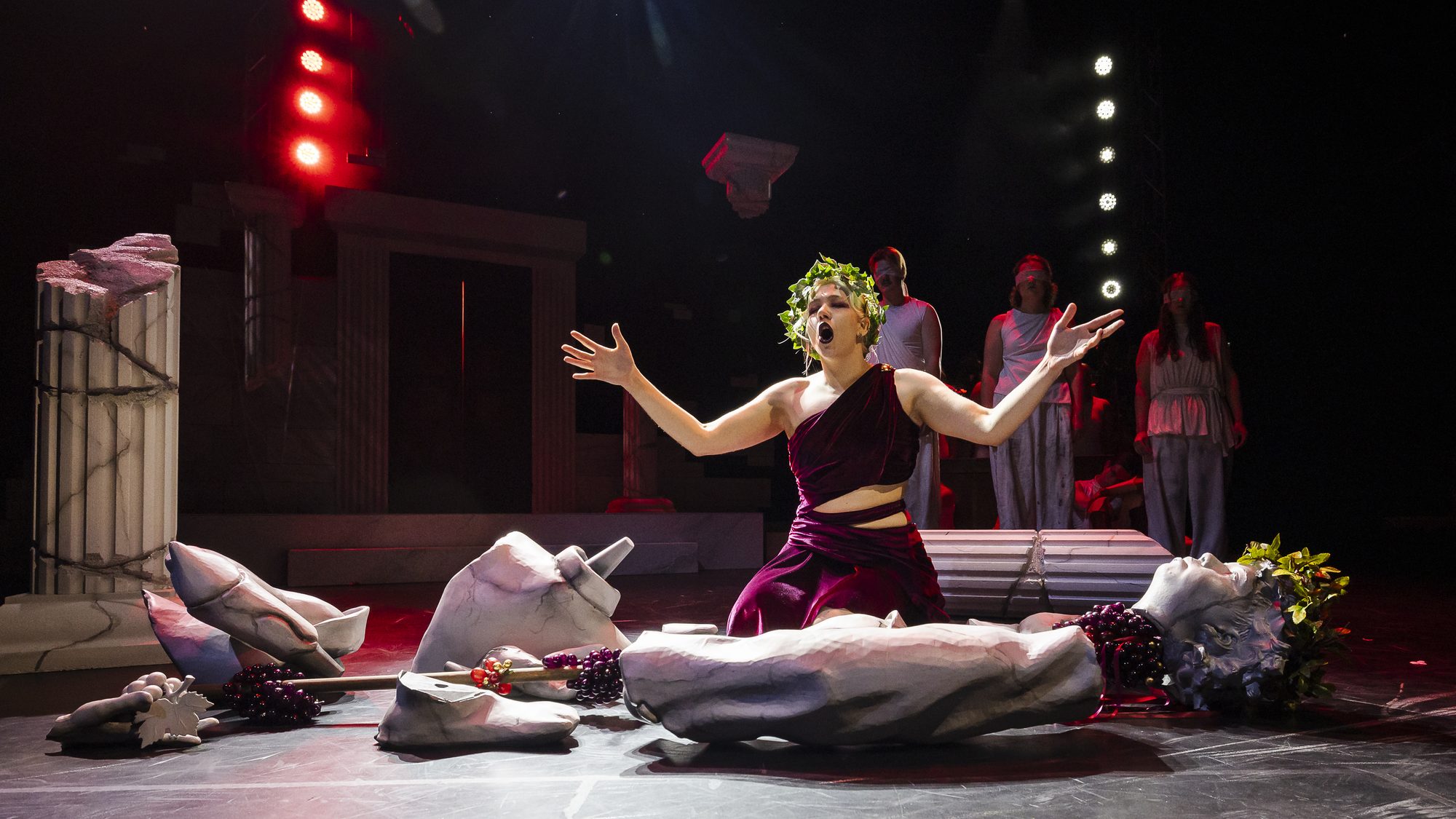
A performer in magenta velvet and an ivy crown kneels over the broken pieces of the statue with arms flung wide, crying out.
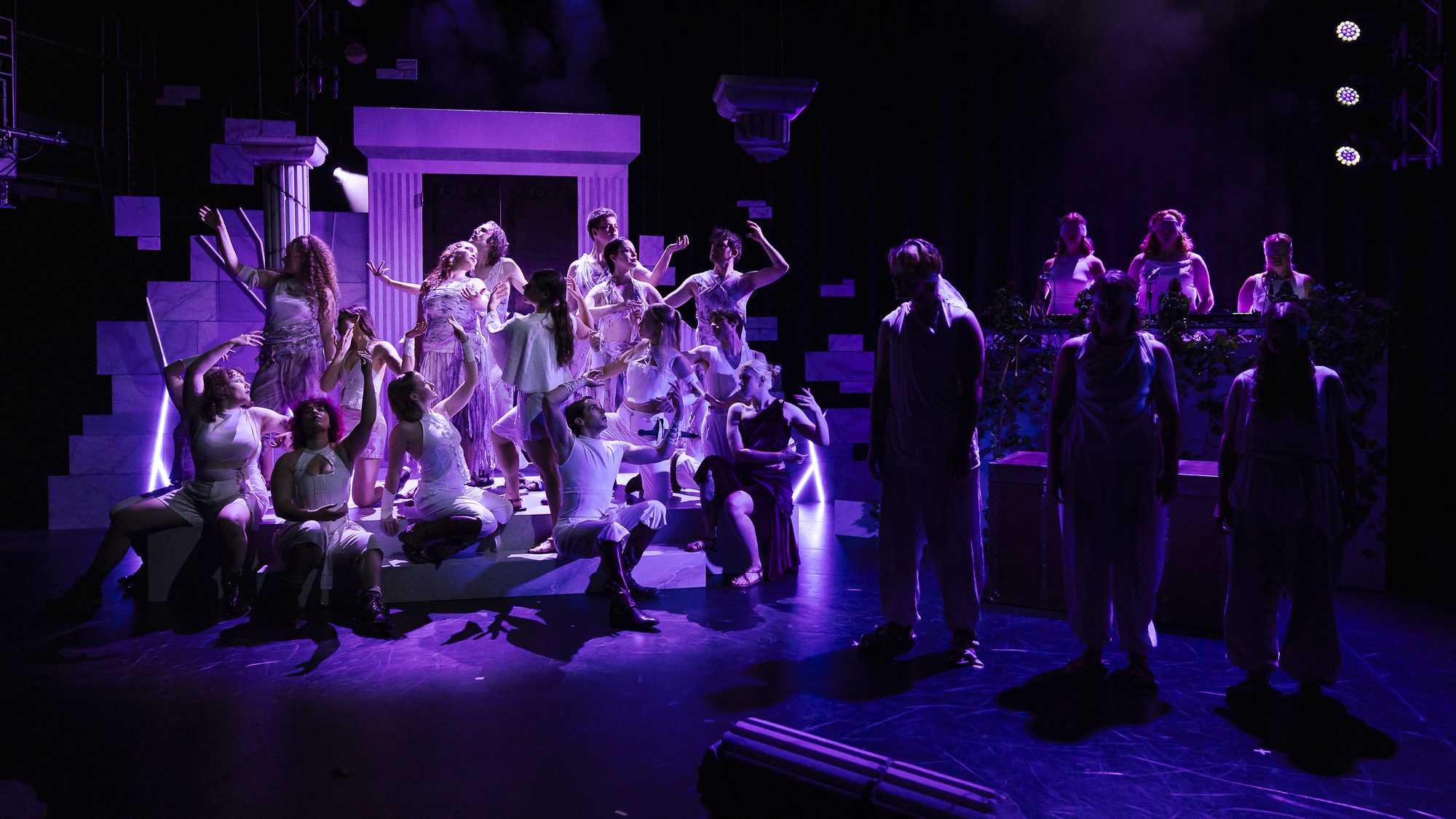
In violet light, the chorus masses on the palace steps with staffs raised while a line of figures stands in silhouette beside them.

1 of 26

Photos: Stephen Heath

About the BPA

The Bachelor of Performing Arts (Performance Making) is an incubator for future cultural leaders. Artists who are passionate about telling stories and driving change in the global performing arts landscape.

Our students have a diverse range of interests, from performing and directing, to writing plays, producing festivals, facilitating community-engaged arts projects, and collaboratively devising dynamic physical performance.

Their journey begins with the development of a strong skills base grounded in rigorous training in text-based acting, voice, movement, and theatre history. They then go on to deepen their practice by being introduced to devised, transcultural, and experimental approaches to making performance so that by the time they graduate, they have a full range of tools at their disposal to create new work that is distinctly their own.

The Performance Making program is centred around processes that are inclusive and reflexive, and our teaching is grounded in a work ethic designed to help you to become an independent and critically thinking artist.

Our graduates are well positioned to be the cultural leaders and innovators of tomorrow. They have the communication, collaboration, and project management skills to produce their own work as soon as they graduate and have a wide range of opportunities to build industry connections that help put them in the driving seat of their own careers.

Learn more about the Bachelor of Performing Arts (Performance Making) ↗