Access Guide
The BacchaeGenerator 2026
About this guide
This guide helps audiences prepare to attend The Bacchae. It includes information about the venue, a visual story, and content and sensory information in full. You can choose to read only the sections of this guide that will be of benefit to you.
The visual story goes through what happens throughout the show, including the ending, so it is behind a spoiler warning. It stays closed unless you open it.
- On the website, with a screen reader: the visual story is a collapsed button called ‘Spoiler warning: the visual story, scene by scene, including the ending’. Leave it closed and keep reading to skip it, or press it to open it. The next heading is Where to get support.
- In the Word version: the sections are numbered. The visual story starts with a line marked ‘Spoiler warning’, which tells you which section to skip to, and finishes with ‘End of spoilers’.
The guide is also a Word document: The Bacchae Access Guide (Word).
At a glance
- Saying it: Bacchae has two popular pronunciations, BACK-eye and back-EYE. We don’t mind which one you use.
- Where: Flex Theatre, WAAPA, The Minderoo Centre for Performance Excellence, ECU City
- When: 12 to 18 November 2026, starting at 7.30 pm
- Running time: 105 minutes
- Ages: recommended for ages 15 and over
- Audio description: Monday 16 and Wednesday 18 November, with a tactile tour at 6.30 pm
- Access: ramp access through the Roe Street entrance; the Companion Card is accepted
Booking and assistance
Wheelchair and mobility access
If you require wheelchair or mobility access to any of WAAPA’s venues, or need companion seating, please book your tickets by calling or visiting the WAAPA Box Office. There is ramp access to the Flex Theatre foyer through the Roe Street building entrance.
Companion Cards
For patrons who require the assistance of a companion or carer, a second ticket is issued at no cost to the Companion Card holder. To book, please call or visit the Box Office.
For schools
If a student in your group needs audio description, a tactile tour, a quiet space, or anything else, tell the box office when you book, or email the WAAPA Box Office.
WAAPA Box Office
- Telephone: (61 8) 6304 6895
- Days: Monday to Friday
- Times: 10.00 am to 12.00 pm, and 12.30 pm to 3.00 pm
- Email: waapaboxoffice@ecu.edu.au
- Book online: WAAPA Box Office
Audio description
The following performances of The Bacchae will be audio described:
- Monday 16 November, 7.30 pm
- Wednesday 18 November, 7.30 pm
Audio description is a live spoken commentary. A describer tells you what is happening on stage in the gaps between the words of the show.
You listen through a receiver and headphones, which we lend you for the night. Jessica Thomas and the audio description team will meet you at the Box Office, give you a receiver, and help you get it working. Hand it back at the end of the night. This is a free service.
To find out how the receiver works, and what we can’t do yet, see Audio description at WAAPA.
Tactile tours
There will be a tactile tour before each audio described performance, an hour before the show starts:
- Monday 16 November, 6.30 pm
- Wednesday 18 November, 6.30 pm
Please arrive 15 minutes before the tactile tour. This gives you time to check in at the box office and make your way into the foyer before the tour begins.
How to let us know you are coming
If you are coming to one of these performances and would like to join the tactile tour and use the audio description, email the WAAPA Box Office at waapaboxoffice@ecu.edu.au at least 24 hours before the performance you are coming to.
On the night, Jessica Thomas, Associate Producer (Access and Inclusion), will meet you at the Box Office. You can ask the Box Office for her by name, and she will help you get to the tactile tour.
Getting here
The Bacchae will be performed in the Flex Theatre at WAAPA, The Minderoo Centre for Performance Excellence, at the ECU City campus.
The venue is at ECU City, 500 Wellington Street, Perth WA 6000, and you enter through the Roe Street building entrance.
Coming in
- The Roe Street entrance is a revolving door. If you would rather use the automatic swinging door, press the assistance call button to the left of the revolving door, and security will open it for you.
- Security in the lobby will ask to see your ticket. If you would rather have your ticket checked in person, ask security to walk you to the Box Office, and the Box Office will check it there.
ECU City is well connected by public transport:
- Train: Transperth trains stop at nearby Perth Station, a short 2-minute walk to campus.
- Bus: The campus is directly integrated with the Perth Busport. Multiple bus routes stop right under the campus, providing convenient access from various parts of the city and beyond.
Paid parking is available nearby on Roe and Wellington Streets through the City of Perth. You can search for more parking locations.
About The Bacchae
The Bacchae is a play from Ancient Greece. It was written by Euripides almost 2500 years ago, and it is a tragedy: a story where people make choices that lead to terrible harm, and understand what they have done too late.
Our production is adapted and directed by Kyle Morrison. It changes some of the language, and it adds sonnets by William Shakespeare.
The room: the Flex Theatre
WAAPA’s Flex Theatre is an intimate, contemporary theatre space designed to adapt to many staging formats. It can be transformed to suit any theatre production.
For The Bacchae, the Flex Theatre seating is set up in a thrust or U-shaped style. There is seating facing the stage, as well as to the left and right of the stage.
The set
All set pieces are described from the point of view of the audience sitting facing the stage.
In the centre of the stage, there is a tall statue of the character Pentheus raised on four hexagonal stone slabs. There is a collection of pillars across the stage; they appear to be a white stone. There is a short pillar in front of the statue to the left; it is broken off at the top. In the back left of the space, there is an elevated platform with a step; at the back of the platform, there is a large brown double door held in a white stone arch. On either side of the door, there are stone bricks creating walls; to the left of the door, the stones reach almost to the top of the door; on the right, they reach a quarter of the way up. On each side, there are some stone bricks hanging above, disconnected from the wall’s structure. There are strip lights positioned like a lightning strike along the brick walls. The walls appear to be falling apart, with the bricks appearing in a cascading style. Next to the door, to the right, there is a large pillar; it is whole. To each side of the platform, there are pillars hanging from the ceiling with their bottoms appearing broken off. In the back right of the stage, there is another elevated platform. There is a large desk with DJ equipment, with a black drape covering the front of the table; there are three microphones equally spaced coming out of the desk. In front of the DJ desk, on the stage floor, there is a large rectangular brown chest.
There are black curtains behind the set and along the venue walls. There are two large lighting structures rigged from the ceiling in each corner of the stage.
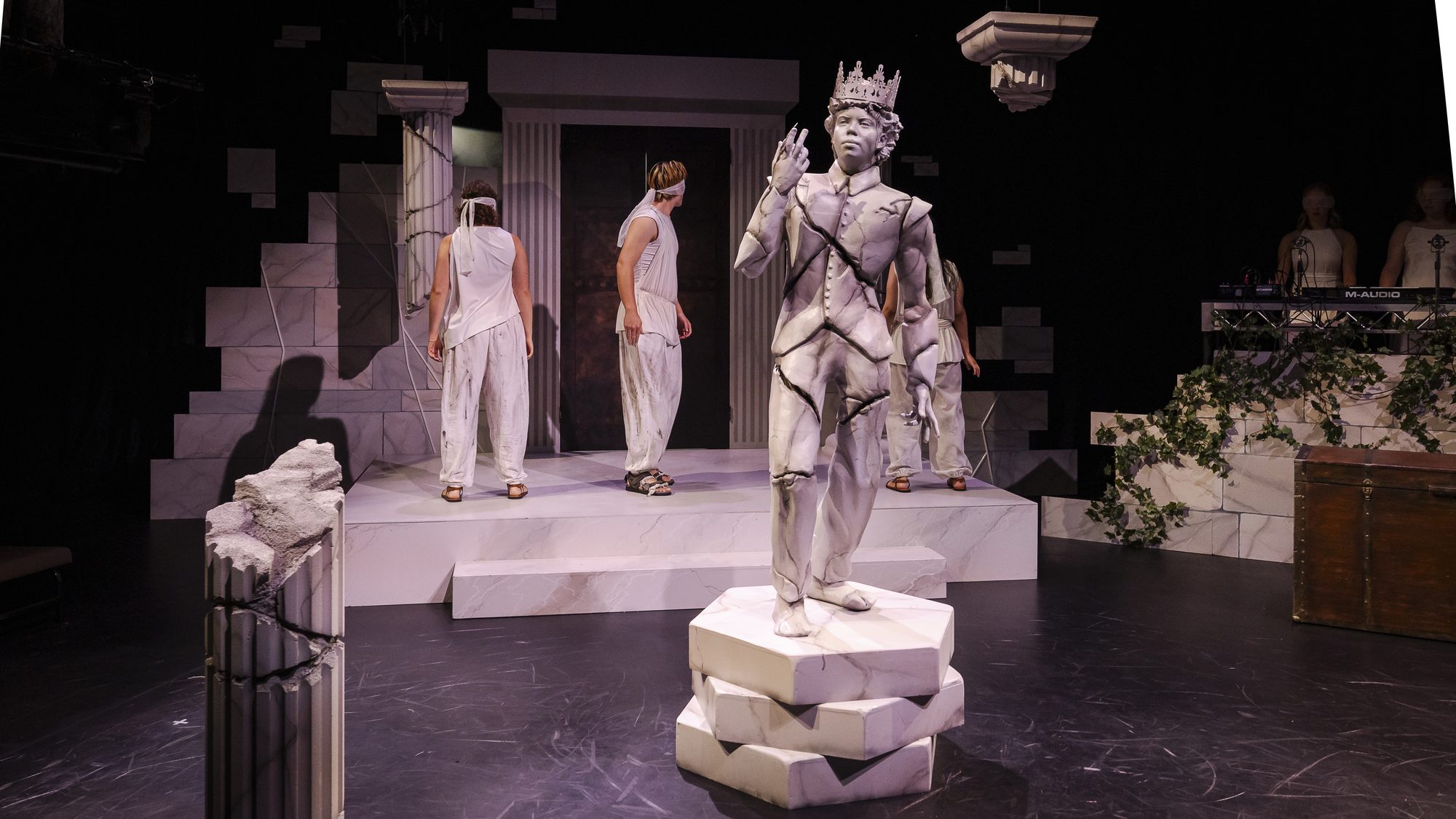
Photograph: Stephen Heath
Performance conventions
In this production of The Bacchae, there are multiple performers playing the same role on stage at the same time. Dionysus is played by six performers, and Tiresias by three. There are moments when all performers speak in unison; however, they mostly speak individually.
The Bacchae has gender-neutral casting. Some male roles, such as Dionysus, Cadmus, and Tiresias, are played by performers with feminine voices, and some of the maenad chorus have masculine voices. Characters keep the pronouns of the play.
The character Tiresias is blind; he wears a blindfold over his eyes throughout the performance. He is also a seer and a prophet, so the text refers to things he ‘saw’ or ‘sees’.
Content and sensory information
The Bacchae is recommended for ages 15 and over.
The Bacchae includes content that could be distressing or triggering for some audience members. The production includes references to and depictions of:
- substance abuse (mostly alcohol)
- sexual references
- horror themes
- violence
- dismemberment
- a character’s psychosis
- references to the killing of animals
- references to the killing of children
- strobe lighting
- theatrical haze
- loud electronic music with heavy bass
- thunder sounds
There are a few brief moments when Dionysus addresses the audience indirectly, through physicality and eye contact, while the dialogue stays addressed to other characters. There are also moments when Dionysus addresses the audience directly through dialogue.
Themes
Kyle Morrison’s adaptation of The Bacchae explores rave and party culture, the idea of time-transcending third spaces, substance use, and the repercussions of these activities on family, responsibility, and community. A central dramaturgical question of this production is: what happens to the children and community when the parents are taken away? And more so, what shifts when they are away under the influence? Kyle delves into the idea of Dionysus’ ‘spell’ being made real through party and rave culture, parasitically infecting the parents and older people of Thebes, the Maenads. This is shown in Scene Four, where the messengers relay what they saw at Mount Cithaeron, which parallels directly the image of a bush doof and hallucinogenic illusion.
Kyle’s retelling of The Bacchae strays from the original tale with the addition of new characters called The Fates: three spirits connected to Mother Boodja and the history of the land. They are three interweaving godlike souls that control what happens on stage, especially sound and sometimes the movement of characters. Throughout the play, the Fates speak sonnets by William Shakespeare, bringing another form of classic text into the mix. They are connected to the traditional wise seer in the play, Tiresias, but are not mortal. Kyle uses the Fates to represent Country, and their manipulation of sound and movement from a sound desk is a symbol of their inherent care and control of the land and its people. Essentially, they sit above the Greek gods and are all-seeing, all-knowing.
Kyle Morrison establishes a certain status for each character, then lets the audience watch each position crumble as the society does around them. As characters fall, their physicality on stage shifts, and pieces of the set become scattered ruins, much like the many civilisations that have come before us. Morrison uses the motif of collective movement to represent these different structures and their disintegration. For example, the soldiers are a group that controls and protects, so they move with stiff and powerful physicality, whereas the Maenads (the chorus of worshippers) are a flowing, rough ensemble driven by impulse and pleasure, finding indirect softness and often erratic movement. Movement is a tool for symbol and motif.
Visual story
This part of the guide goes into detail about the sights, sounds, and story of The Bacchae, scene by scene. It contains spoilers.
Spoiler warning The visual story, scene by scene, including the ending Closed, so you can skip it. Open it to read.
Pre-show
A pre-recorded Acknowledgement of Country plays. It includes the voices of Jayda Corunna, Tiahni, the cast member playing Pentheus (Gus Patterson or Prince Attwood), and director Kyle Morrison.
Opening moments
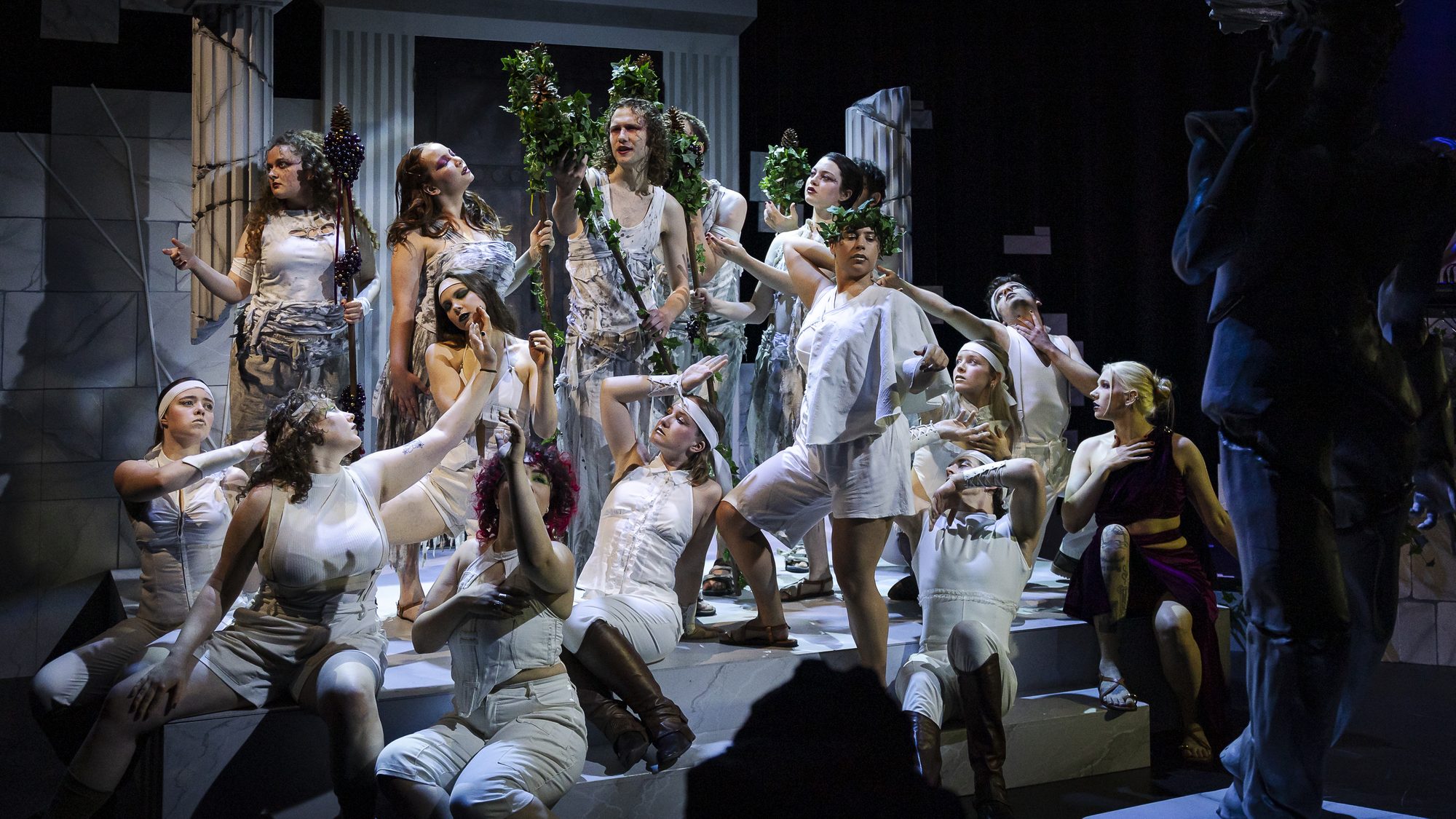
Photograph: Stephen Heath
A group of figures enter from different points in the space. Six figures hold a thyrsus and stand tall on the platform as the rest of the ensemble crowd the space in front on the steps, forming a chorus shape. The Fates sit on the DJ platform and speak in Shakespearean sonnets. Addressing the space, Dionysus announces himself as a god, son of Zeus and Semele (he is played by six performers), as the chorus makes statue-like shapes framing the god. Dionysus announces he is coming to his mother’s city of Thebes in the form of a mortal man, the stranger, to answer claims that he is not a god. Dionysus explains that his mother’s sisters, Agave, Ino, and Autonoe, claim that Semele had taken a mortal lover and blamed Zeus, and that Zeus struck her dead for lying.
He explains that he has driven the women from their homes in Thebes to the clefts of Mount Cithaeron, where they have been made to wear costumes and dance in Bacchic celebration. The mothers have been driven in a crazed fit onto the mountain alongside Cadmus’s daughters, including Agave, mother of Pentheus.
The maenads enter; Dionysus watches, chanting as they dance in Bacchic rituals. They move in circular patterns around the statue of Pentheus. They dance as they shout in praise of Dionysus (Bacchus).
This scene involves a thunder sound and strobe lighting as Dionysus speaks. There are also coloured flashing lights and loud electronic music with heavy bass.
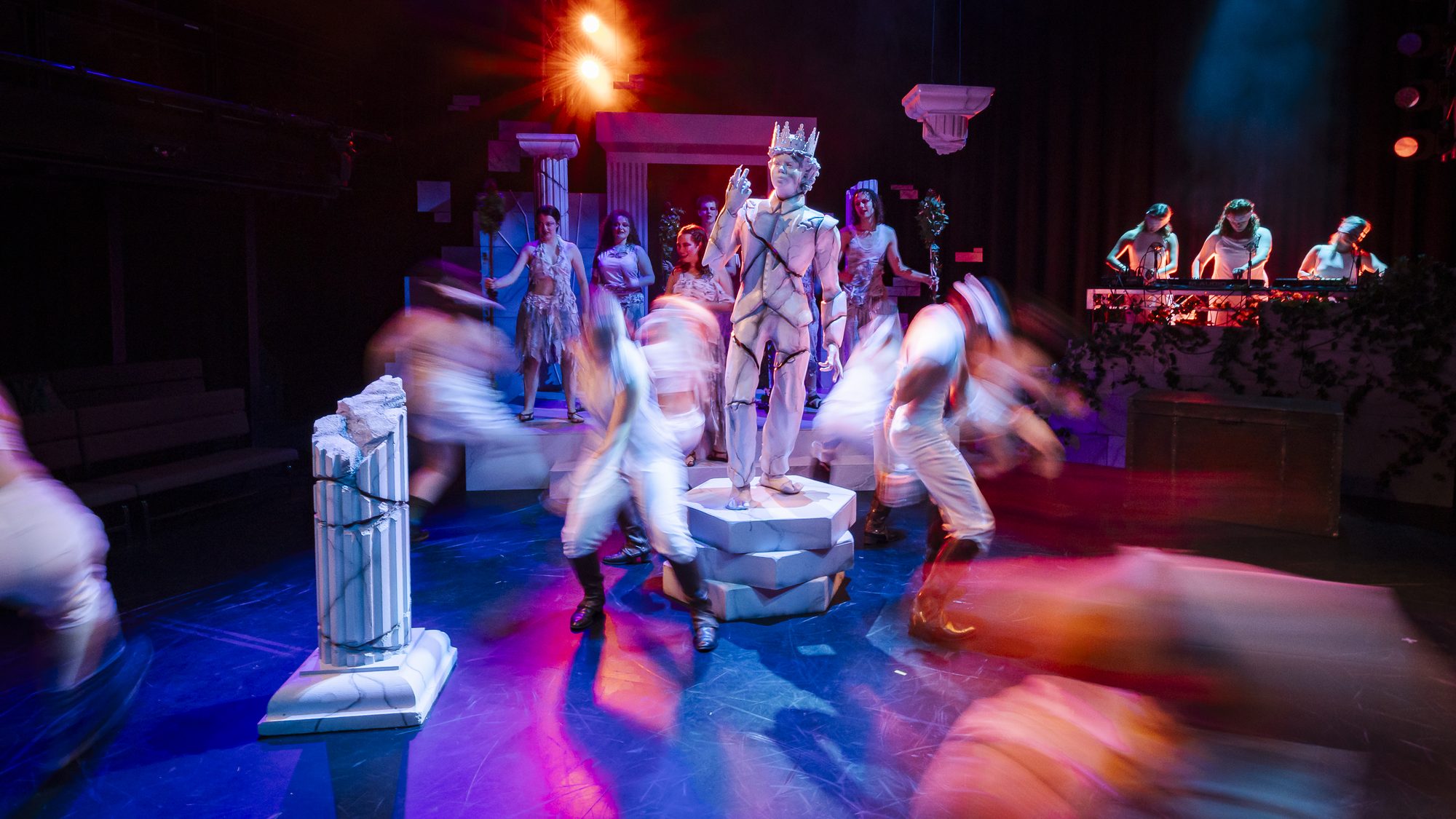
Photograph: Stephen Heath
Tiresias goes to the house of Cadmus
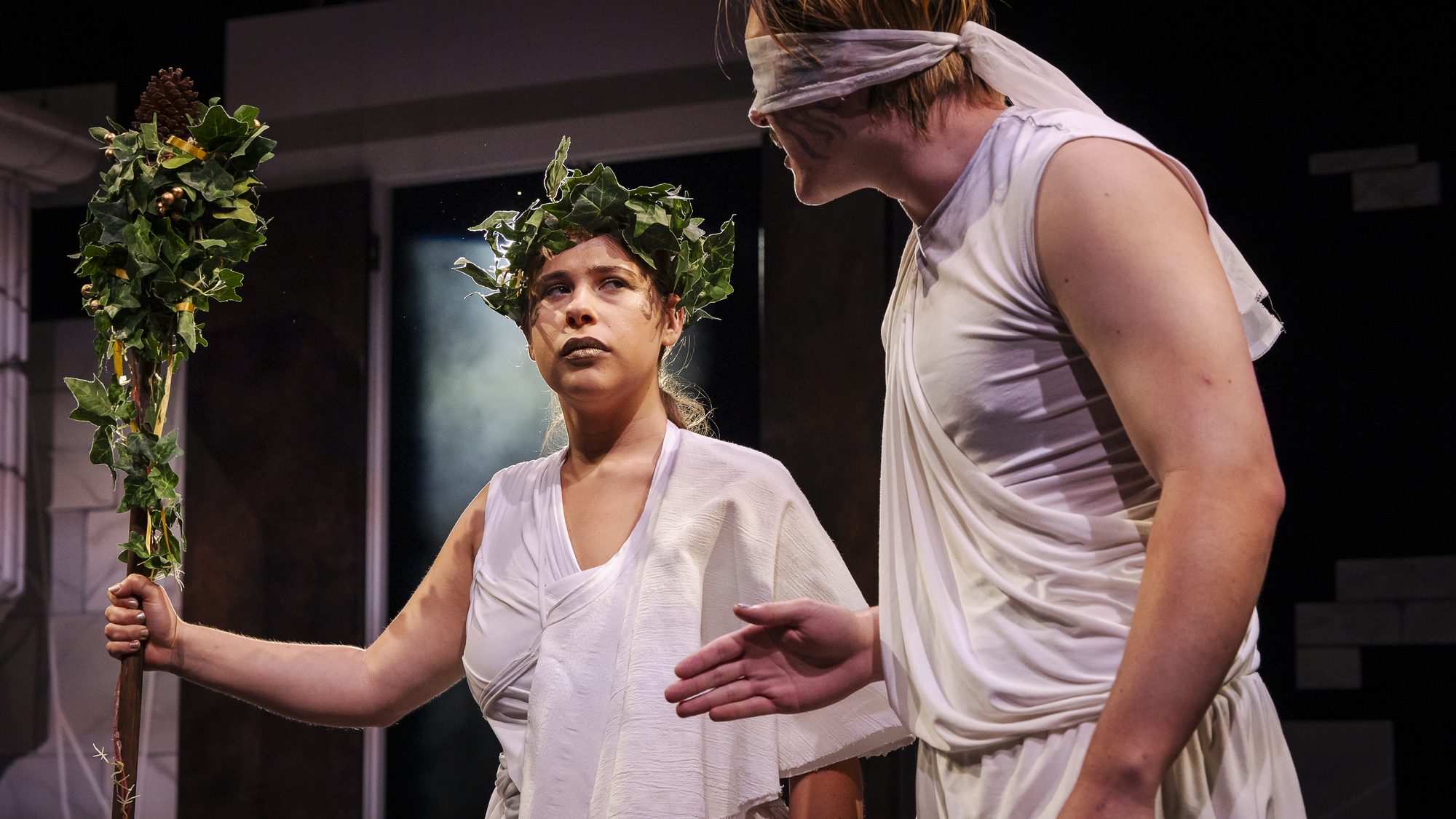
Photograph: Stephen Heath
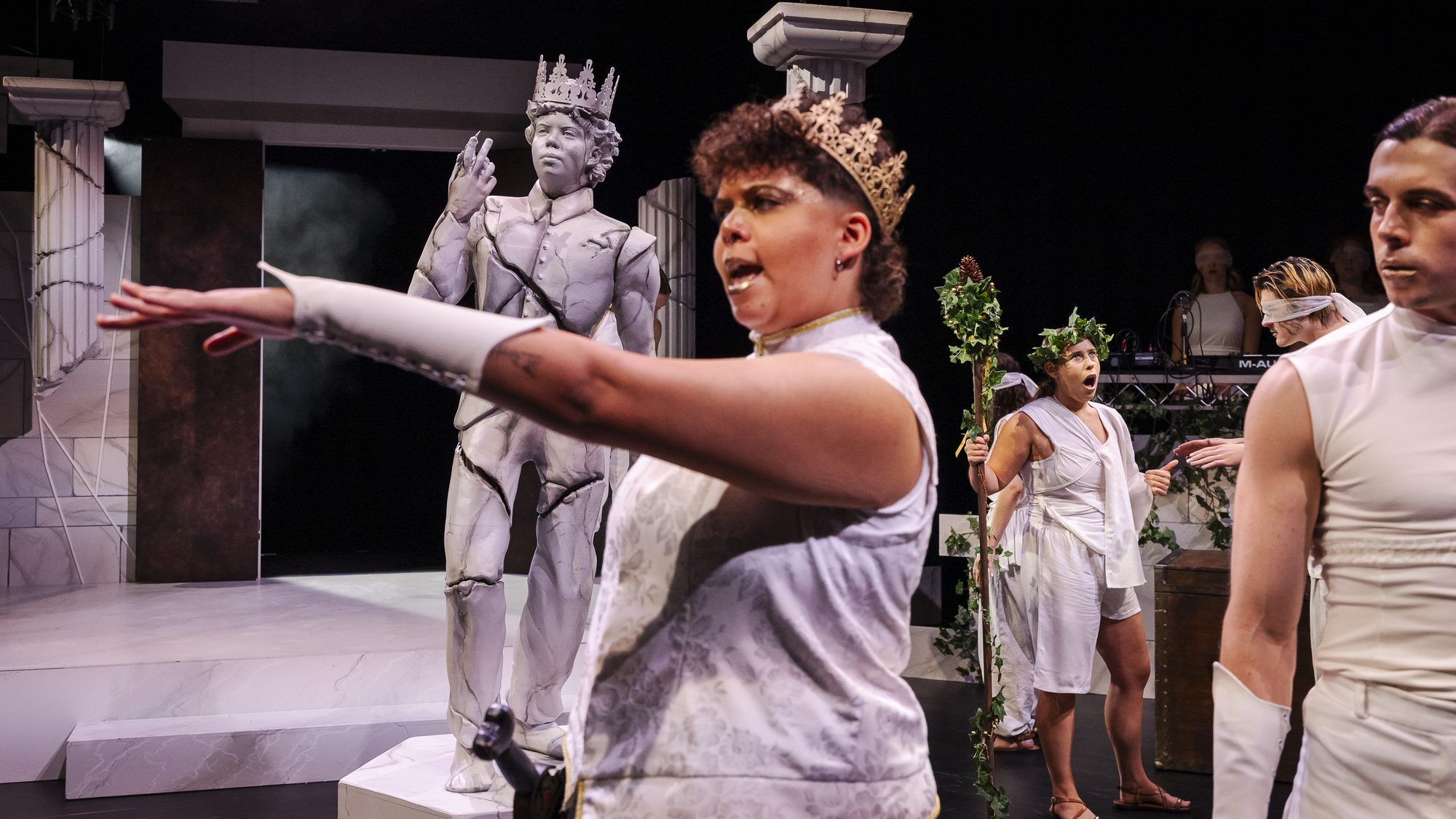
Tiresias, a blind prophet and seer, enters and knocks on Cadmus’s door. Cadmus enters through the door, dressed in clothes for the Dionysian ritual, with a thyrsus and an ivy crown. Cadmus announces the entrance of Pentheus to the blind Tiresias. Pentheus enters with four armed soldiers, angry at the state Thebes has fallen into while he has been away, and angry that the Thebans are leaving home to go to Bacchic rituals. When he notices Cadmus and Tiresias, Pentheus expresses his disgust at Cadmus’s outfit. Cadmus and Tiresias prepare to join the rituals, and Pentheus blames the stranger for leading the Thebans away. He orders his soldiers to hunt down the stranger and the followers of Dionysus.
There are moments of loud sound in this scene when Cadmus bangs his thyrsus on the ground.
Photograph: Stephen Heath
Dionysus is captured
Photograph: Stephen Heath
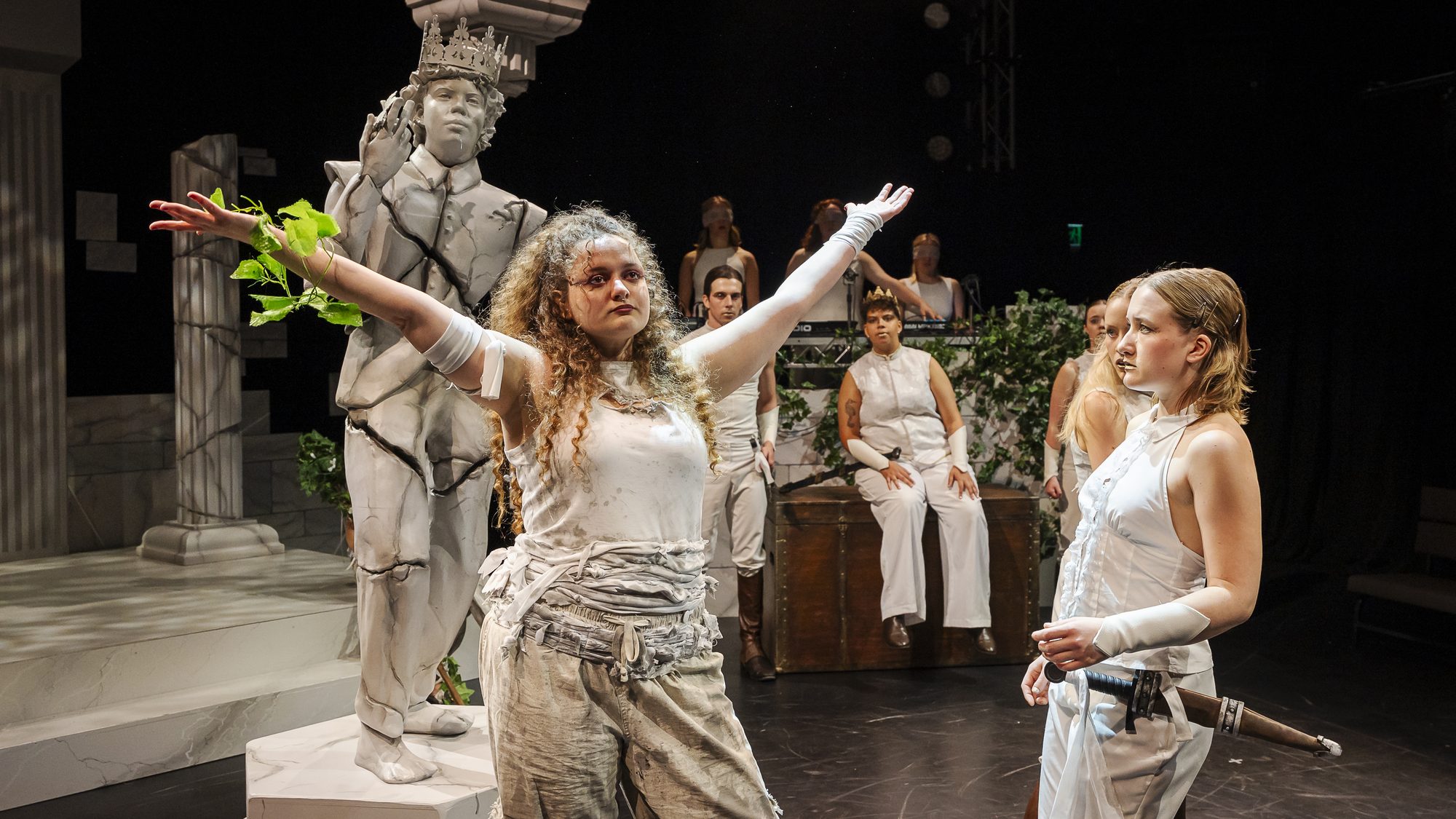
The god Dionysus, in mortal form and disguised as the stranger, is arrested and handcuffed by the soldiers. Pentheus orders the soldiers to uncuff the stranger, but he can uncuff himself. Pentheus discusses the Bacchic celebrations and presses the stranger with questions. Pentheus orders the soldiers to take the stranger to the stables, and leaves with the soldiers.
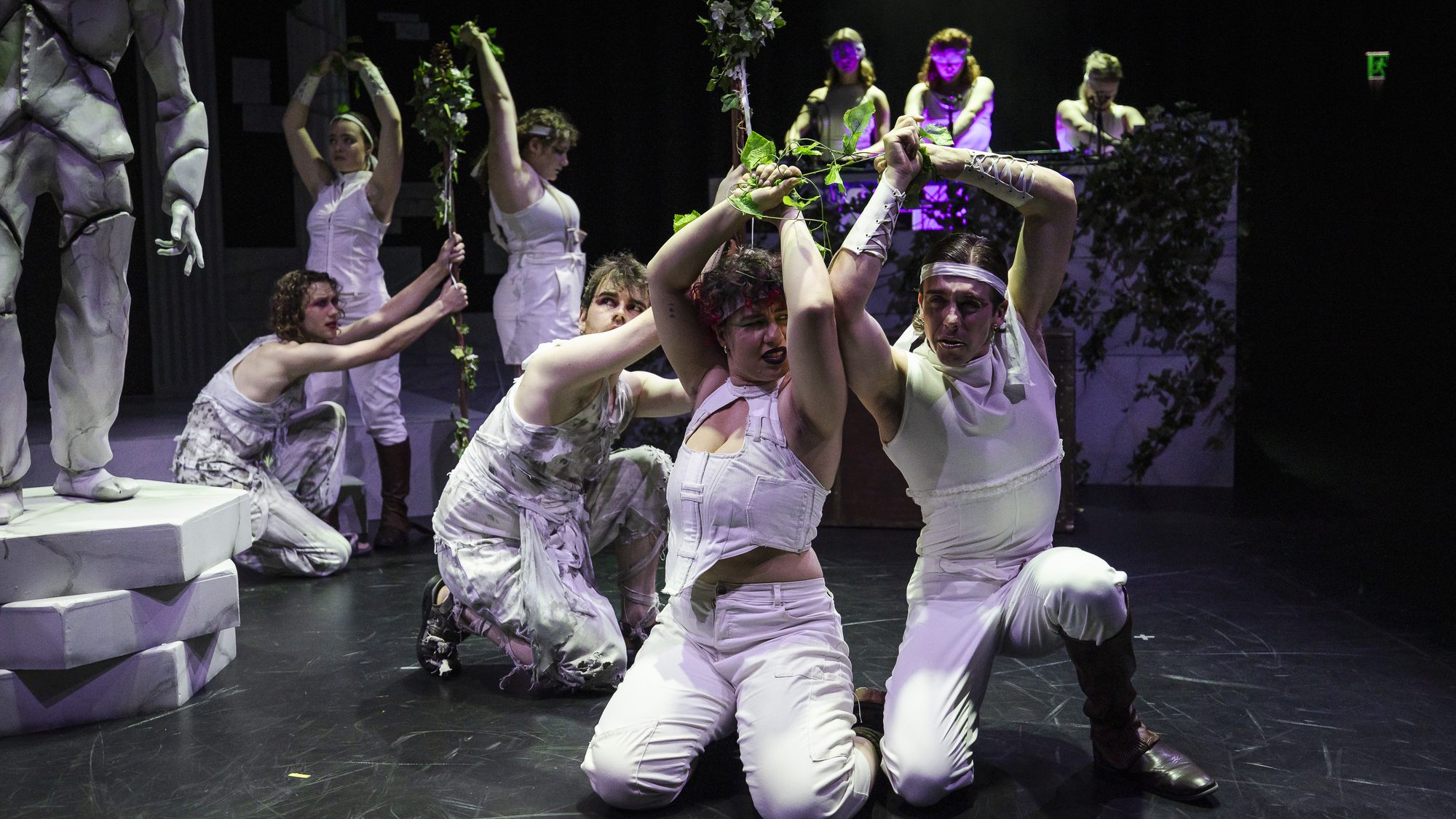
Dionysus’s followers enter, stomping; they are tied up with vines and cuffed. They fall to the floor in the centre of the stage and call out for their god Dionysus.
There are moments of loud sound, including sound effects when Dionysus releases himself from the cuffs. As Dionysus’s followers enter, there are loud stomping sounds.
Photograph: Stephen Heath
The escape
Photograph: Stephen Heath
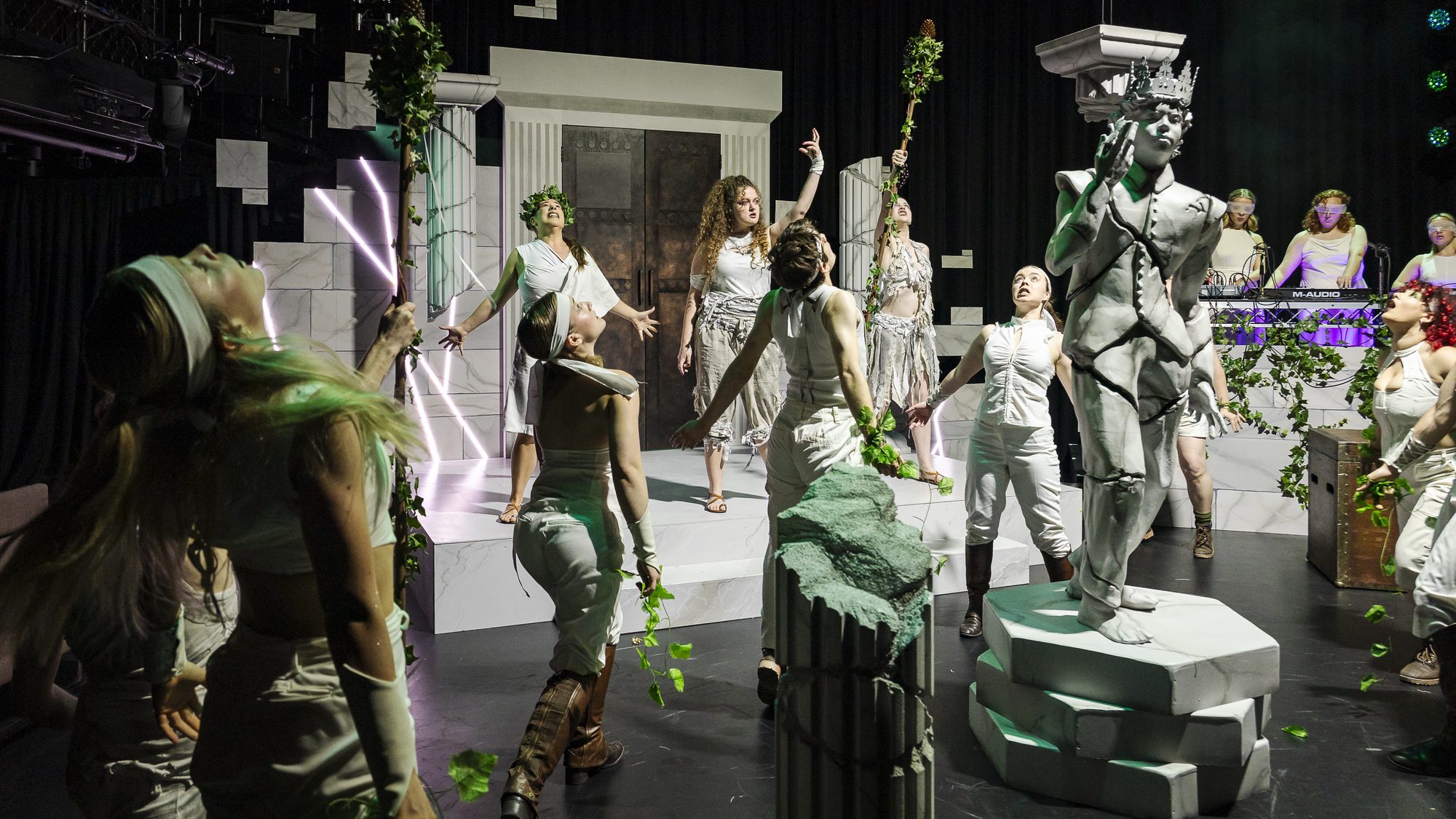
Dionysus calls out to his followers; he causes an electric strike and an earthquake and frees himself and his followers with ease. They pray to Dionysus. The Maenads begin to destroy Pentheus’s palace on the orders of Dionysus. They pull the statue of Pentheus to the floor and rip it limb from limb, struggling with the weight. They rip apart the slabs holding the statue up and rip off the door, laying it on the platform steps. Cadmus joins in, breaking a pillar from the platform in half and walking it to the stage floor. Pentheus arrives with his soldiers; he sees that the stranger has escaped, still unaware it is Dionysus in disguise. They discuss the destruction as four messengers run into the torn-apart city; Dionysus prompts Pentheus to listen to what the messengers have to say. They have just come from the mountains, and they have seen the Bacchic rituals.
There are moments of loud sound and flashing lights in this scene. There are loud rumbling sound effects during the earthquake, and a bang as each Dionysus brings their thyrsus to the ground; there are also flashing lights.
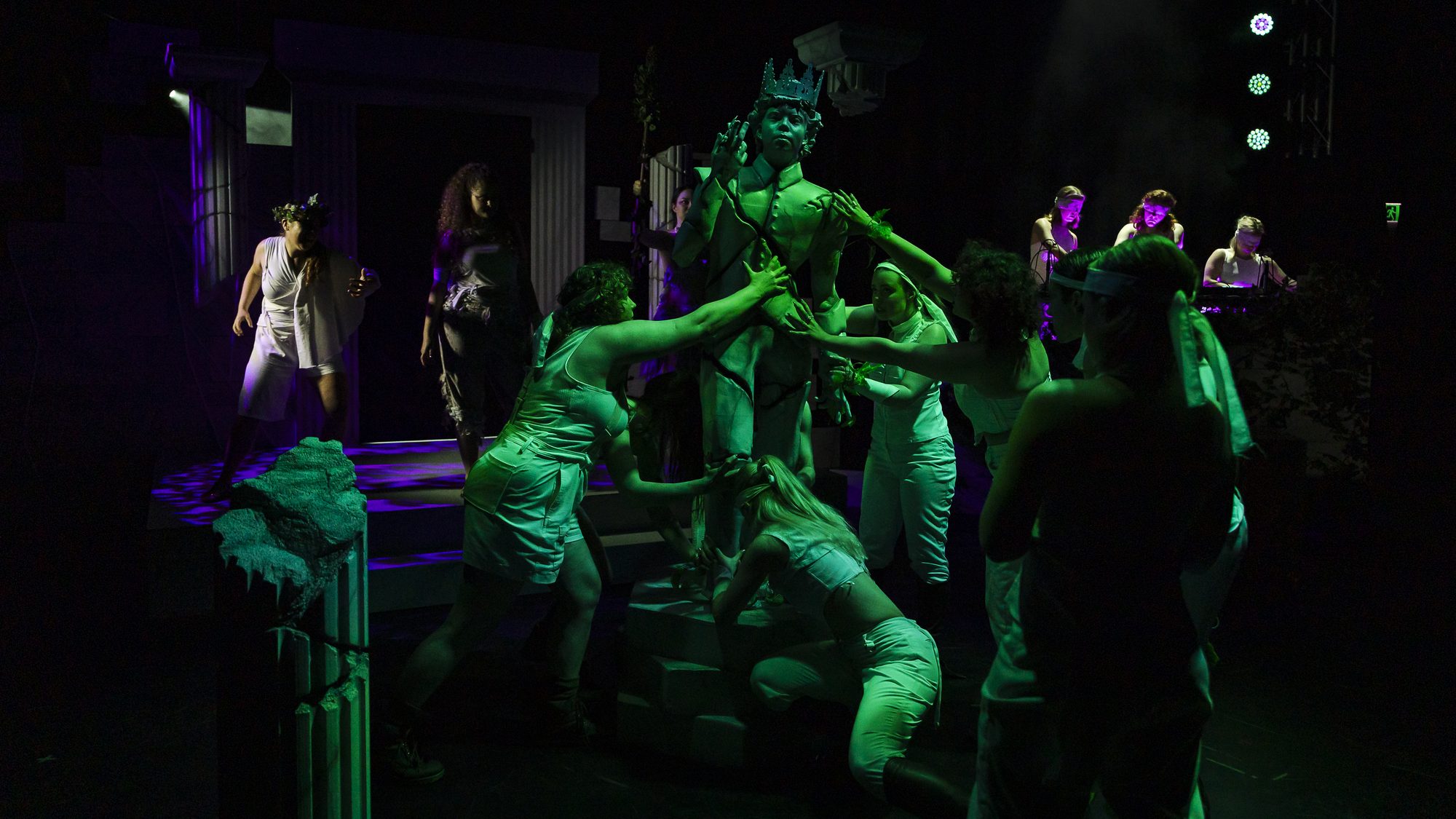
Photograph: Stephen Heath
The messengers
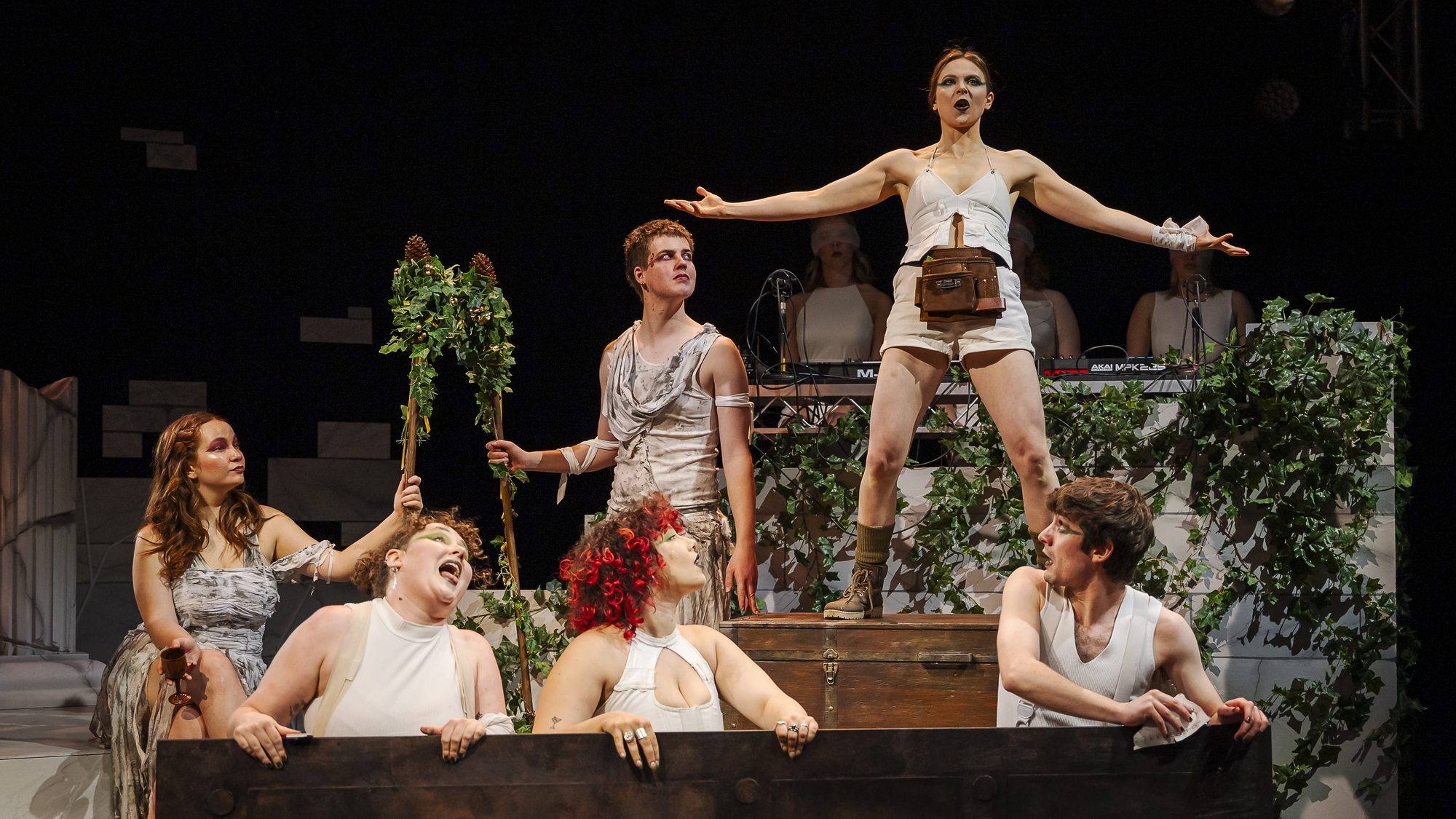
Photograph: Stephen Heath
The messengers recount what they have seen on the mountain: the maenads working miracles and dancing in a frenzy. Agave called out to attack the messengers, but they ran off and escaped being torn apart. As they recount the events, they try to put the city back together, picking up the door; they get distracted while talking, leaving the weight of objects to the other messengers. They recount that they saw the women tearing cattle apart with their bare hands, with blood covering their hands. They talk about children being destroyed in the maenads’ path. Pentheus sends for troops to march against the Bacchae; the soldiers leave.
Dionysus, as the stranger, convinces Pentheus that he must look the part to go into the mountains and see the maenads. Pentheus goes into the house, convinced and slightly dazed by the words of the god. Dionysus addresses the chorus, saying that when Pentheus goes to the Bacchae, he will die, butchered by his mother’s hands.
This scene involves graphic descriptions of violence.
Pentheus goes to the Bacchae
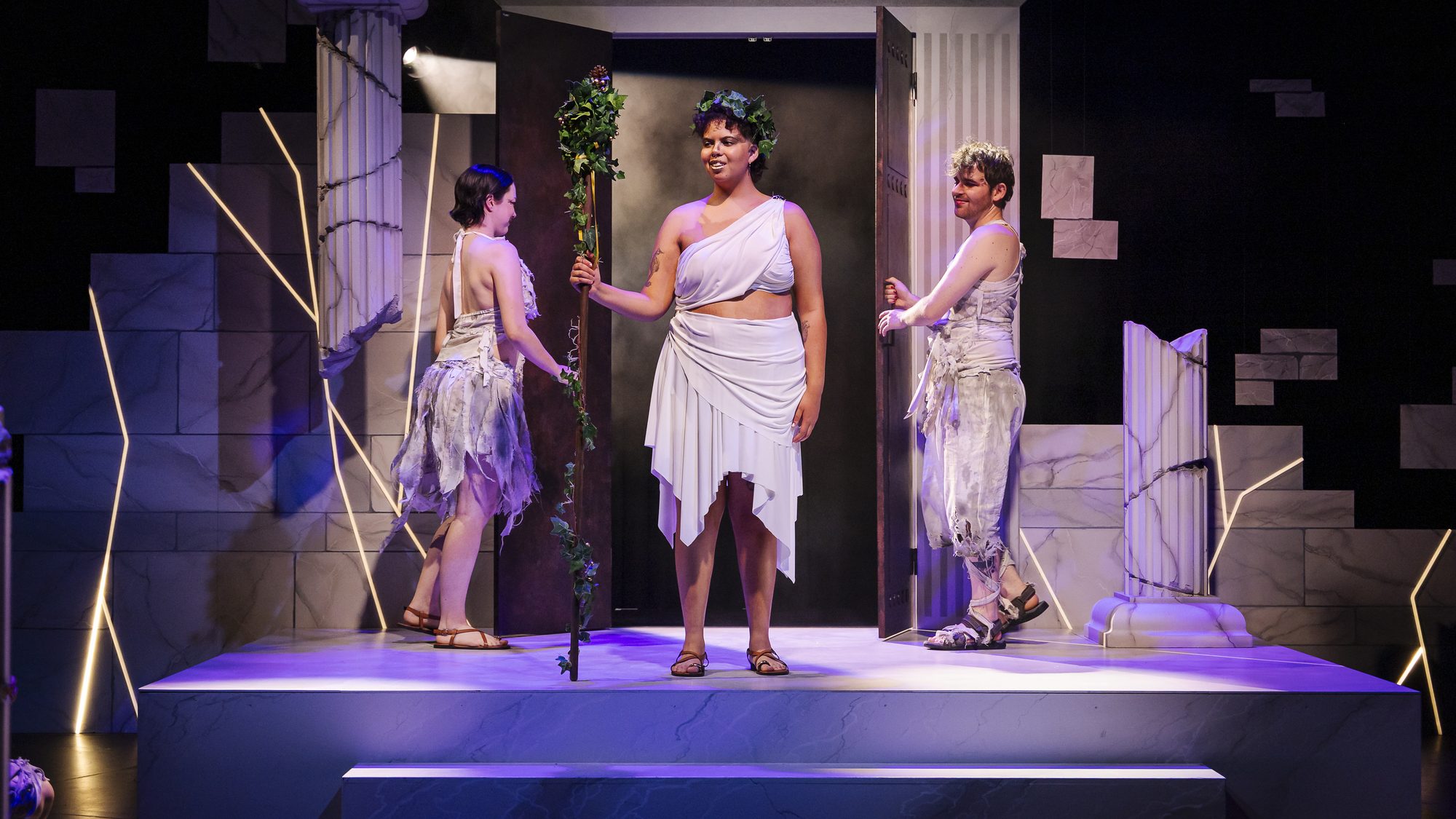
Photograph: Stephen Heath
Pentheus enters through the doors, dressed in maenad clothing and holding a thyrsus. Dionysus begins fixing Pentheus’s outfit. The king appears more dazed by the god, no longer able to look at the Dionysus performer who is speaking, and instead addressing the performer who spoke last. He appears more and more under Dionysus’s influence. Pentheus leaves for the mountains, heading to the Bacchae. Dionysus states that he will triumph. The chorus enter, dancing a Bacchic dance and speaking in chant. The Fates speak in sonnet.
There may be audience clapping or cheers when Pentheus enters in maenad clothing.
The soldiers announce Pentheus’s death
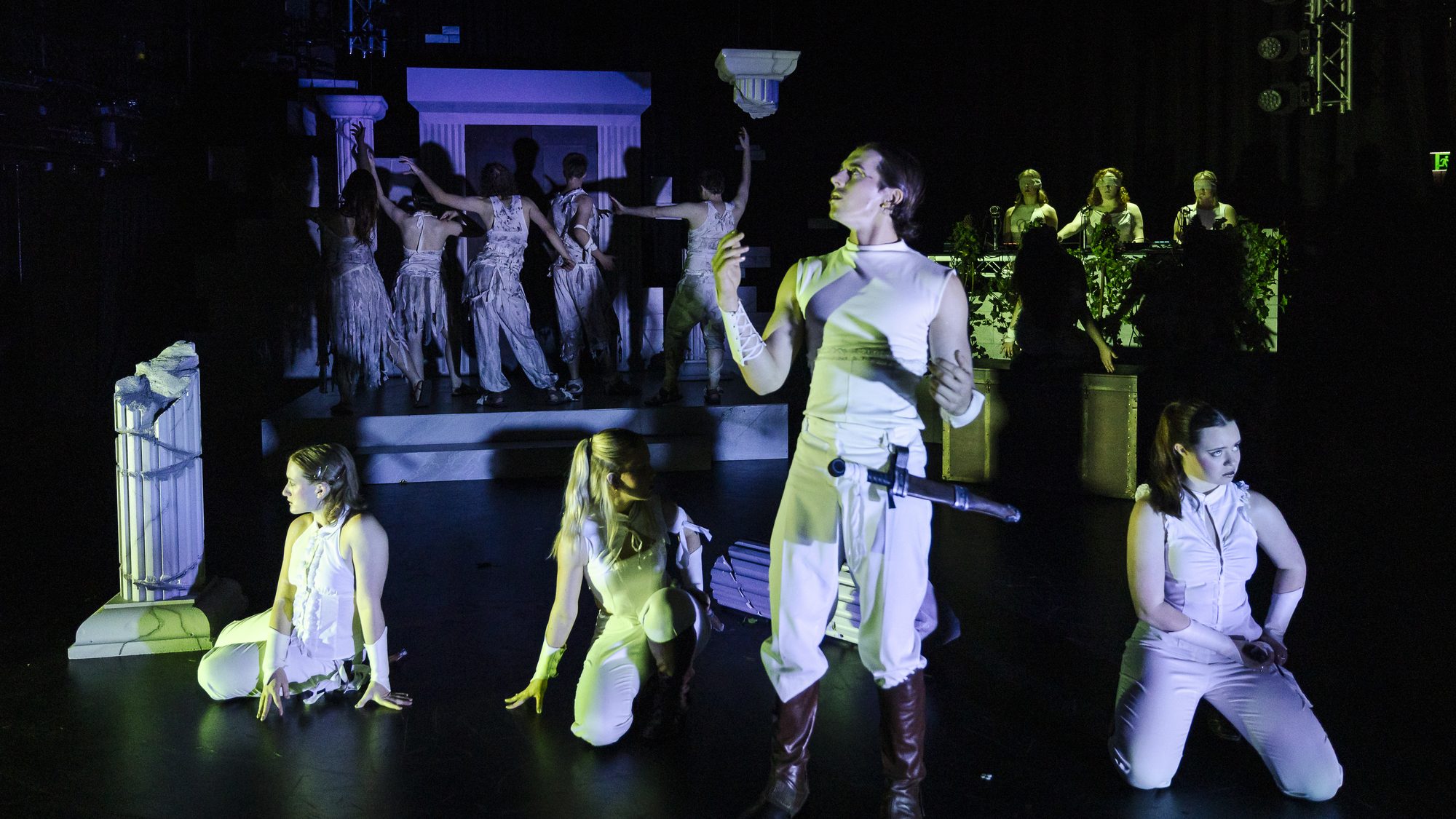
Photograph: Stephen Heath
The soldiers return from the mountain and speak with Dionysus in disguise; they announce that Pentheus is dead, and they mourn. They recount how they went into the mountains and saw the maenads, and that the maenads could see Pentheus more than he could spy on them. They recount that as Pentheus shouted commands, Cadmus’s daughters could see him. Agave and her sisters ran towards Pentheus; then the attack began, with Agave striking first. The soldiers say that the women ripped Pentheus limb from limb, tearing out his flesh with their hands. One of the soldiers says that he needs to leave, and that they must worship all that comes down from the gods as the wisest custom; the other soldiers follow him out.
This scene involves graphic descriptions of violence.
Agave presents her trophy
Photograph: Stephen Heath
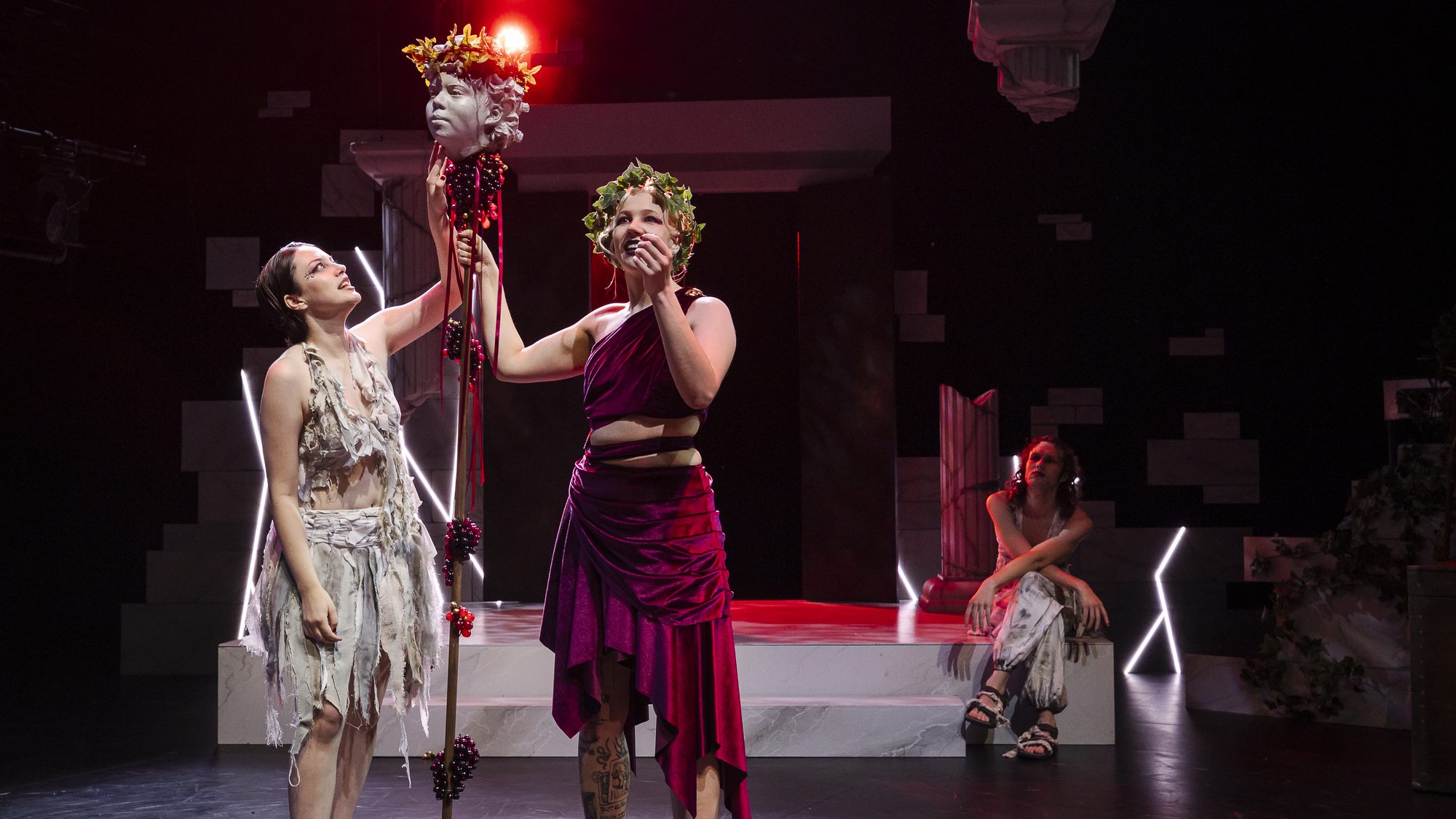
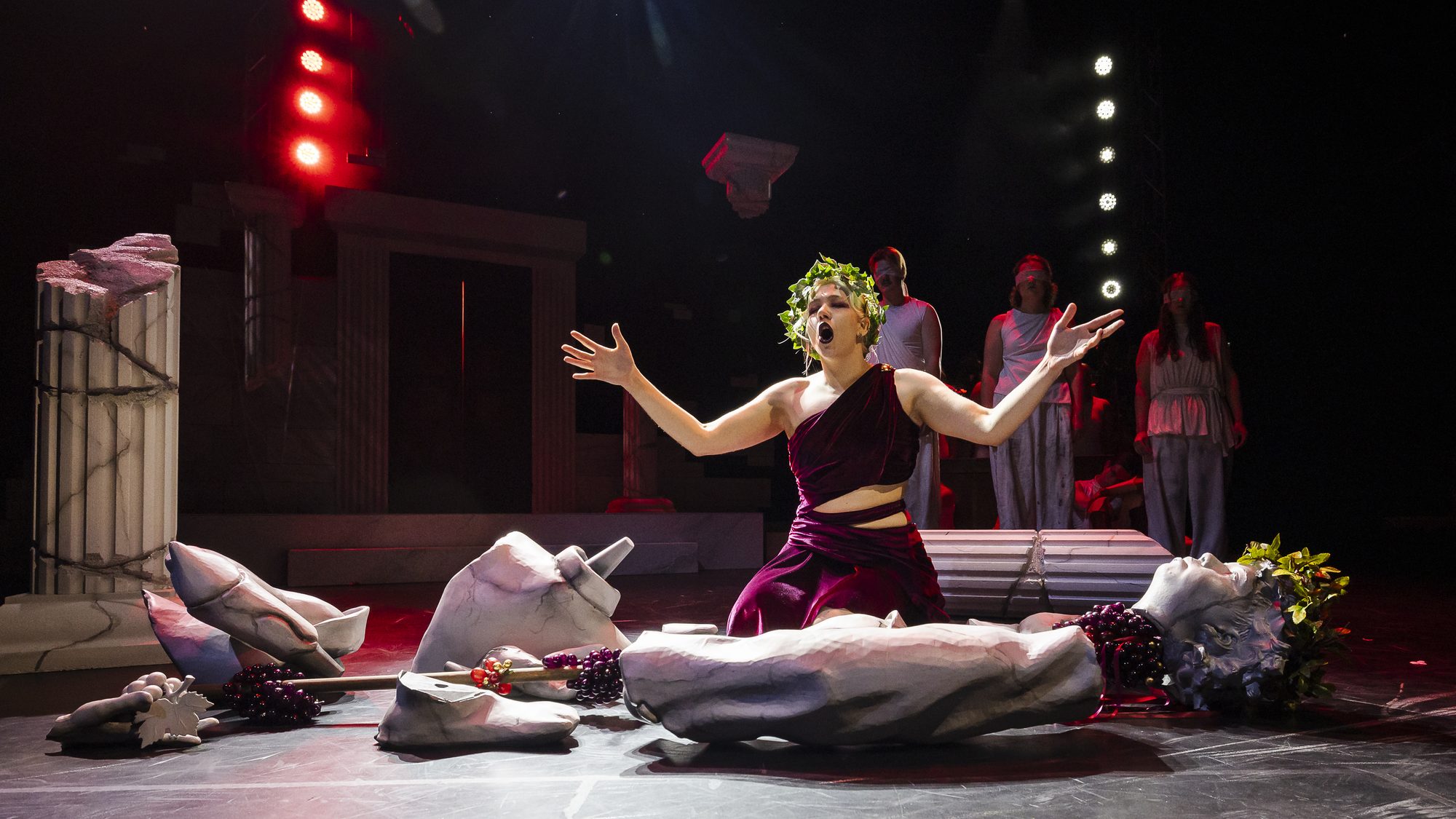
Agave arrives in the city, proudly presenting the head of Pentheus on top of a thyrsus; she believes the trophy is the head of a young lion. She begins to boast about her hunt, looking for Cadmus and Pentheus. When Tiresias enters, she believes it is her father Cadmus; she presents her trophy and prize. Tiresias brings her back to her senses; she looks at the sky as it returns to normal. She sees Tiresias; she sees the head of her son; she places the thyrsus on the floor. She cannot believe what she has done. Tiresias explains he brought back what he could of her son’s body, as the ensemble places his body parts next to Pentheus’s head. Agave tries to perform a ritual burial but cannot finish; she falls to the ground in grief. Dionysus and Cadmus enter. Dionysus reveals himself, saying that this is their punishment for dishonouring his divine nature. He says that Agave and her sisters must now be exiled to the barbarian lands, and foretells that Cadmus will be turned into a serpent. They walk off stage.
This scene involves horror themes and references to murder and violence. It shows a character in psychosis.
Photograph: Stephen Heath
Closing moments
Photograph: Stephen Heath
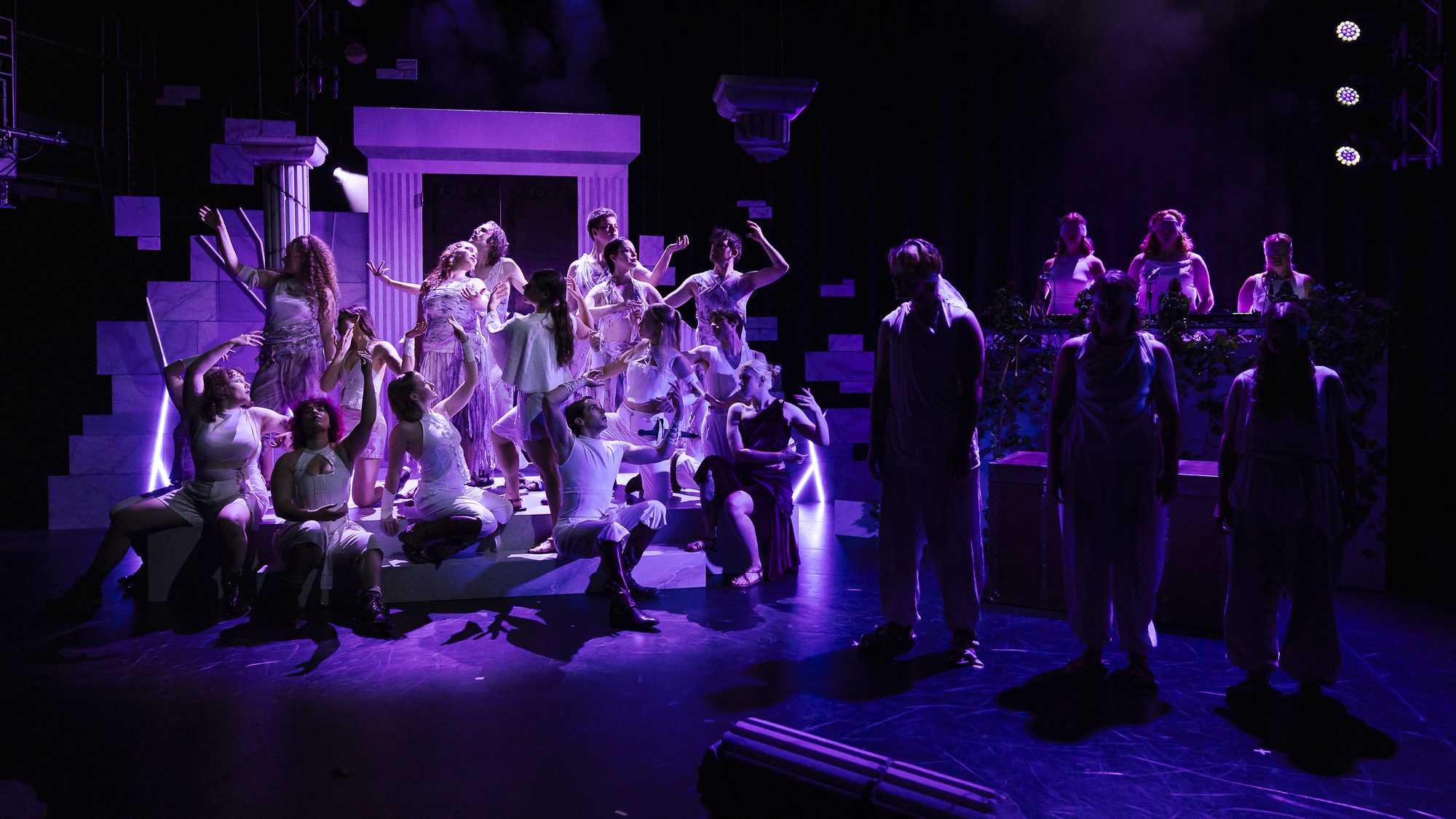
The Fates speak their final sonnet. Dionysus and the chorus enter, re-creating their shape on the platform from the opening of the show, as Pentheus’s body remains on the stage floor.
After the show
The performers take their final bows, and there will be loud clapping and cheering.
Where to get support
If anything about The Bacchae raises any concerns for you, these places are here to listen:
- Lifeline: 13 11 14
- 13 YARN: 13 92 76
- Beyond Blue: 1300 22 4336
If you are thinking about suicide, or you are worried about someone else’s safety, contact emergency services on 000, go to the Emergency Department of your nearest hospital or make an urgent appointment with your GP.
For more information about suicide prevention or supporting someone who is suicidal, the Mental Health Commission of Western Australia has resources and advice.
If you or anyone you know is struggling with addiction, support is available:
- The Drug and Alcohol Youth Service (DAYS) is a free and confidential service located in East Perth which provides young people (aged 12 to 21) and their families with access to a comprehensive range of alcohol and drug services.
- Next Step Drug and Alcohol Services provide a range of treatment services for people aged 18 or over experiencing problems associated with their alcohol and other drug use, as well as support for families.
- There is a list of support services and emergency contacts for people experiencing family and domestic violence in WA.
For ECU students and staff
ECU Counselling Service is a professional and confidential service, available to ECU students free of charge. Their phone number is (61 8) 9370 6706, and they are open Monday to Friday, 8.30 am to 4.30 pm, on Level 1 of the City Campus, Wellbeing Precinct CC.1N.135.
You can also contact the After-Hours Support service by calling 1300 583 032 or texting 0488 884 232. This service is available from 4.30 pm to 8.30 am, Monday to Friday, and 24 hours a day across the weekend and public holidays.
More about the production
The Creative Learning Pack, written by the company, goes further into how The Bacchae was made. The program page has the full cast and creative team.
Written by Jessica Thomas (Arts and Cultural Management), with contributions from the 2026 Performance Making Company and Jeremy Neideck. This guide is updated as details are confirmed.