Order vs rave mania: Pentheus vs Dionysus
Teacher: this activity aims to assist students’ understanding of the movement quality and conventions of the Greek chorus and the Bacchae; it also serves as a physical warm-up to prepare the students for an active class.
Activity (use upbeat music to support this activity):
- The teacher picks one student to act as Dionysus; ‘Dionysus’ begins in the centre of the space. And one student to represent Pentheus. These two main characters stand on opposite sides of the room facing each other to begin. All the other students scatter around, finding space.
- Dionysus begins to move around the room as if they were dancing at a party. Pentheus begins to move as if they are ‘marching’ or rigidly keeping order.
- If Dionysus approaches you, you begin to dance as if you were at the party as well, being affected by their movement. If Pentheus approaches you, you begin to follow order, march, and be rigid.
- Students must allow Dionysus’ or Pentheus’ movement to influence how they move, almost copying rhythm, movements, and gesture. That is, if Dionysus or Pentheus gets close to another student, that student becomes ‘infected’ by the rave or the order.
- The goal of the two main characters is to infect as many people as possible with their movement, to enlist them to their team, so eventually everyone is moving in two large ‘flocks’, doing ‘flocking’ movement work in two teams working against each other.
Teachers can prompt each group with different movement and gesture ideas throughout to avoid getting stuck in a pattern. When the exercise reaches a natural ending, ask them to find a final pose as their team.
Debrief: be sure to finish with a debrief discussion.
- How did it feel to become infected by Dionysus or Pentheus? Did it happen quickly or slowly for you?
- What sort of movement were you focusing on?
- What sort of feelings arose from the movement you were copying?
- How did it feel to move as one collective group; was it difficult?
Note: remind students throughout that they don’t have to copy their leaders exactly; rather, the leader’s movement is stimulus that can be adopted and expressed individually.
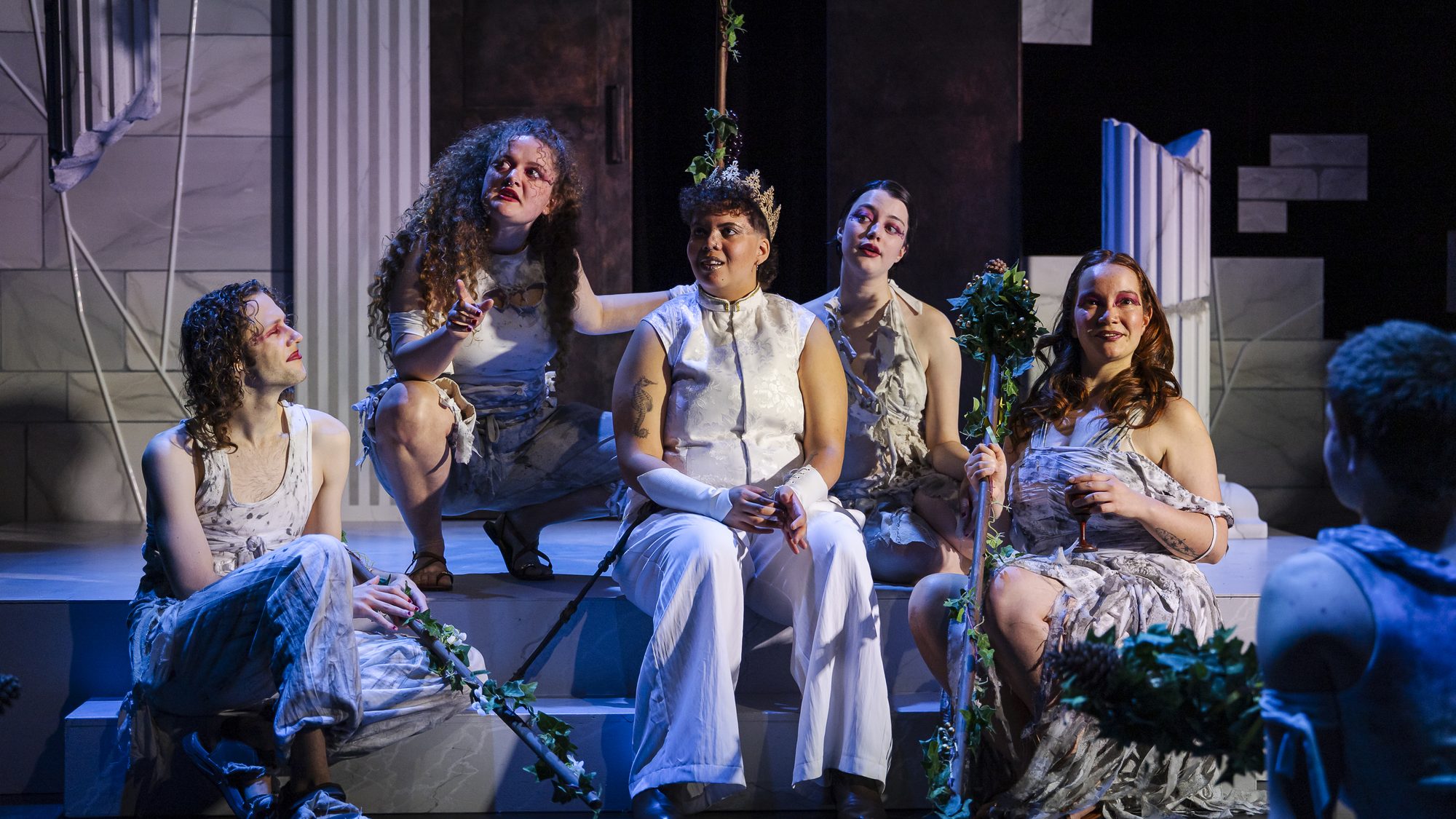
Photograph: Stephen Heath
Interpreting theme and symbol: poetry slam
Discussion: begin with a short class discussion using the prompts below.
- The Fates were controlling the music in this production, a significant part of rave and party culture. How do you think their presence and control shaped, or attempted to resist, the inevitability of this tragic story?
- This production focuses on rave and party culture. How was this represented in Kyle Morrison’s production? What moments stand out in your mind? How did the design enhance or support this? Do you remember any of the language used? (Technology, AI, money, grind culture, red pill, and the manosphere?)
- Looking at the resources at the end of this pack, how have other directors presented this classic text? What setting, design, and issues have they focused on to bring this text into the 21st century?
Activity: poem collective
- Working individually, give students five to ten minutes to write a stream of consciousness about the euphoria depicted by the Soldiers, Maenads, and Agave when they were most convincingly under Dionysus’ spell.
- Now have the class come back together and form into groups of five or six. Using their creative writing notes, they must first share what they have written and then work together to form one collective poem. One by one, each student will offer an idea, reading a line from their free-write. Responding to this, another student will contribute a line from their free-write that they think connects or follows on from this. Eventually they will form a larger work that replicates the larger picture of the initial question.
- Students can shuffle the lines once they have all contributions, depending on what story they want the poem to tell.
Share and reflect: one member from each group presents their poem to the class. The teacher can then offer this reflective prompt:
“What are the creative benefits of collaboration, using multiple minds and artists to create one singular piece of art?”
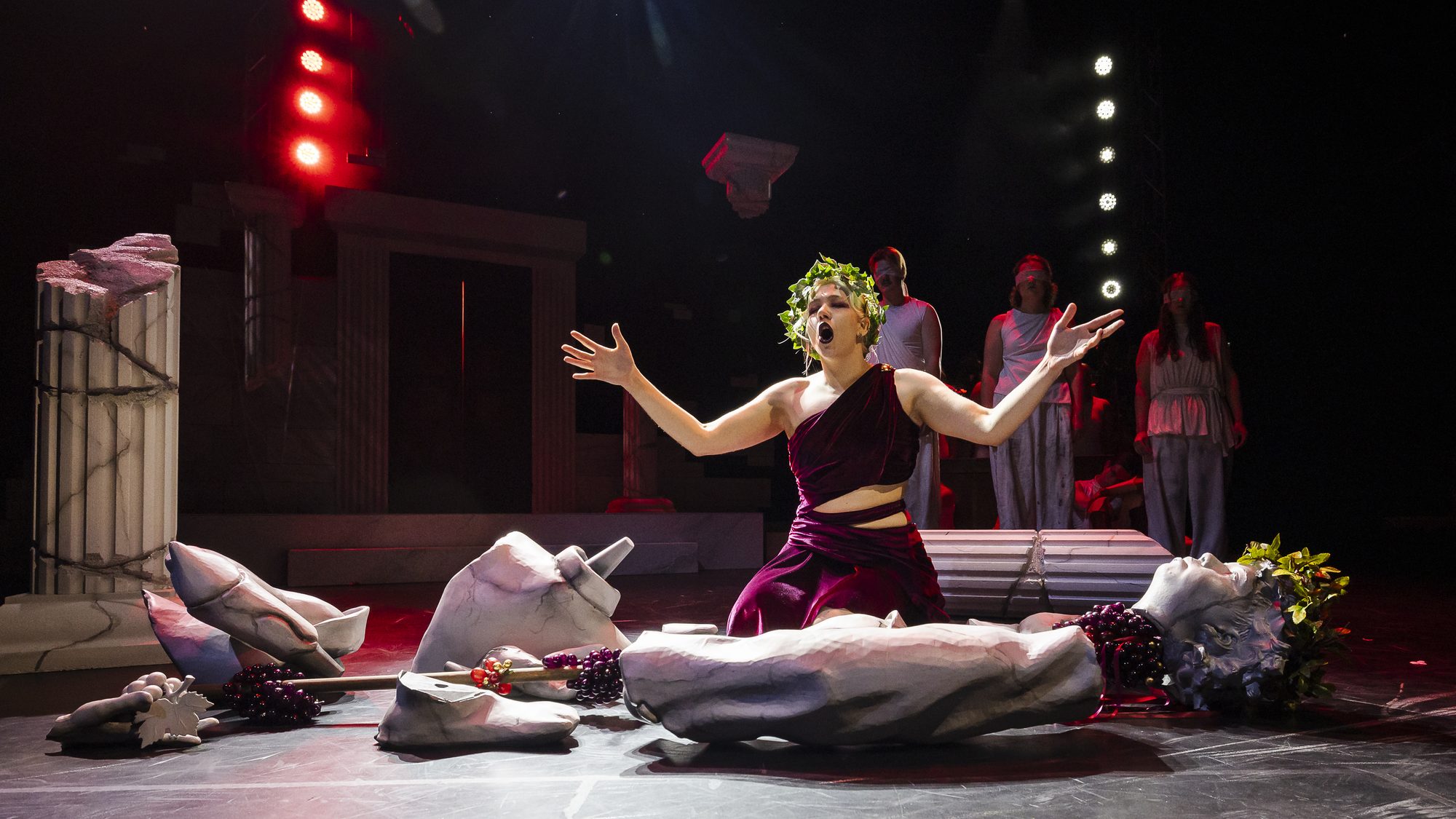
Photograph: Stephen Heath
An interview with the character
Teacher: this concept explores a constructive and entertaining take on embodying classical characters within a modern-day setting: a job interview. Students will each be allocated a role from the cast list in this pack and answer personalised questions as if they are in an interview, embodying their character. Learning intentions vary, from building performer confidence in young creatives to creating a space where learning classical texts is explored in an immersive, approachable, and interactive setting.
Activity: the aim of the game is to gain the trust of the individual interviewing you and be accepted into ‘Thebes Corporation’ (a fictional company inspired by the geographical location of the play). This is done through committing to your character, being confident with the questions asked, and not hesitating; as we say in the theatre, you must “yes, and…”.
Steps:
- Students get into pairs and find a space in the room.
- Pairs choose, or are allocated, a character from the list below.
- They cast themselves as either the character or the interviewer.
Character list
- DIONYSUS · God of wine and pleasure · Divine son of Zeus and Semele; cousin of Pentheus.
- TIRESIAS · An old blind prophet and lore keeper · Teacher of Agave and Pentheus; prophet of the gods.
- CADMUS · The old, retired king of Thebes · Grandfather of Pentheus; father of Agave and Semele.
- PENTHEUS · The young king of Thebes · Son of Agave; grandson of Cadmus; cousin of Dionysus.
- AGAVE · Leader of the Bacchanalians · Mother of Pentheus; daughter of Cadmus; sister of Semele; aunt of Dionysus.
Begin by having the pairs talk about the character being interviewed: what do they remember from the play, who are they, what character traits do they have, what did they do in the play?
Students can begin with questions such as:
- Why do you care about Thebes? What do you think needs to change in Thebes?
- How would you be a good leader, and what would you do to change this society?
- What kind of person are you, and what qualities would you bring to this job?
- List some of the things you have already done (thinking of the story of the play).
Once these are answered, encourage the interviewer to improvise some questions to find out more about the character.
Show and debrief: you can have two or three pairs present their interviews (one or two questions) to the class. Props like two chairs and an interviewer’s jacket or microphone can help set the scene. Then be sure to debrief what they have learnt and recalled about the characters.