Conventions of Greek theatre
The Greek pantheon
Greek theatre has strong ties with ancient religious celebrations, eventually developing into the Festival of Dionysus in Athens. All Ancient Greek tragedies were based on local myth, with different versions of the same story emerging across regions and traditions.
This is particularly prevalent in The Bacchae, in which Dionysus is referred to with several different names including Bacchus, Bromius, Evius, Dithyrambus, Iacchus, Xenos, and Lysios. Many tragic playwrights, including Euripides, drew upon the Greek pantheon (made up of the twelve Olympian gods) to establish mythological narratives, allowing audiences to recognise familiar characters, stories, and religious traditions. This familiarity expanded the philosophical impacts of the story beyond a singular narrative, using well-established myths to explore broader philosophical implications.
Monologue
A monologue is a long dramatic speech performed by a single person or character within a play. Monologues were commonly used within Greek tragedies to engage the audience’s imagination and deepen their engagement with the dramatic world. These monologues, while serving to push the narrative forward, “exploit the audience’s capacity to visualise and re-animate” dense imagery in their mind (Rehm, 2017, p. 71), allowing spectators to construct aspects of the action beyond what is physically presented on stage.
Chorus
Chorus is one of the less accessible conventions of Greek theatre, as its exact function and performance practice remain only partially understood. Images on ancient Greek vases, likely sold at the Festival of Dionysus as souvenirs, suggest that the chorus was made of 12 to 15 young men who sang and danced their way throughout the entirety of the play. They were not professional actors but were highly skilled and trained over the course of a year for their role in the Festival of Dionysus.
Throughout a traditional Greek tragedy, the chorus would sing songs and odes which punctuate the dramatic structure. These collaborative performances provide commentary on the action while raising larger questions about the cosmos or ethical questions. Ultimately, the chorus serves as a bridge between the theatrical performance and its audience, aiming to represent multiple ideas, voices, opinions, and feelings, allowing for more complex self-discovery.
Watch: the company’s chorus work in rehearsal, working with the elements of the play (blood, wine, milk, honey, bones). Video at performancemaking.com/learning/bacchae-2026-06-form-style-and-convention. Original music by David McEwan.
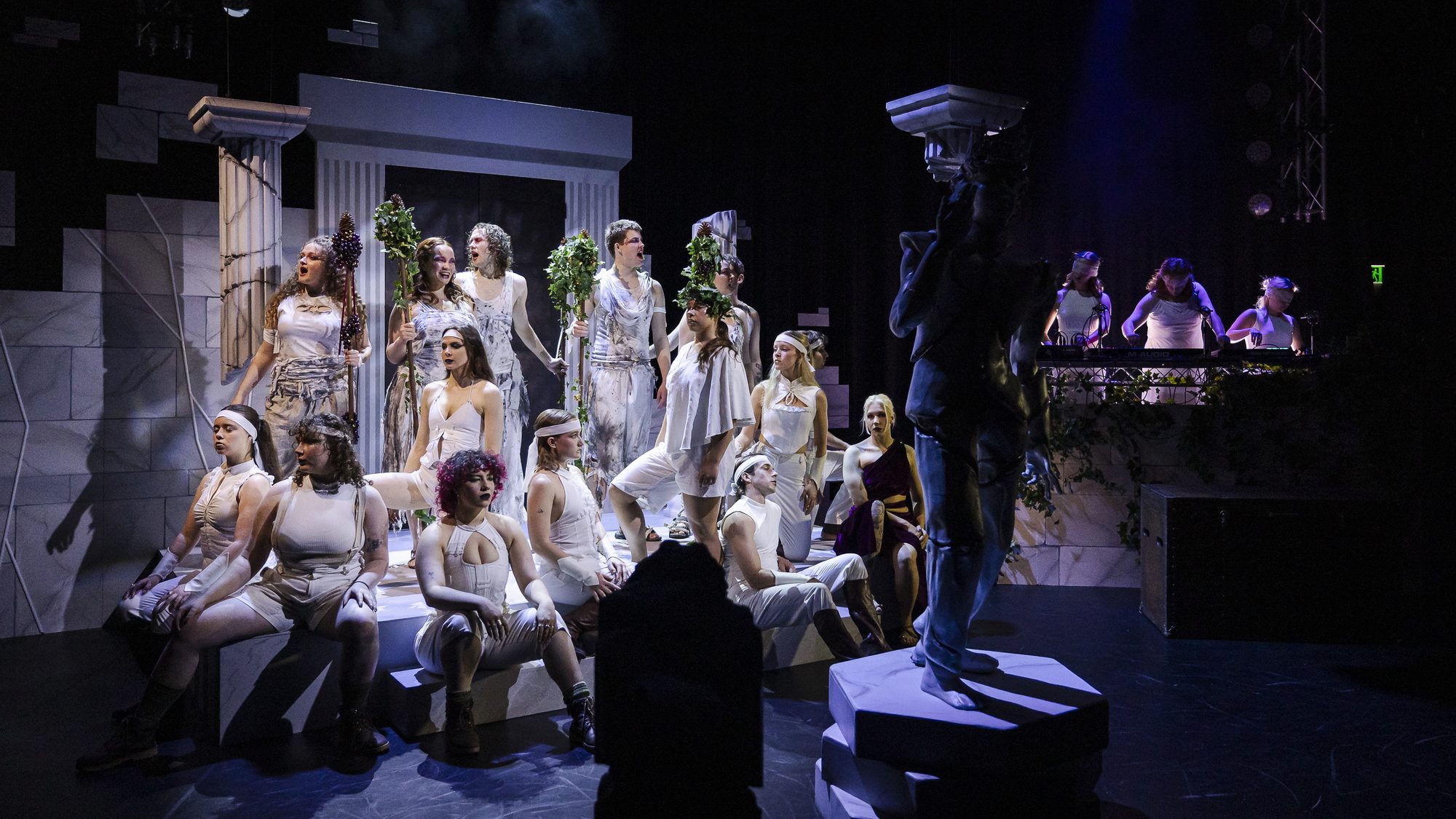
Photograph: Stephen Heath
Dance and song
Dance and song are among the most obvious remnants of Greek tragedy’s origin in religious celebration. These songs and dances were almost exclusively given to the chorus and were based on well-known fifth-century “cult hymns, epinician odes, wedding songs, funeral laments, and so on” (Rehm, 2017, p. 84). Importantly, song and dance were used in religious rituals to praise Dionysus, an obvious connection discussed throughout The Bacchae. Through these familiar forms of expression, song and dance elevated the emotional experience of fifth-century audiences, drawing upon shared cultural knowledge and religious traditions to deepen their engagement.
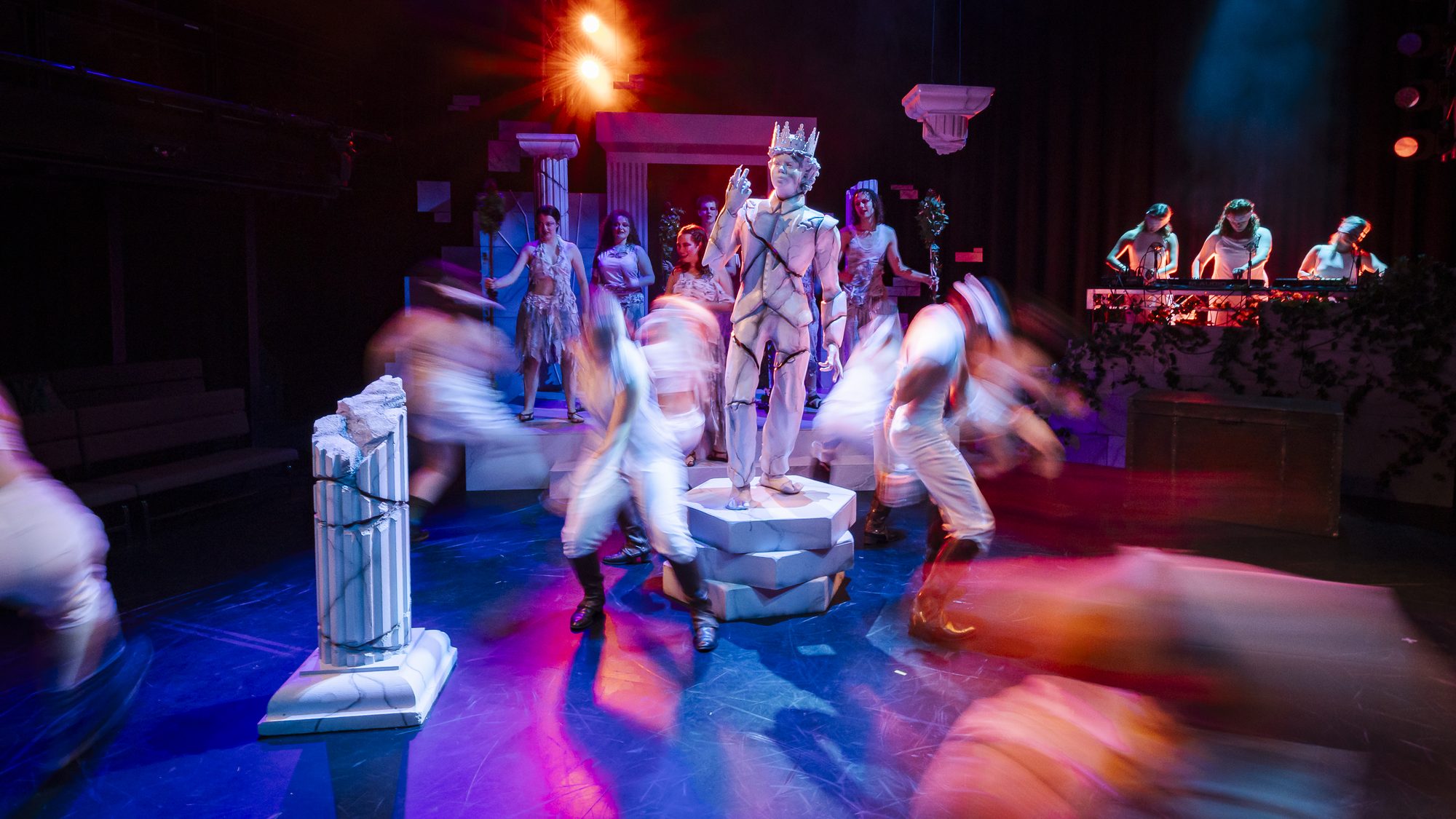
Photograph: Stephen Heath
Verse
One of the key sources informing our modern understanding of Greek theatre is Aristotle’s Poetics, in which he suggests that tragedies emerged from a performance tradition called dithyramb. These were rhythmic choral rituals performed to honour Dionysus. This connection to oral and musical tradition helps explain the prominence of poetry, rhythm, and song in Greek tragedy, where language functions differently from naturalistic dialogue.
Beyond its cultural and artistic significance, verse had practical implications in ancient Greek theatres. In the large, open amphitheatres of ancient Greece, performers were required to transmit information to audiences at considerable distances. Verse provides a structure for the actor to give information in a clear, rhythmic way.
Masks
Masks are less commonly used in contemporary productions of Greek tragedies but were a necessary staple for most ancient performances. Masks were worn by all actors including the chorus and served several practical purposes. First, lead characters within a traditional Greek tragedy were typically played by about three actors; masks allowed one actor to play multiple characters with minimal confusion. Secondly, masks enhanced visibility of characterisation in large open-air spaces. The shapes and features of the mask interacted with light and shadow, helping generate specialised symbols of emotion, identity, and dramatic tone. This visual clarity was particularly valuable in large open-air spaces, where audiences needed to recognise characters and interpret their responses to unfolding events from a distance.
Form
The Bacchae belongs to a theatrical tradition that can be understood today as a ‘presentational’ form of theatre. This is because The Bacchae uses a specific set of conventions within the tragic genre that suggests no interest in creating an illusion of reality. Rather than serving purely as entertainment, Greek theatre (emerging from the Festival of Dionysus, the god of wine and theatre) was used as a sacred and civic ritual with direct implications on the day-to-day lives of the Athenian people.
Greek tragedies frequently deal with themes of immense philosophical, ethical, and cosmological significance, often before large outdoor audiences with limited theatrical technology. Consequently, Greek theatre developed a distinct set of conventions suited to these performance conditions, prioritising clarity, heightened expression, and the communication of complex ideas in ways that differ from representational forms of theatre.
Euripides’ The Bacchae uses direct address, chorus, verse, monologue, dance, and masks, and strongly evokes the Greek pantheon throughout. In its time The Bacchae did something really special; rather than directly imposing political ideology or a particular understanding of the greater cosmic world, it demonstrates the dangers in suppressing or not tolerating difference (Stuttard, 2016).
Style and techniques
Language and rhythm
Although The Bacchae is written in verse, Euripides adopts a less formalised and more conversational style than his contemporaries, Aeschylus and Sophocles. Euripides retains the metric (structured rhythm) verse while incorporating a more naturalistic quality into his dialogue (Stuttard, 2016). This approach helped establish a more immediate and personal connection with its audience. Given the themes and lessons of The Bacchae are inherently interpersonal, Euripides likely wanted audiences to be affected on a personal level, rather than encountering them solely as abstract philosophical questions.
Antithesis
Euripides relies heavily on antithesis (opposing ideas) throughout The Bacchae as a tool to further unsettle the audience. According to Stuttard, “The Greek mind was trained to think in polarities; to categorize, distinguish, and oppose” (Stuttard, 2016, p. 12). Euripides exploits this tendency by presenting characters, ideas, and forces that resist clear categorisation, challenging the very frameworks through which audiences understand the world.
This is particularly prevalent in the characterisation of Dionysus:
Youthful god, yet an immortal; male, yet effeminate; conceived in Thebes, yet worshipped abroad; presents both tragic and comic views of life. (Stuttard, 2016, p. 12)
Imagery
In The Bacchae Euripides spared no details when describing every moment of violence or bliss. The play’s dense imagery serves multiple purposes and holds a strong relationship to Euripides’ use of antithesis, particularly in his exploration of delusion, illusion, and madness. Of particular interest, however, is the way Euripides approaches violence. Throughout the play, animals are torn apart and Pentheus is dismembered, with these acts all described in horrific detail. Yet the extended accounts delivered by the messengers and soldiers serve a purpose beyond simply conveying events that would have been difficult to stage physically.
Euripides engages the audience’s imagination, using vivid and often disturbing descriptions to exploit the audience’s capacity to visualise the action in their minds (Rehm, 2017). By requiring spectators to construct these acts of violence imaginatively, Euripides invites them to confront the brutality of the events more directly.
This imagery also contributes to the play’s broader exploration of humanity’s capacity for violence. The Bacchae suggests that violence cannot simply be eliminated through suppression, and ignoring its dangerous potential may allow it to emerge in more destructive and surprising ways.
References: Part 11.