Introduction to the play
The Bacchae was written by the Ancient Greek tragedian Euripides, and first premiered at the City Dionysia festival in 405 BC. It is often thought of as Euripides’ masterpiece, a work which finely demonstrates the conventions of classical Greek tragedy.
It explores several themes, looking closely at the balance between being guided by reason, as opposed to being guided by sensuality. As a play, it analyses the consistency, and conflict, between the laws of humans and the laws of the gods, showing us characters which swear to one extreme or another, and realise their mistakes too late.
The play has inspired many other works of art, both in drama, and beyond. It is a story which is almost 2500 years old. As a result, its influences are broad, and far-reaching.
Kyle Morrison’s production of The Bacchae, performed in November 2026, posits a contemporary take on a classic. Through shifts in language and the addition of Shakespearean sonnets, Morrison achieves a version of the text that highlights certain themes, and puts forward a different dramatic message.
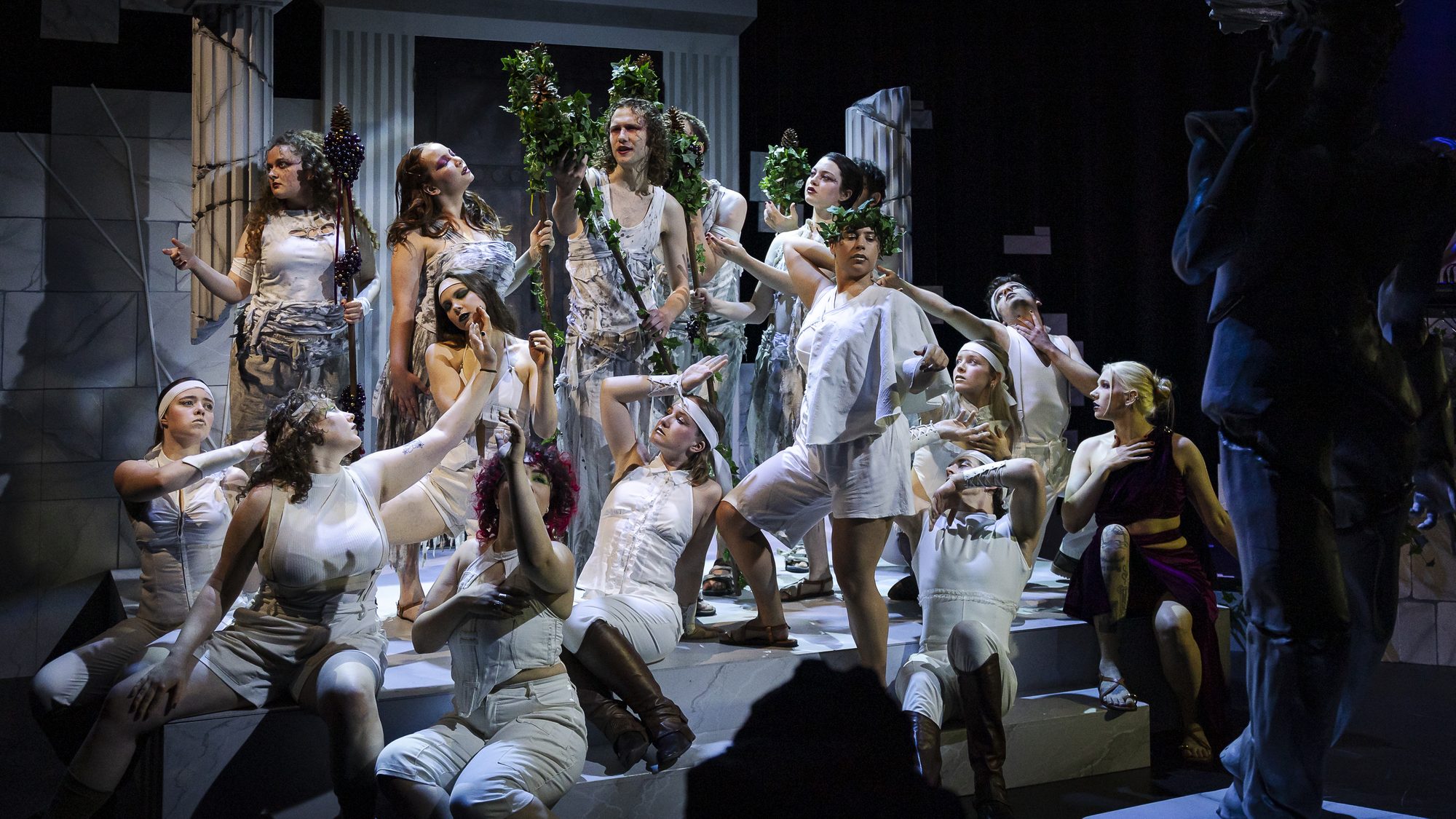
Photograph: Stephen Heath
Synopsis
The Bacchae is the tale of Dionysus, the Greek god of wine, fertility, and ecstasy, returning to Thebes to punish the young King Pentheus for denying his divinity. It begins with the god Dionysus (the son of Zeus and the Theban princess Semele) coming to his mother’s city in the form of a mortal man to answer the slander that he is not a god. As he explains, his mother Semele’s own sisters (Agave, Ino, and Autonoe) said that she had taken a mortal lover and blamed Zeus, and that Zeus had struck her dead for the lie.
Now Dionysus has driven all the women of Thebes out of their houses in frenzy, and they are celebrating his rites on Mount Cithaeron. The aged Cadmus and the prophet and seer Tiresias prepare to join them, but Pentheus, Agave’s son and the king of Thebes, reproaches the old men and orders his soldiers to hunt down the followers of the new god. Dionysus, disguised as a mortal, is arrested and shut up near the palace stables. The god frees himself with ease, shaking the palace with an earthquake and fire.
Meanwhile a herdsman reports that the women on the mountain are working miracles and, when attacked, tearing cattle apart with their bare hands. Pentheus gathers an army, but Dionysus persuades him instead to go and spy on the women himself, dressed as a female maenad and worshipper of Dionysus. Soon a second messenger returns to tell how Pentheus was discovered in his tree and torn to pieces by the women, led by his own mother, Agave.
Agave arrives proudly carrying his head, which she believes to be the head of a young lion. In our adaptation Tiresias brings her back to her senses (this was originally the role of Cadmus). Dionysus, now appearing in his divine form, justifies his vengeance, sends Agave and her sisters into exile, and foretells that Cadmus and Harmonia will be changed into serpents.
Watch the trailer at performancemaking.com/learning/bacchae-2026 once the season opens.