Display options

Change how this site looks for you. Your choices are kept in this browser on this device. Settings on your phone or computer, such as reduced motion or more contrast, are followed automatically.

Text size
Reading
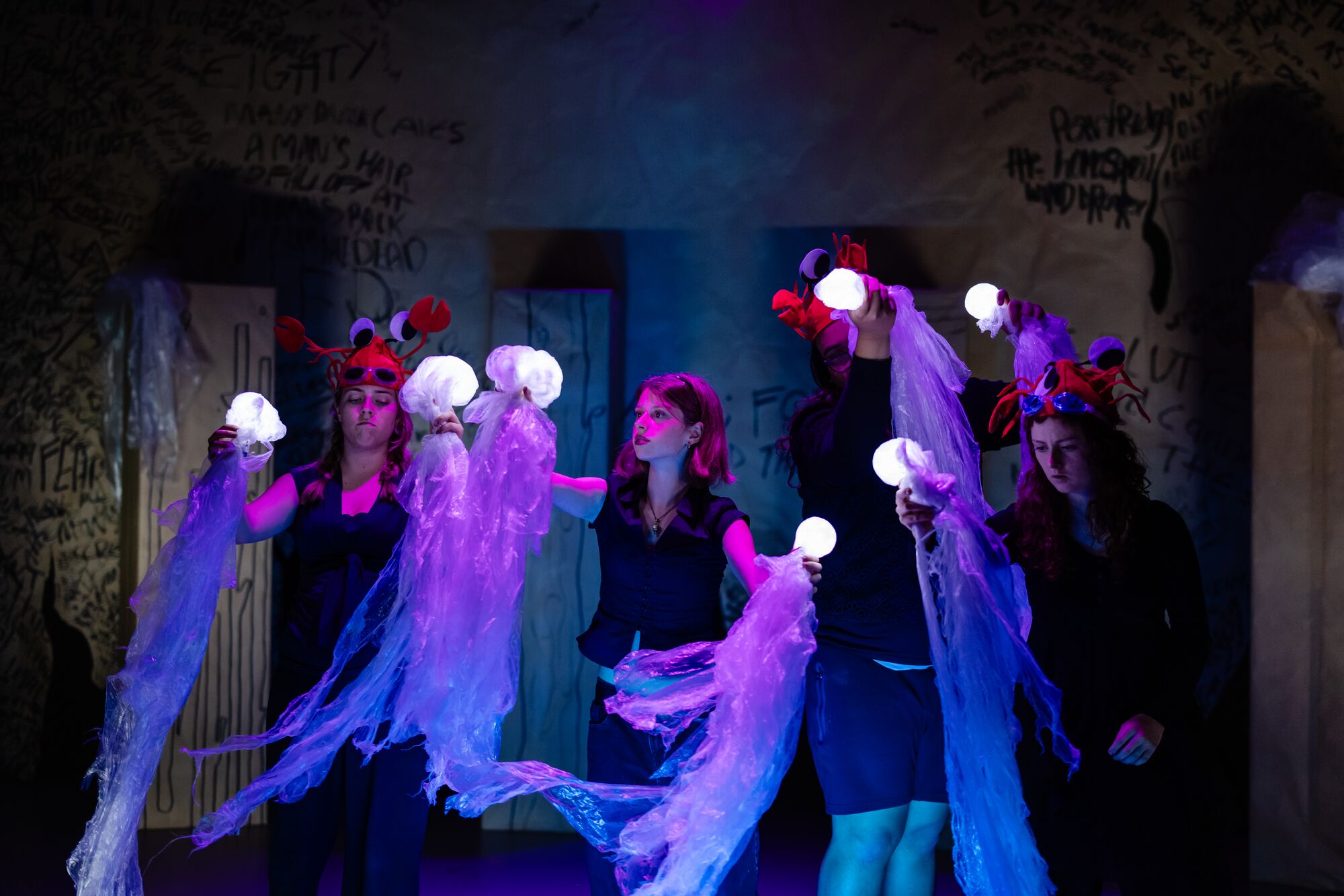
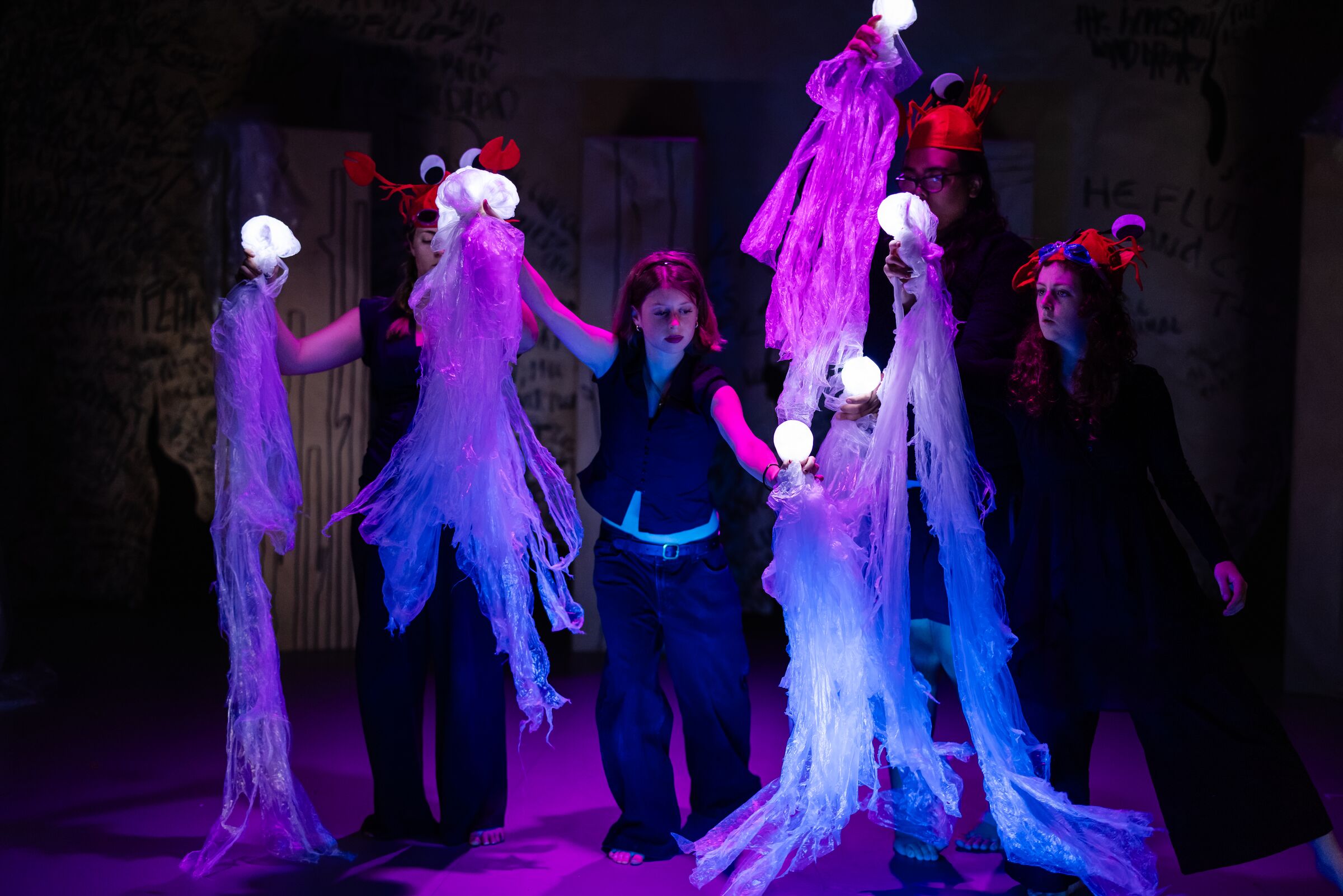
Performers raise the jellyfish puppets high, their plastic strands hanging to the floor in purple light.
A Monsterium, Visual Theatre Lab 2026 · Photo: Kylie Plunkett
Our Productions

Visual Theatre Lab · 2026

A Monsterium

Created and performed by the 2027 Performance Making Company, directed by Nigel Luck. The twelfth production of the partnership between WAAPA and Spare Parts Puppet Theatre.

Acknowledgement of Country

The cast and crew of A Monsterium acknowledge the First People and custodians of the land we meet and perform upon, the Whadjuk Noongar people. We pay deep respect to Elders and community, and we recognise the unbroken cultural practices of caring for the land, waterways, the skies, and all that inhabit this boodja. We extend this respect and acknowledgement to all First Nations people. Always was, always will be, Whadjuk Noongar Country.

Venue
Movement and Voice Presentation Studio 2, WAAPA
Season
11, 12, 13, and 14 November 2026, 7 pm

About

They reflect our world. The fears and concerns of the unfamiliar and unknown. We imagined them and now they live beside us and irritate the fabric of comfort and order.

Through puppetry, animation, and live performance, the ordinary becomes strange and the inanimate comes alive. Objects shift. Materials transform. Puppets breathe.

Drawing on imagery in medieval bestiaries, Jorge Luis Borges’ Book of Imaginary Beings and using the surrealist game Exquisite Corpse, A Monsterium is a playful exploration of the unusual and unsettling.

What happens when the things we imagine begin to live?

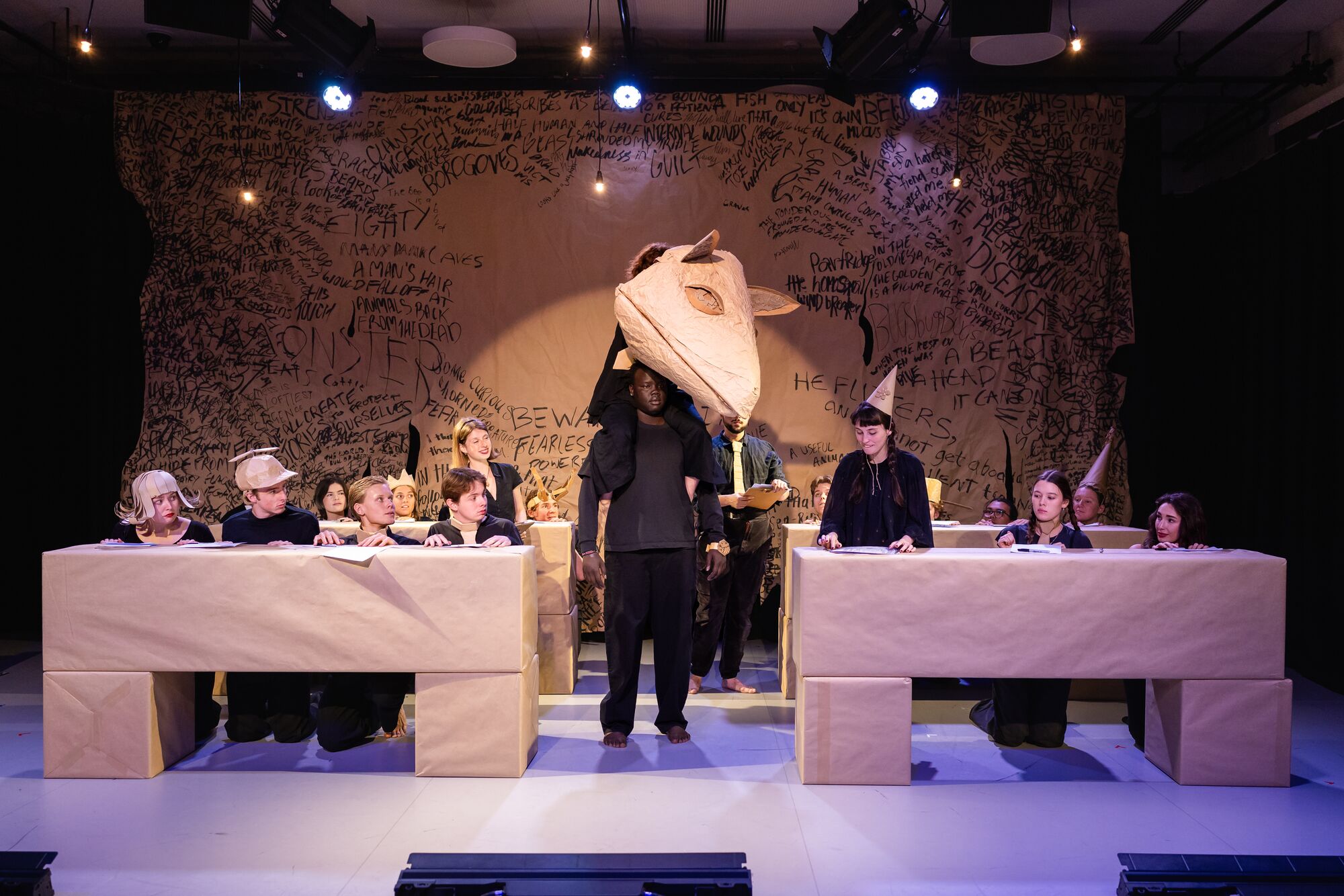
A performer wearing a large horned paper animal head stands between the two tables while the seated company watches.
A Monsterium, Visual Theatre Lab 2026 · Photo: Kylie Plunkett

The WAAPA and Spare Parts Puppet Theatre partnership

Since 2015, WAAPA and Spare Parts Puppet Theatre have been in partnership to deliver high quality puppetry training to the Performance Making students in WAAPA’s Bachelor of Performing Arts (BPA) course, culminating in a public production. The partnership is intended to enhance the creativity and skills of performance makers by introducing them to puppetry and visual theatre as part of their training as well as to connect them to Spare Parts Puppet Theatre as an important part of our theatre ecology. This show, A Monsterium, marks the twelfth performance created as part of this partnership. Countless graduates have found employment with Spare Parts as a result of the partnership and all our performance makers graduate with a deep appreciation of puppetry and more broadly the role of the visual elements of theatre.

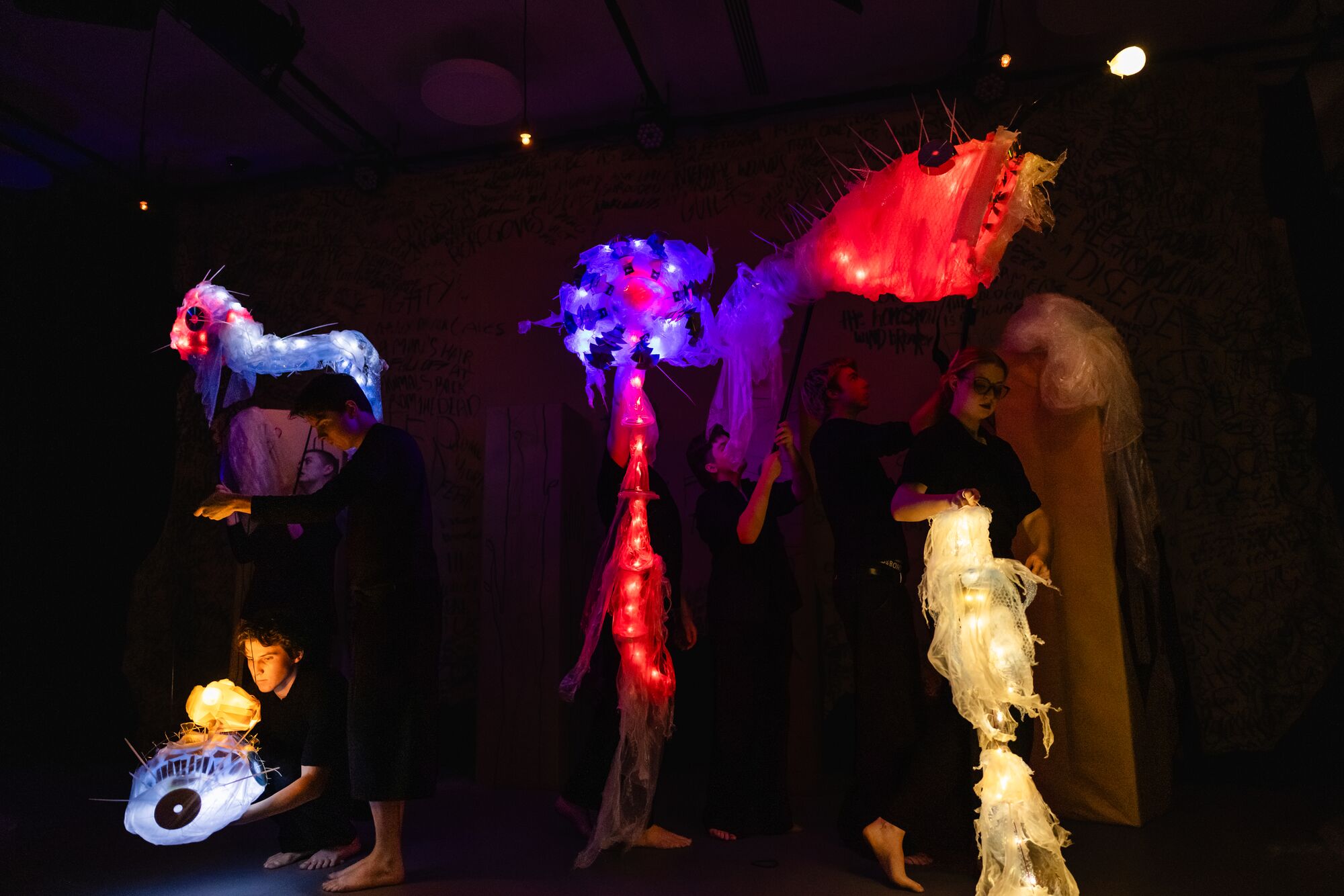
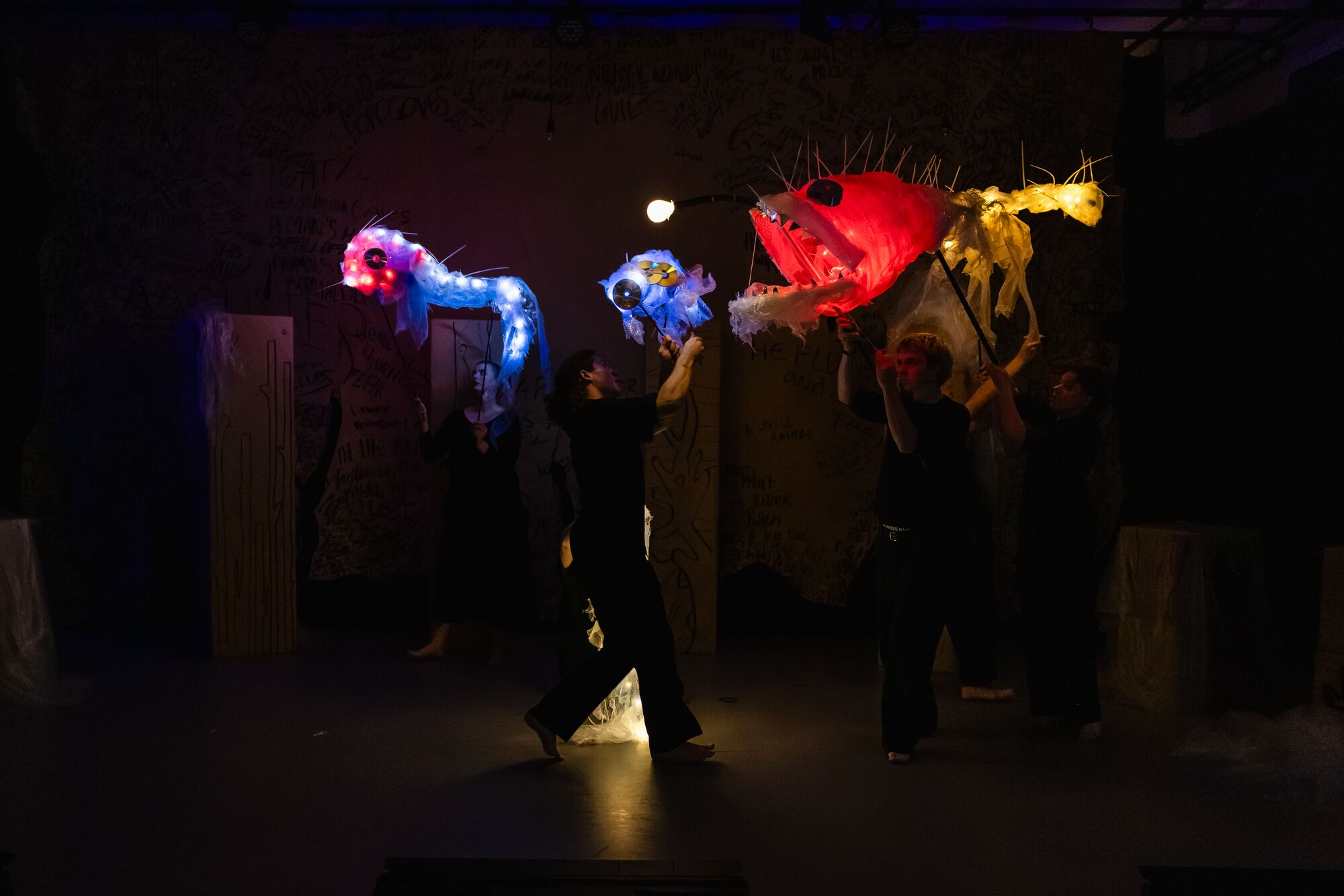
The deep-sea puppets together: an eyeball creature near the floor, the red-tailed bloom, the red anglerfish, and a white jellyfish.
A Monsterium, Visual Theatre Lab 2026 · Photo: Kylie Plunkett

Note from the director

Is it the animal with a tail? Or maybe the one that has a face with a lot of teeth. Perhaps it’s the one that looks like us, but not quite like us. They can frighten and fascinate. And if we listen carefully the monsters might tell us something.

The world is an amazing place full of diversity and wonder but in many ways it seems more quantifiable now than it might have in the past. We know more about our planet and the creatures that inhabit it than ever before but there are still new species being discovered every day. Look up the Panda Sea Squirt and the Blue Galapagos Octopus both described by science in the last couple of years.

In years past when people first began to travel the globe they brought back descriptions of new creatures, often finding imaginative ways to record the unknown and unfamiliar. The Vegetable Lamb of Tartary was described as a sheep attached to a plant by its umbilical cord where it could only graze on the area accessible around the plant. These descriptions of monstrous creatures were taken to be fact at the time and recorded in bestiaries as a true account of the world. The origins of many of these are often thought to stem from real species, the Vegetable Lamb possibly originating from the cotton plant.

We’ve been devising A Monsterium drawing on imagery in medieval bestiaries, Jorge Luis Borges’ Book of Imaginary Beings and using the surrealist game Exquisite Corpse. It’s been a process of looking to engage in creating a sense of wonder of the unusual and bizarre. Looking to embrace the monstrous not as horrific or scary but as something to be celebrated for all the diversity it brings.

As part of this process students have learnt puppetry animation skills for a variety of styles, many of which are seen in the show. We’ve played a lot, often rolling around on the floor with bits of paper or plastic as well as more conventional puppets. It’s been great to see how everyone in the group has thrown themselves into trying out new ways of working and supporting each other in making a very collaborative piece and watching their growth in skills in visual theatre.

Nigel Luck, Director

Creative team

Director
Nigel Luck**
Movement Coach
Frances Barbe*

Design team

Stage Design
Nigel Luck** and Chelsea Ryan Galloway
Lighting Design
George Ashforth*
Sound Design
David Stewart*

Made and performed by

The 2027 Performance Making Company

  • Mabior
  • Jemima Balfour
  • Isobel Alice Blanch
  • Keely Bourke
  • Samuel Boylen
  • Tommy Carroll
  • Harriet Darvall
  • Joe Dimattina
  • Sabrina Fox-Medrano
  • Cianna Gallen
  • Nelly Galluccio
  • Alexandro Gould-Arocha
  • Hamish McGlynn
  • Vincent Miragliotta
  • Freya Olivia
  • Ella Popham
  • Matilda Robinson
  • Lara Simpson
  • Dan Suttner
  • Damon Ward
  • Tess Withnell

Arts and Cultural Management

Associate Producer
Vespa Eastwood

Bachelor of Performing Arts

Producer
Frances Barbe*
Unit Coordinator, PAM3405 Visual Theatre Lab
Frances Barbe*

** Visiting artist. * WAAPA staff.

Production photos

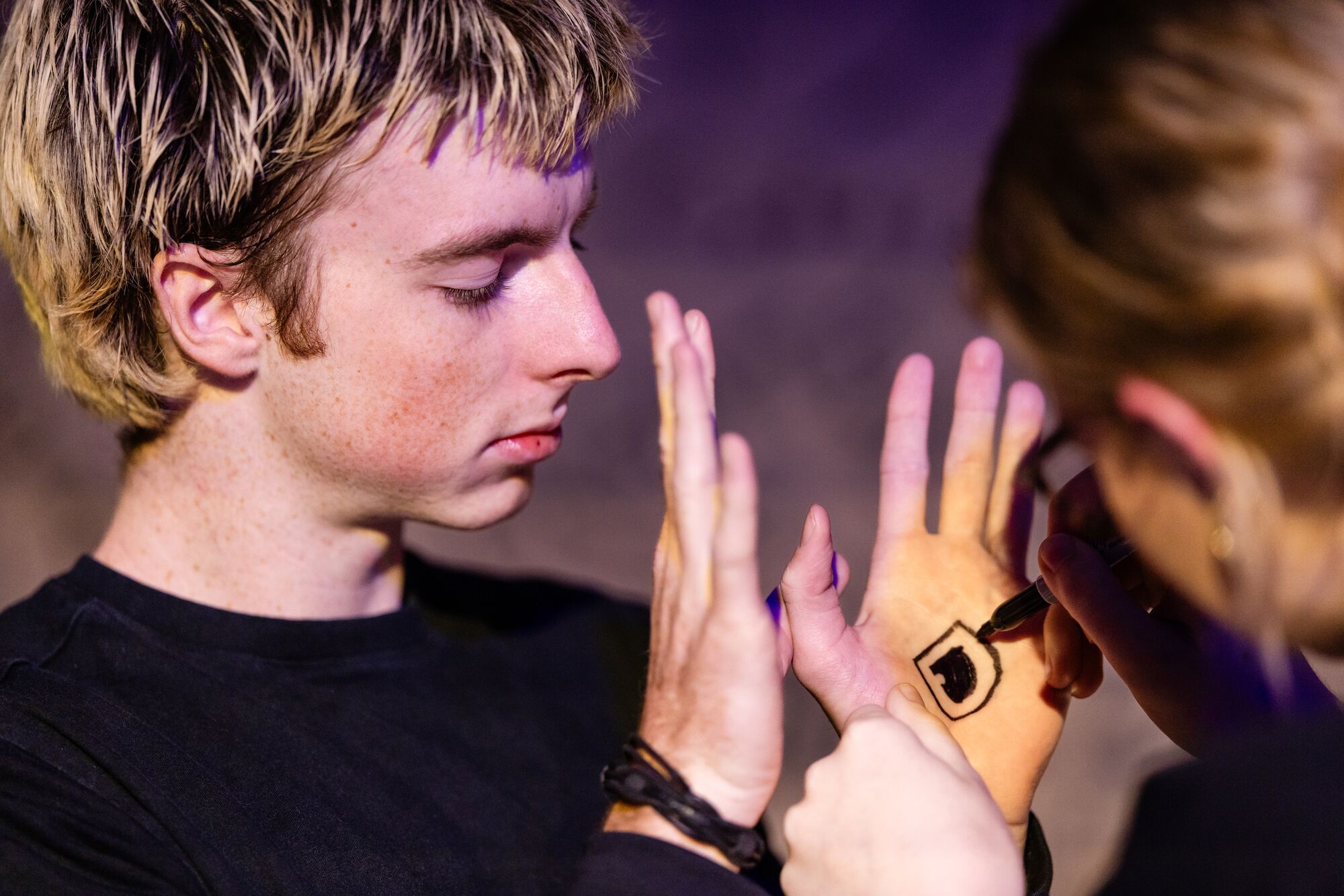
A performer holds up a flat hand while another draws a black eye on its palm with a marker, in purple light.
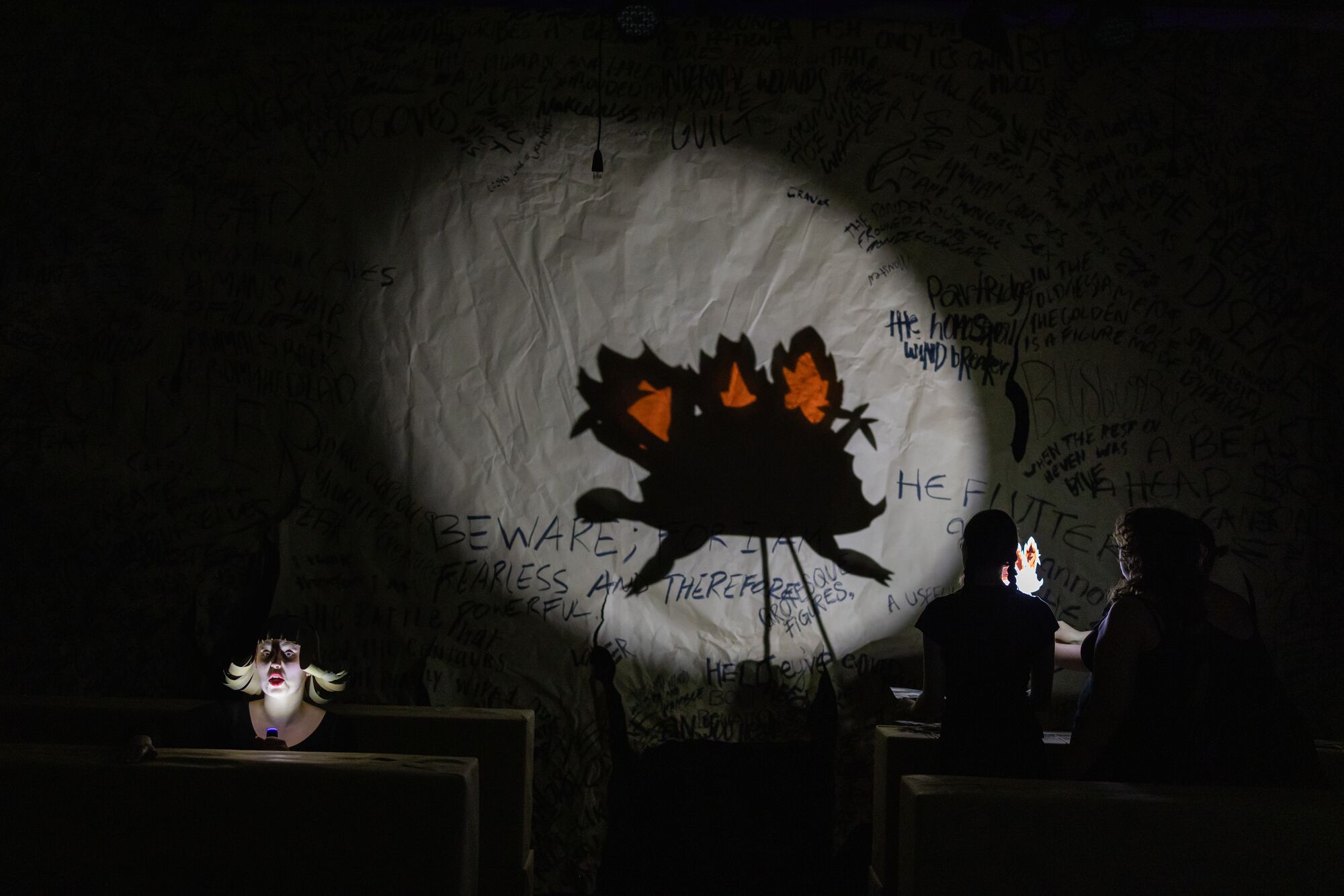
The shadow of a spiked creature with orange flames along its back is cast in a circle of light on the handwritten paper wall.
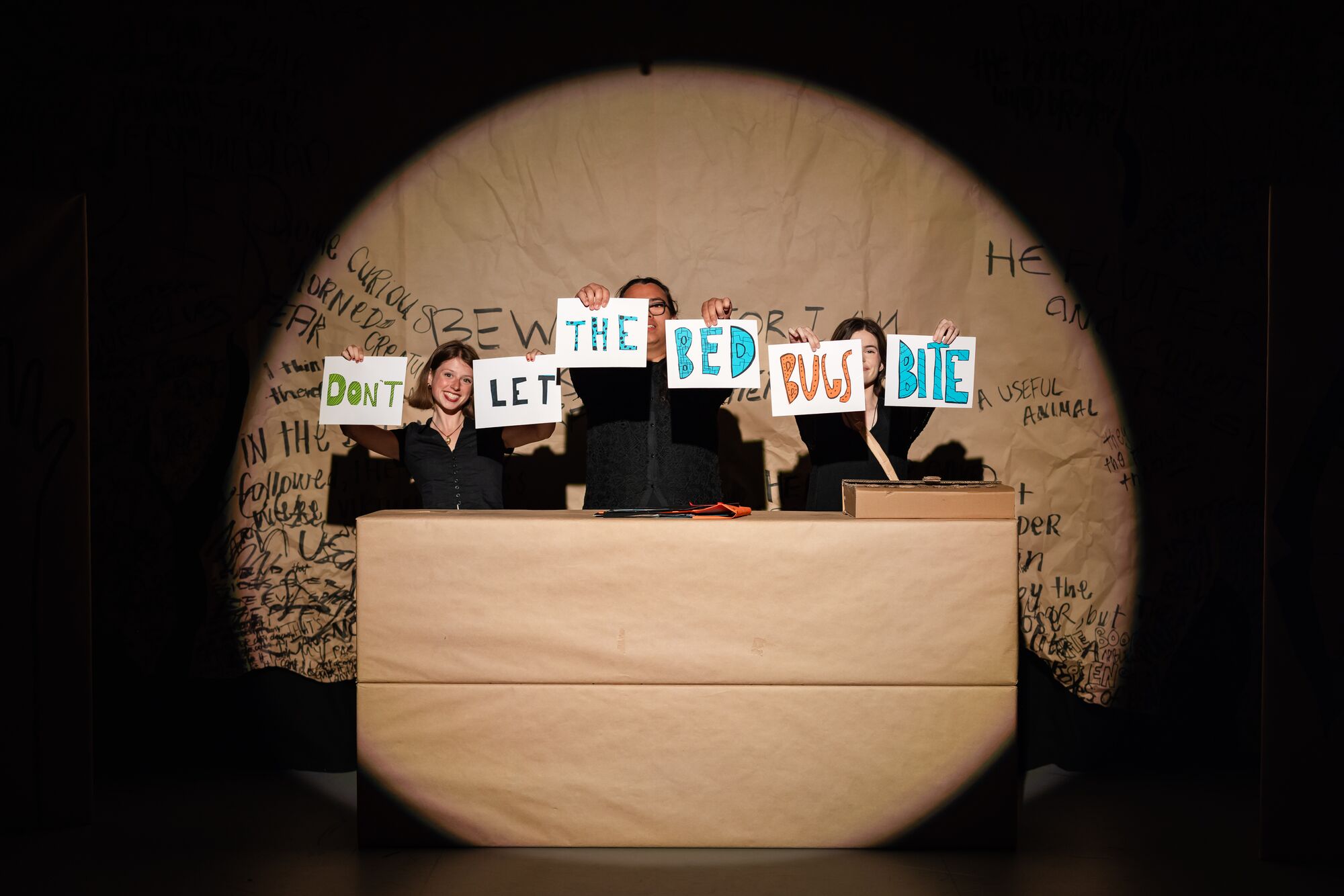
Three performers behind a paper box in a circle of light hold up hand-painted cards spelling 'Don't let the bed bugs bite'.
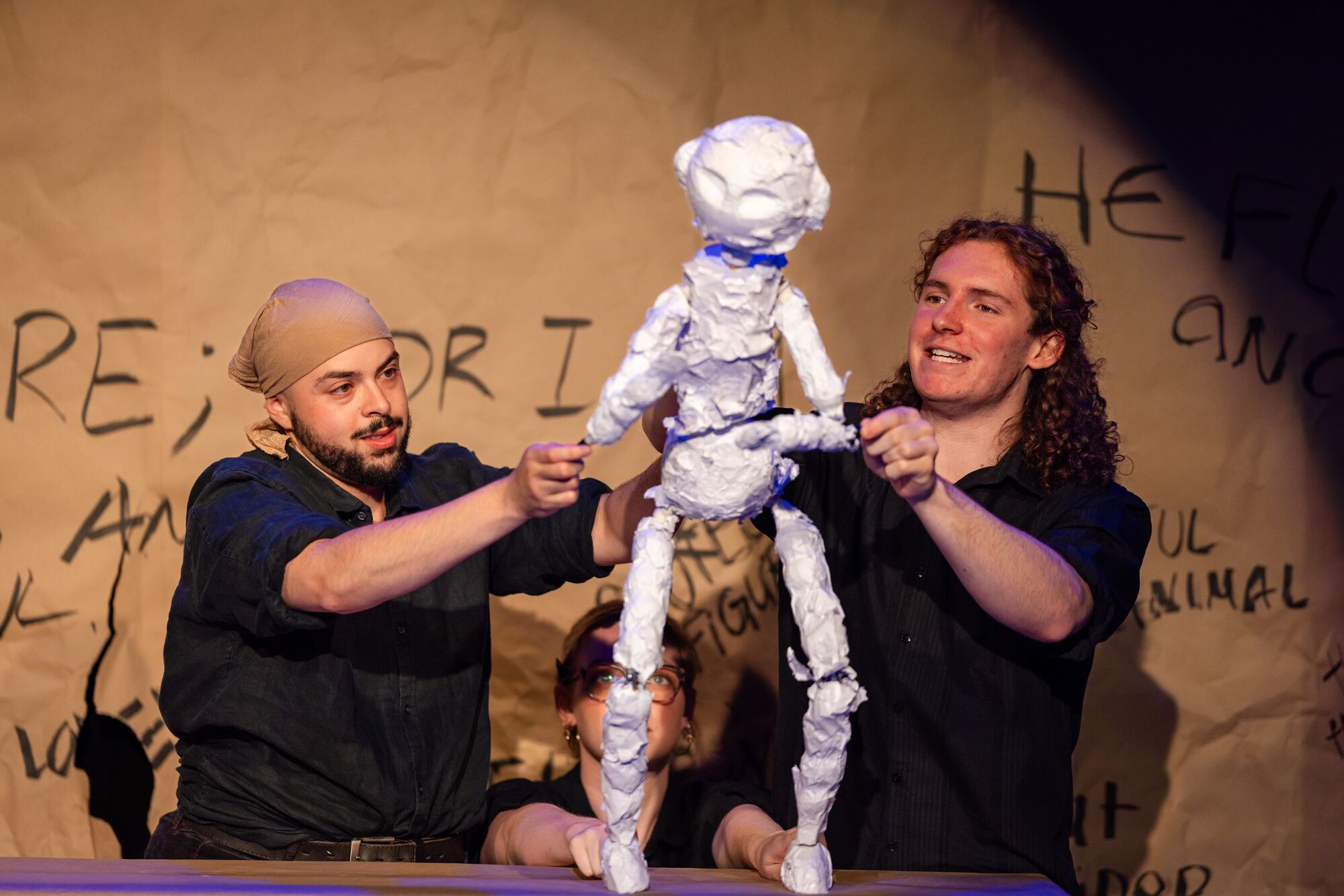
Two smiling performers walk the white paper figure across the table while a third watches from behind.
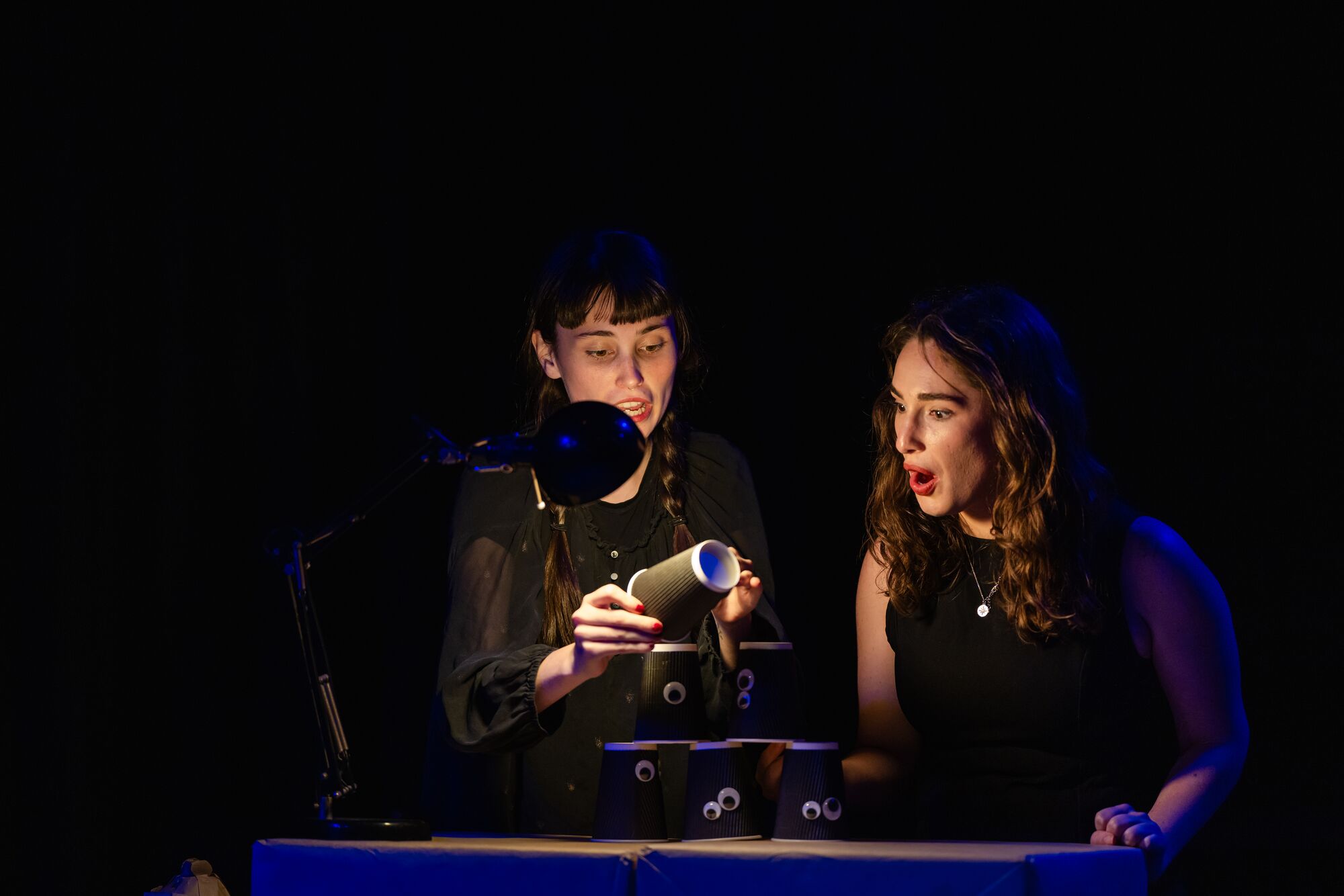
Under a desk lamp, two performers in black lift paper cups with googly eyes from a stack, one of them open-mouthed in surprise.
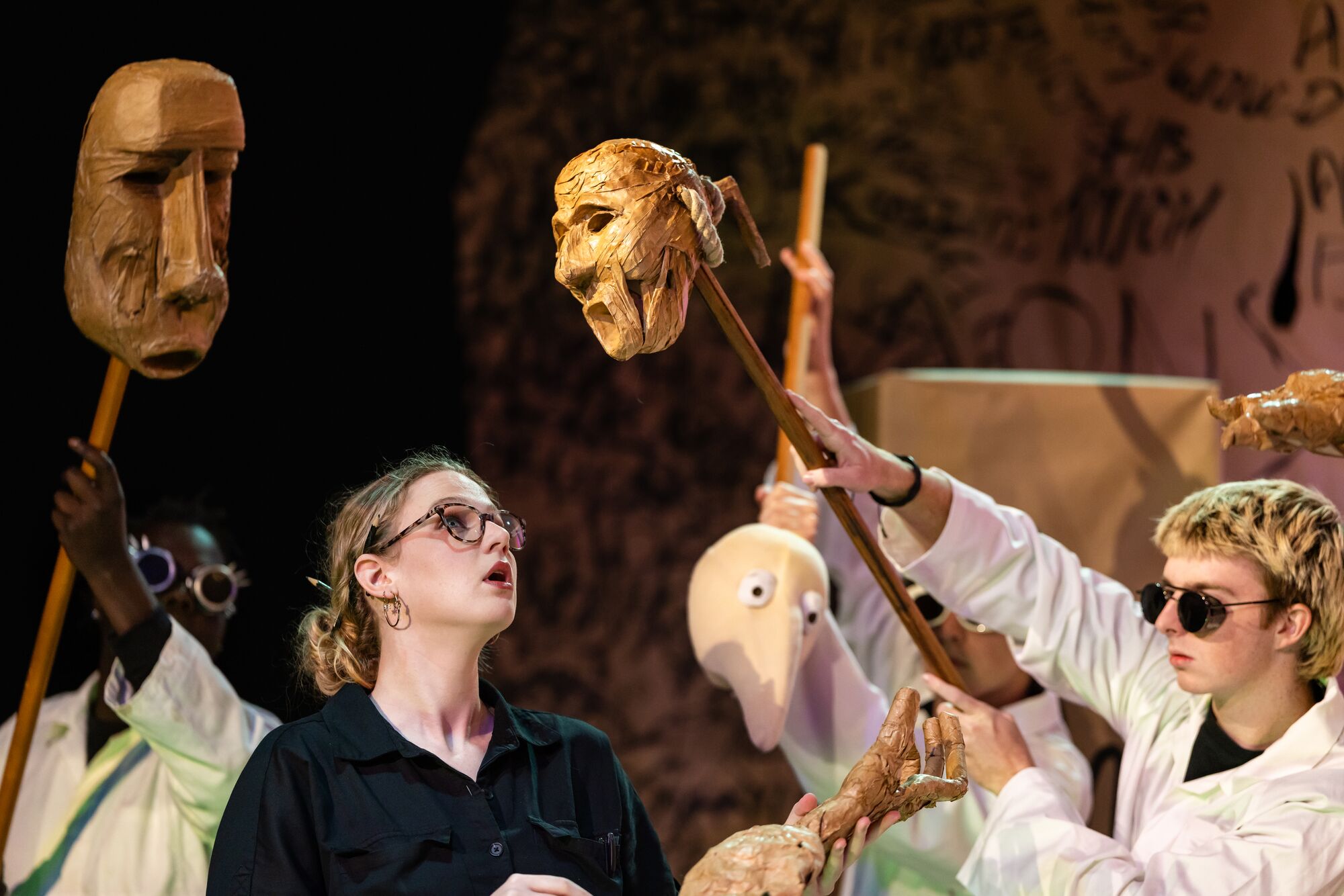
Performers in lab coats and dark goggles hold carved masks on poles and a long-beaked white head around a performer in glasses who looks up at them.
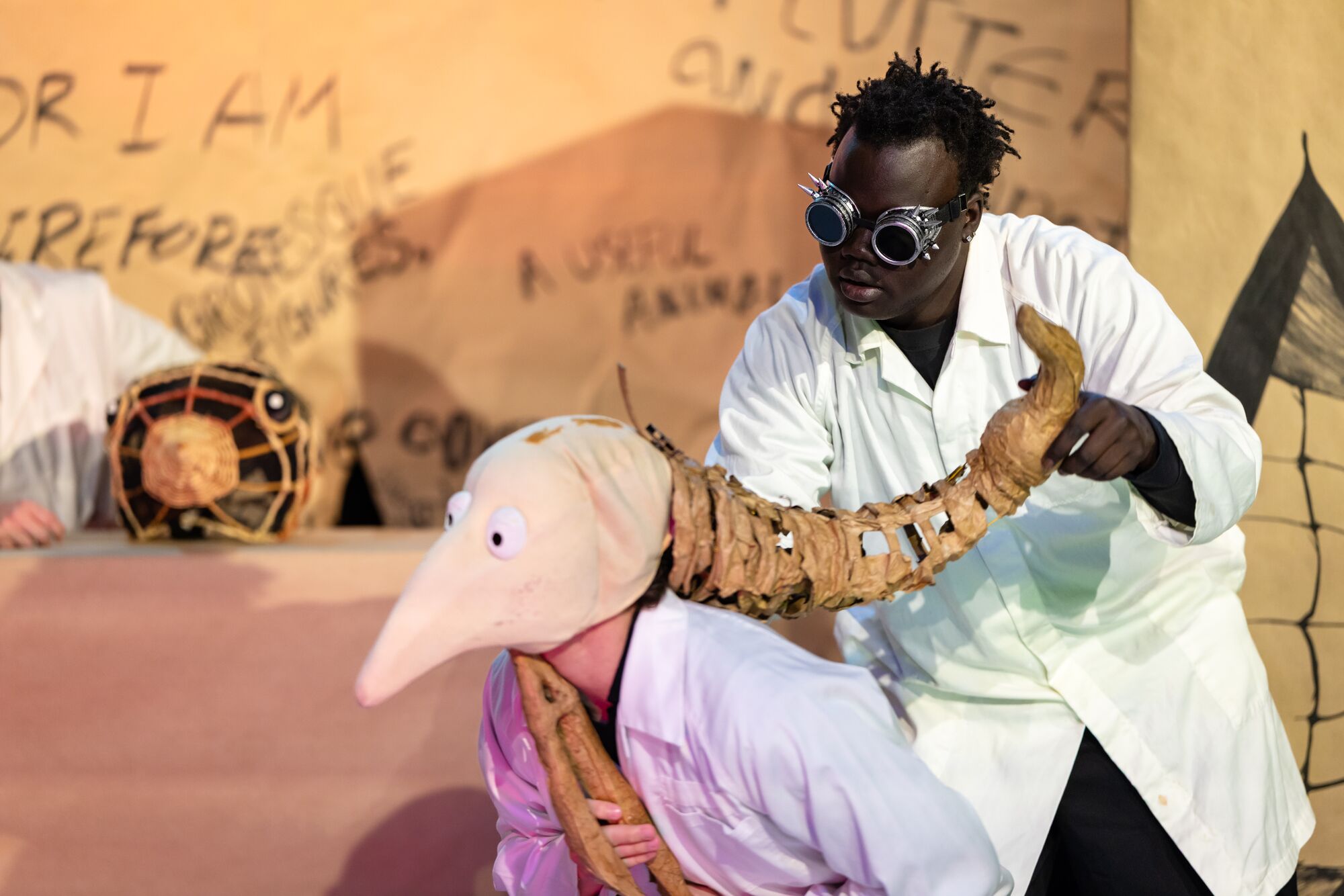
A performer in a white coat and goggles guides a segmented wooden neck joined to a long-beaked white head worn by a performer bent forward.
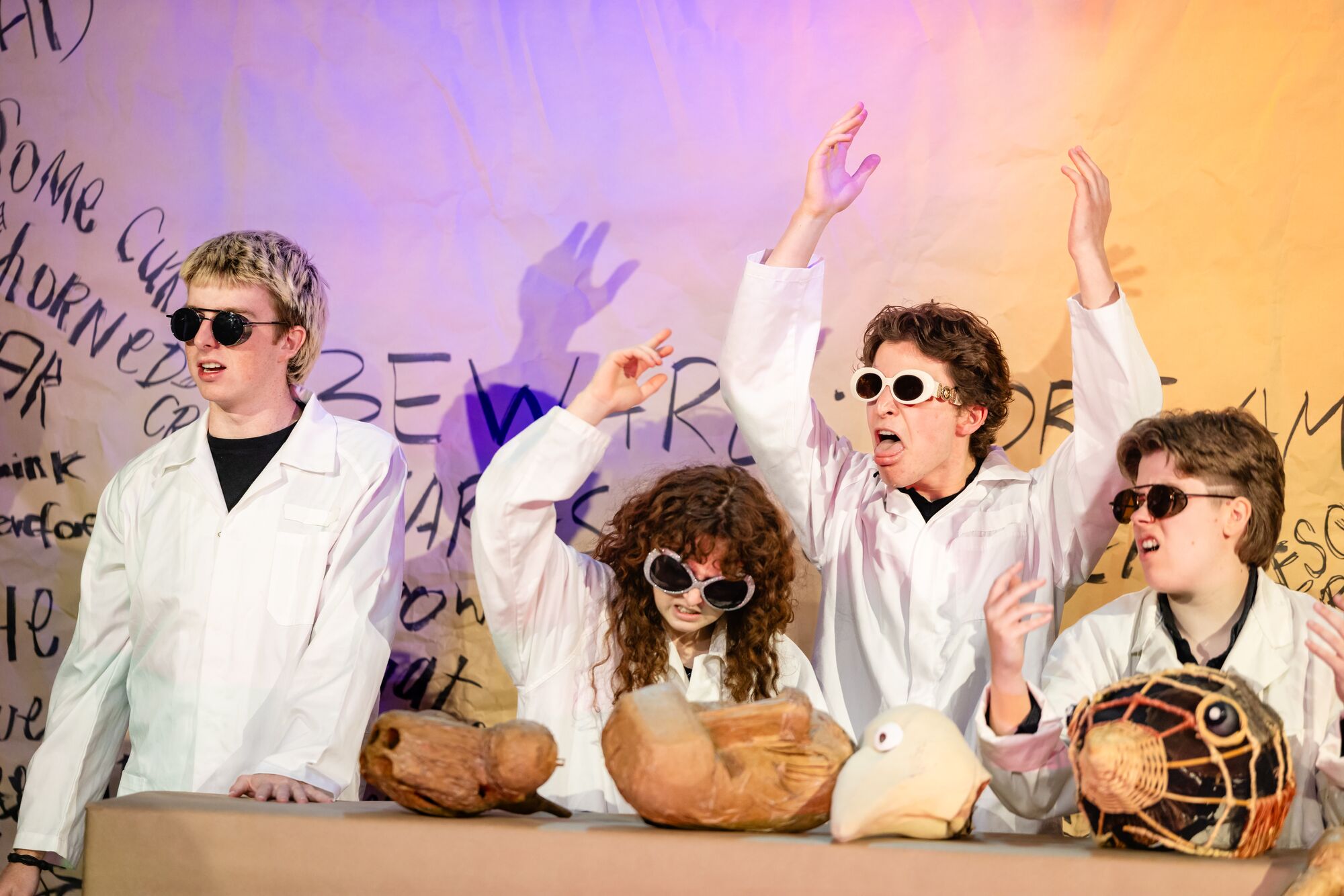
Four performers in white lab coats and white sunglasses raise their hands over a table of creature parts: wooden heads, a beaked mask, and a woven ball.
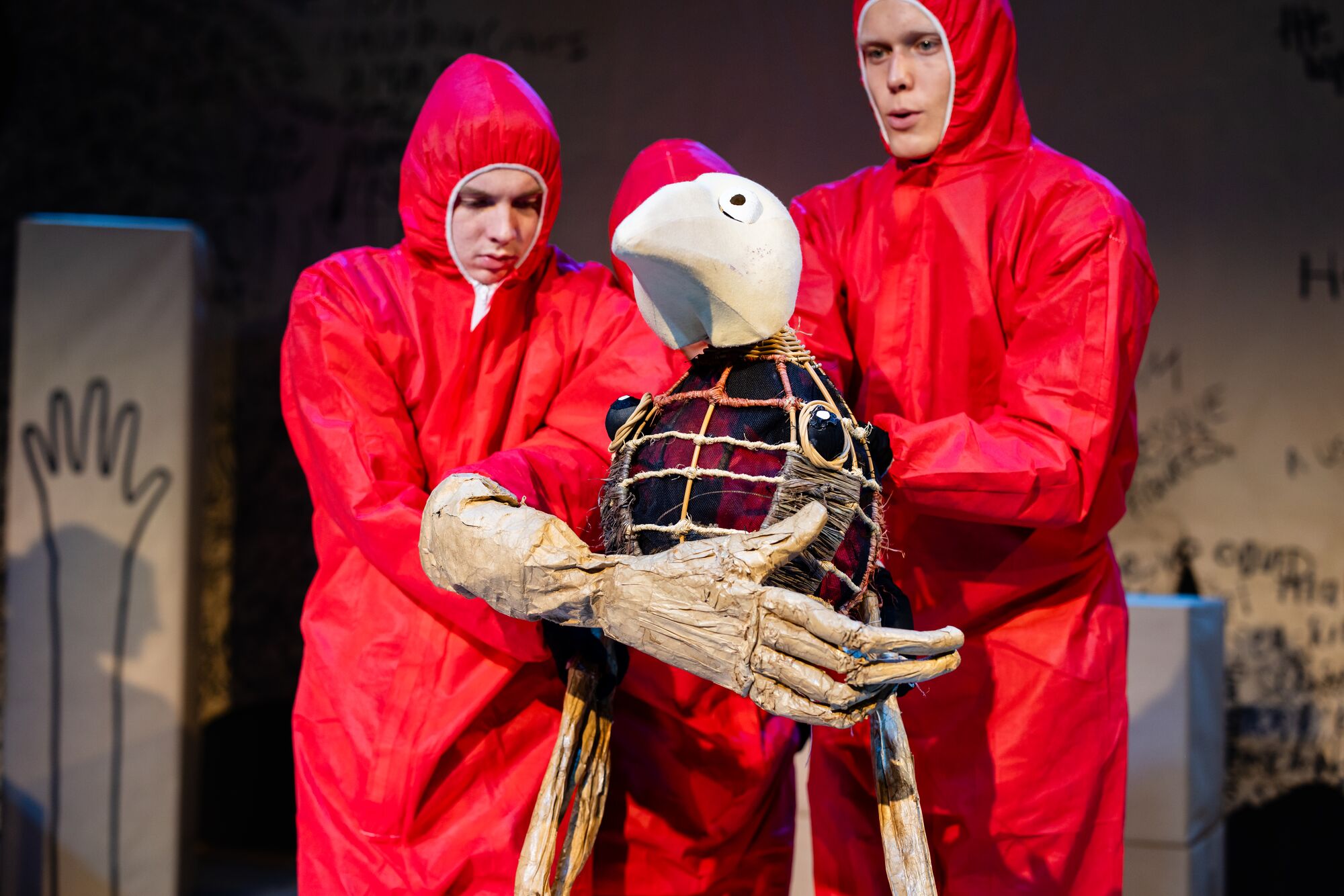
Three puppeteers in red suits fold the creature's long wooden arms across its woven body, under its beaked head.
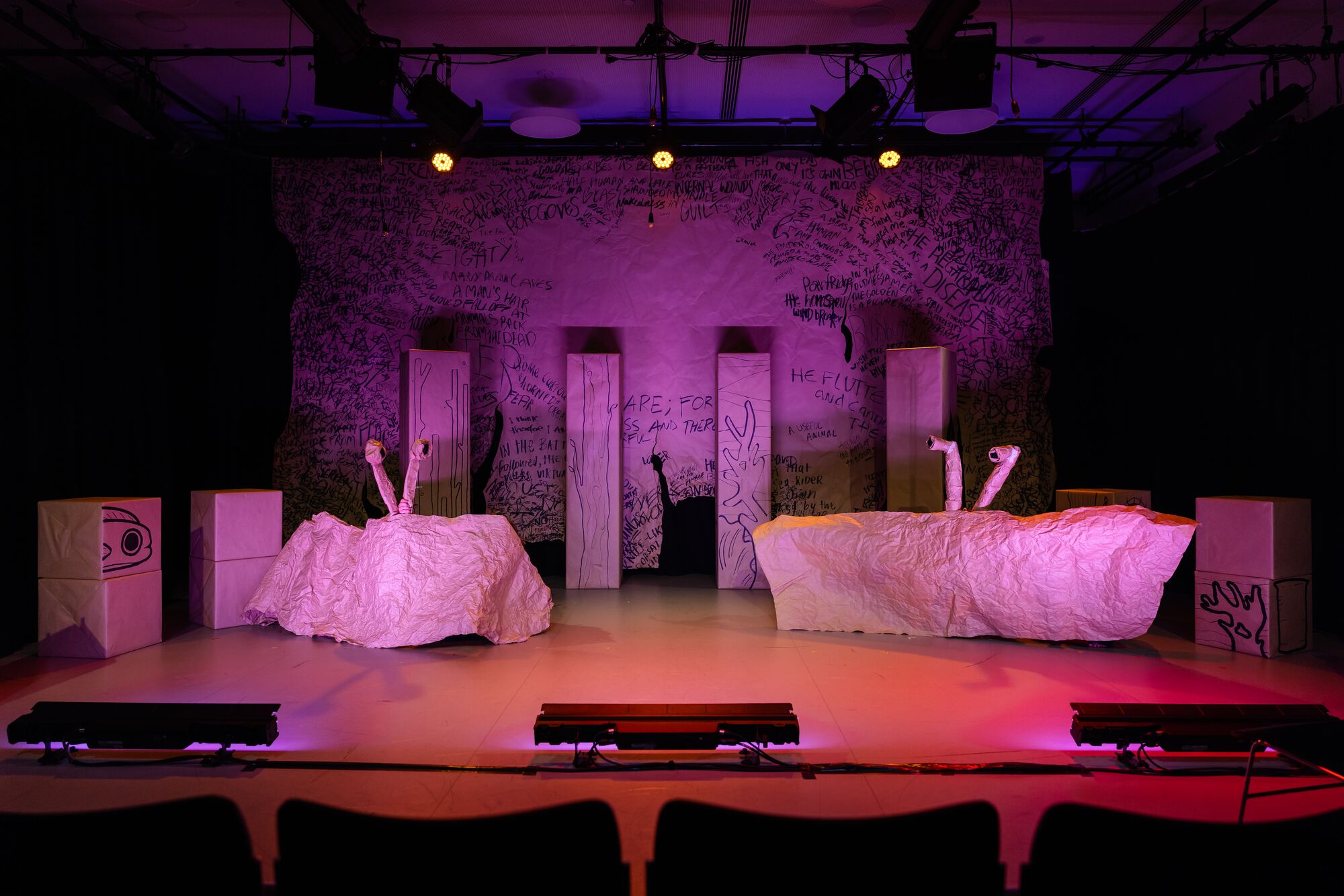
Two mounds of crumpled paper in pink light, with pairs of white-stockinged legs kicking up out of them.
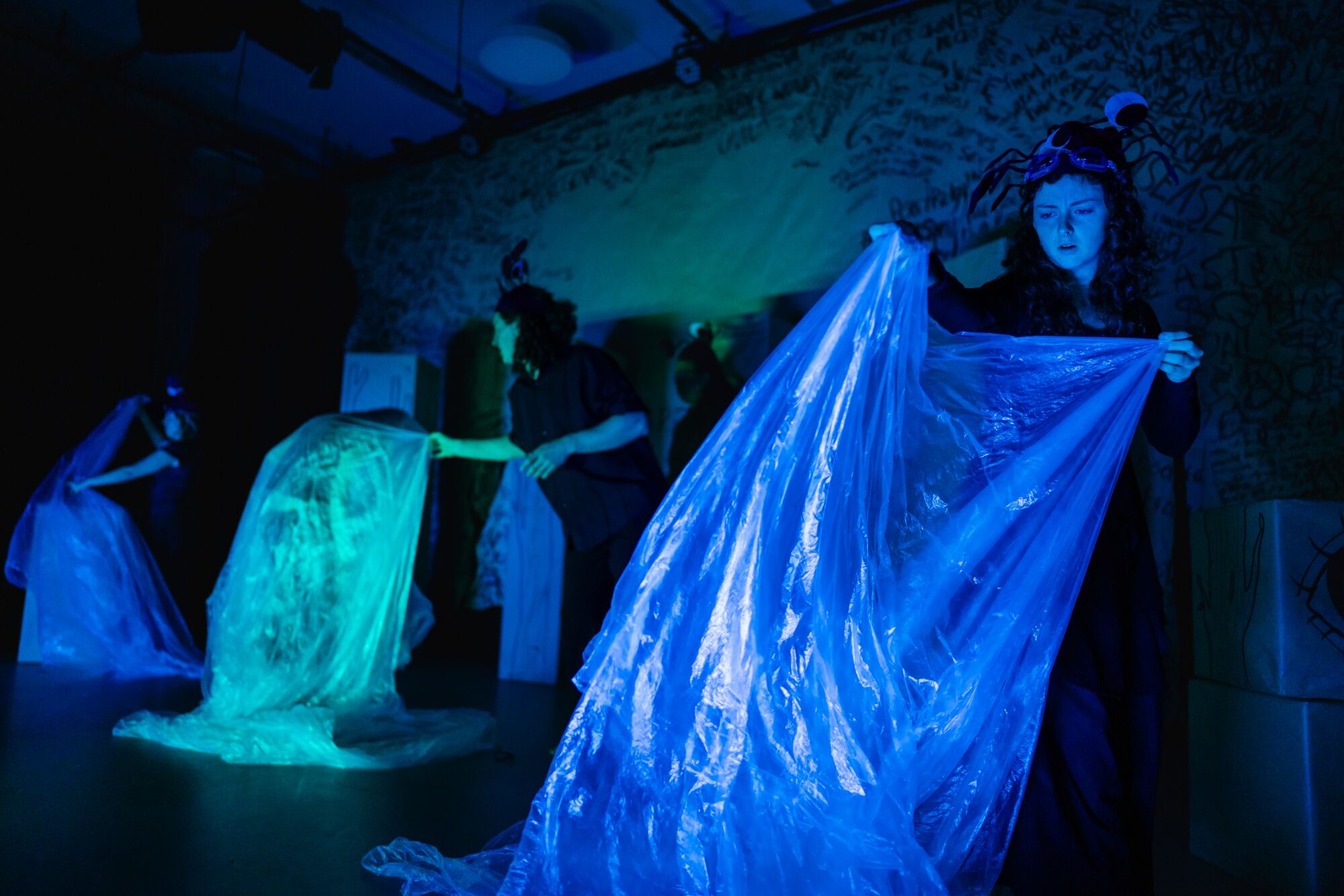
In blue and green light, performers in black with crab-claw headpieces lift and draw out sheets of clear plastic.
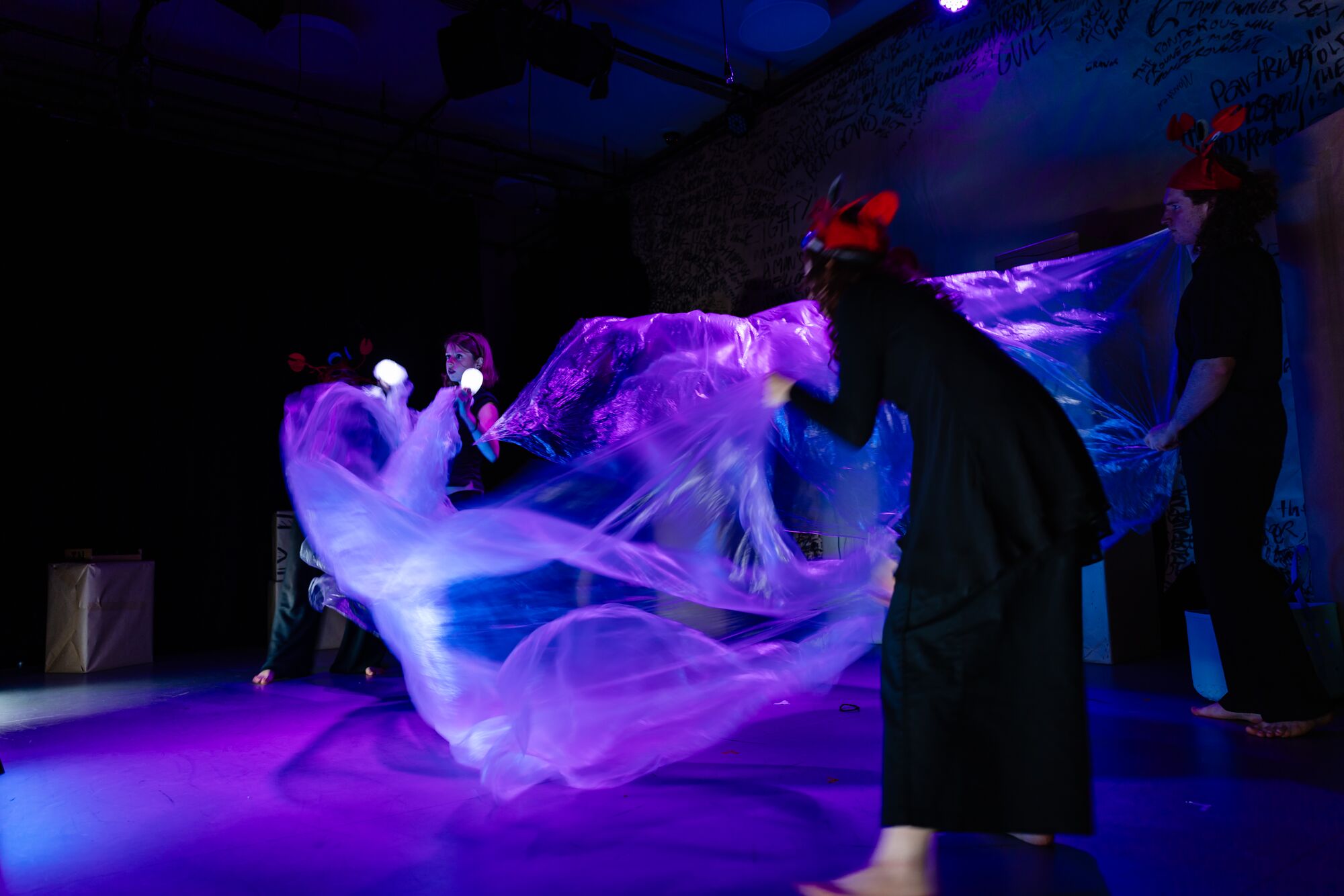
Performers in red crab headpieces swirl a large sheet of clear plastic across the stage in purple light.
Five performers in red crab headpieces hold up jellyfish puppets: glowing globes trailing long strands of shredded plastic.
A large red anglerfish puppet with a glowing lure swims beside smaller glowing creatures above the puppeteers.
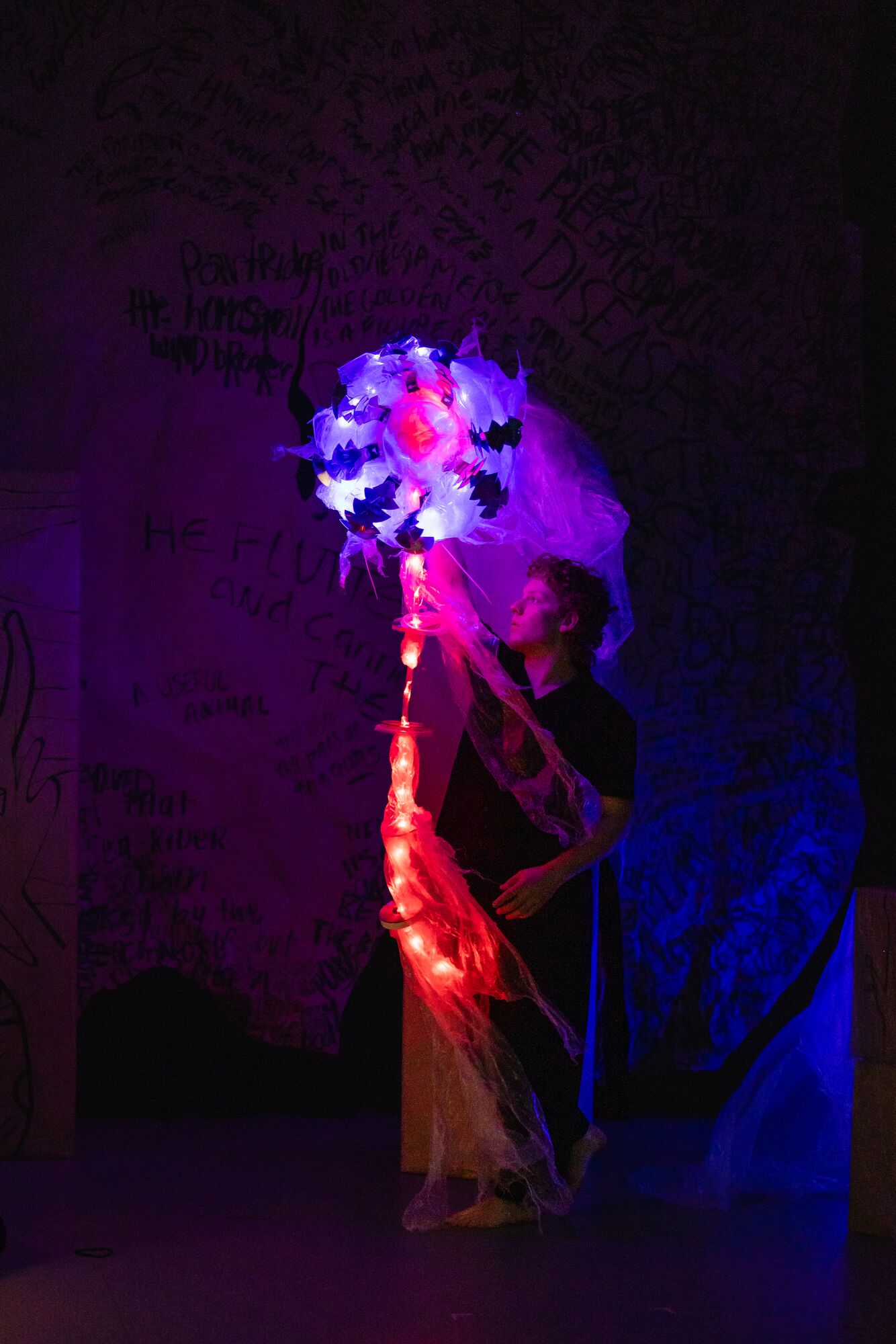
A puppeteer holds up a glowing, flower-like creature with a long red tail lit from within.
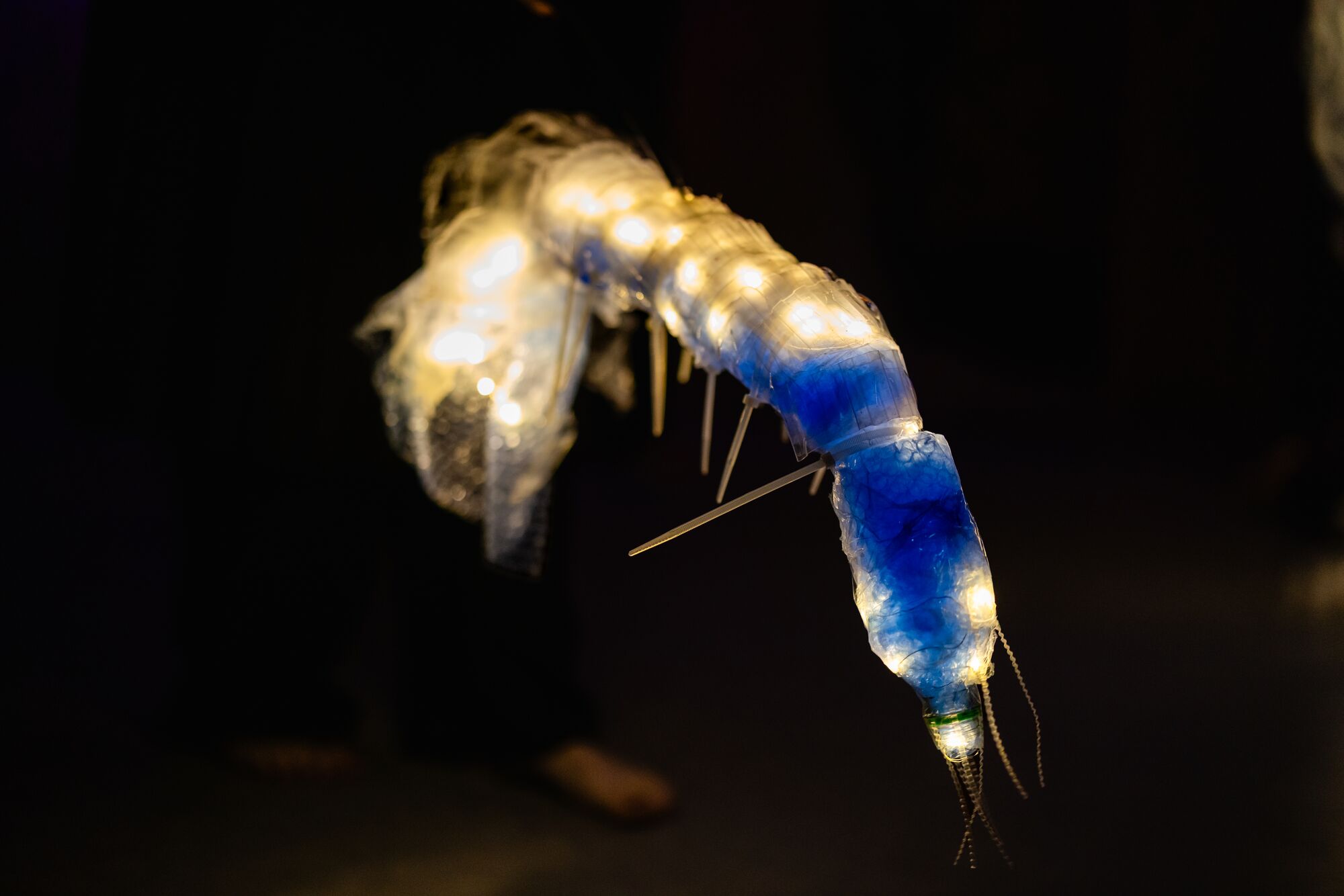
A translucent segmented creature glows with blue and white lights, long spines along its back.
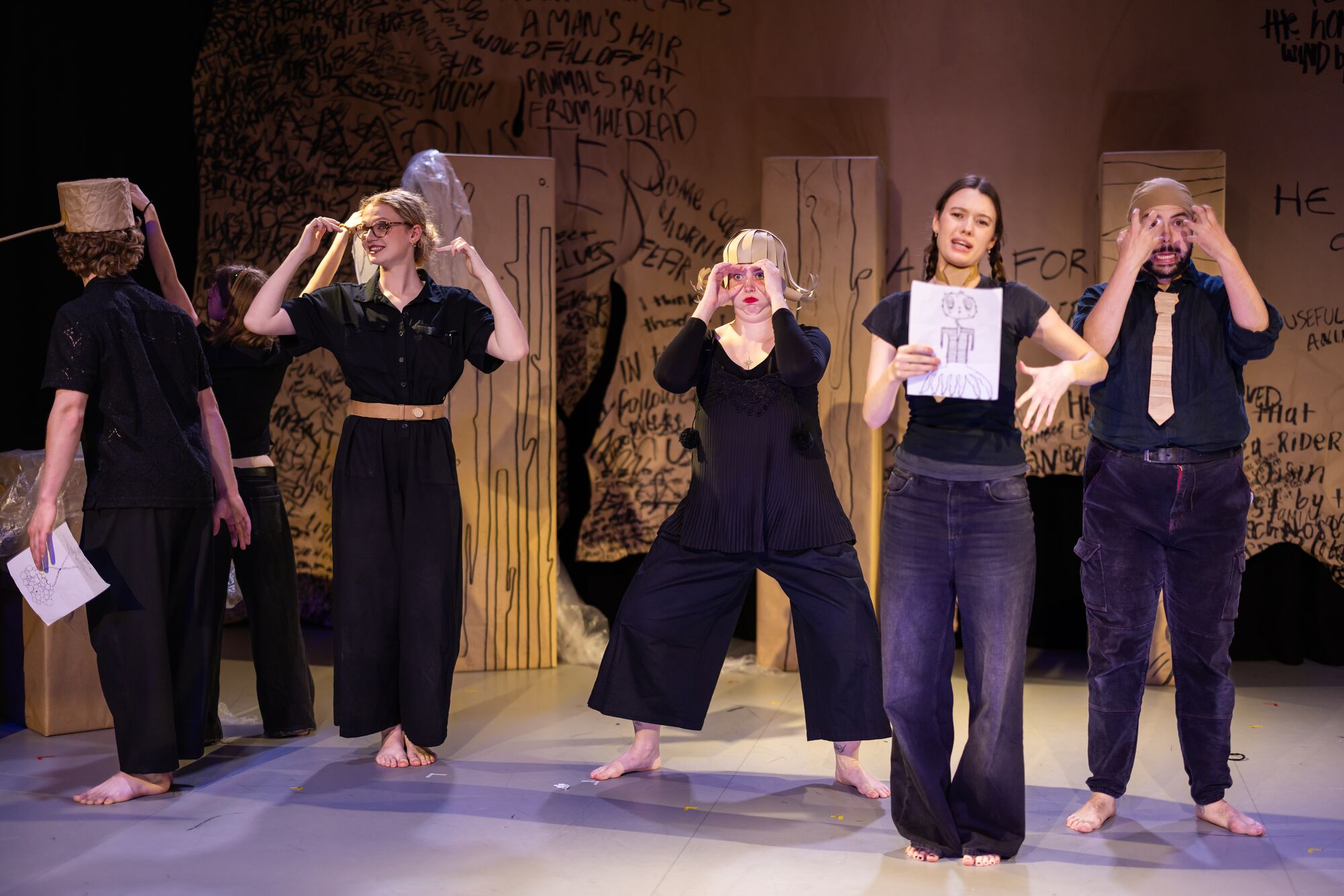
Five performers in a line face the audience with circled fingers held to their eyes like binoculars, one holding up a drawing of a creature.
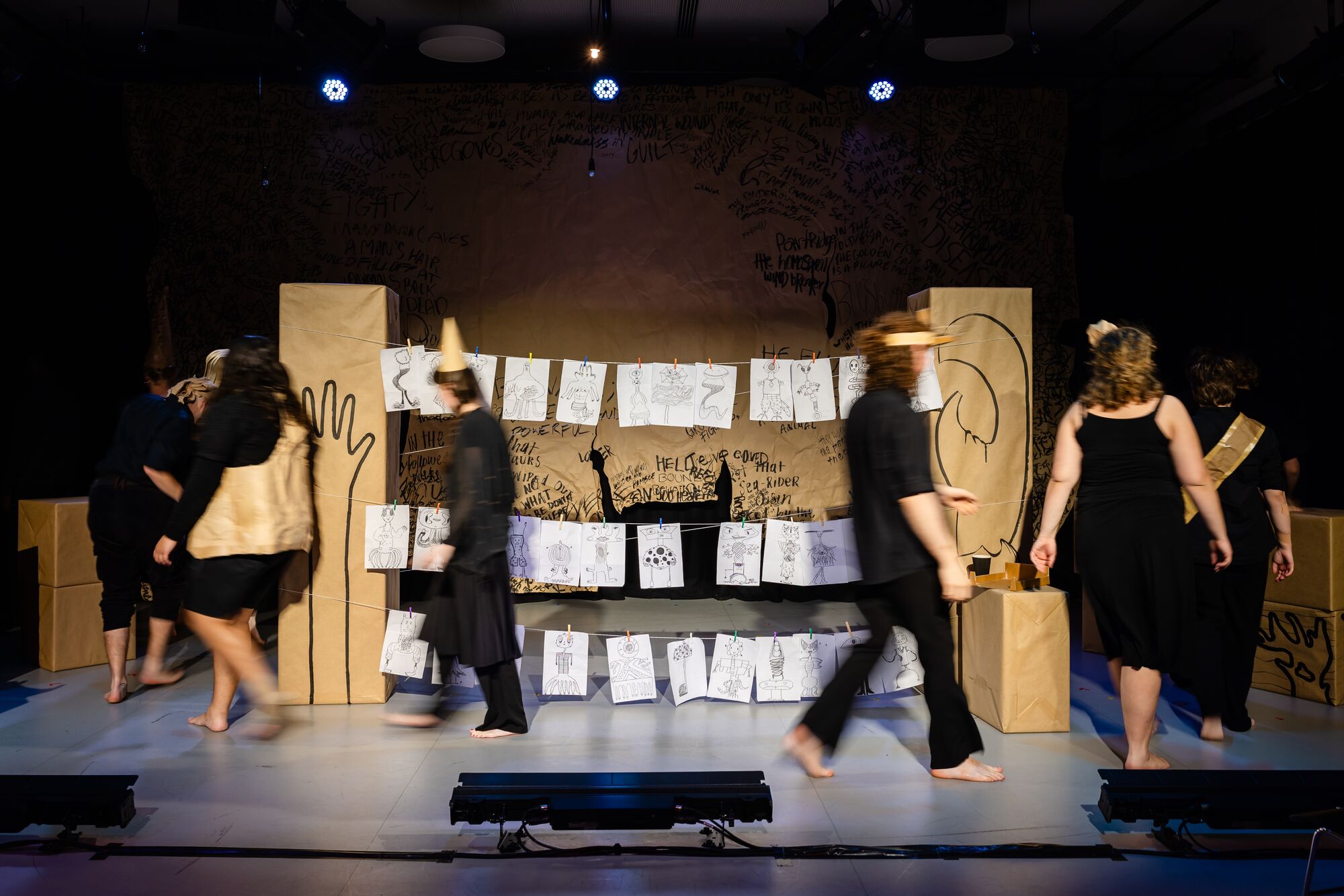
Performers walk past three lines strung with drawings of imaginary creatures, hung between tall paper columns.
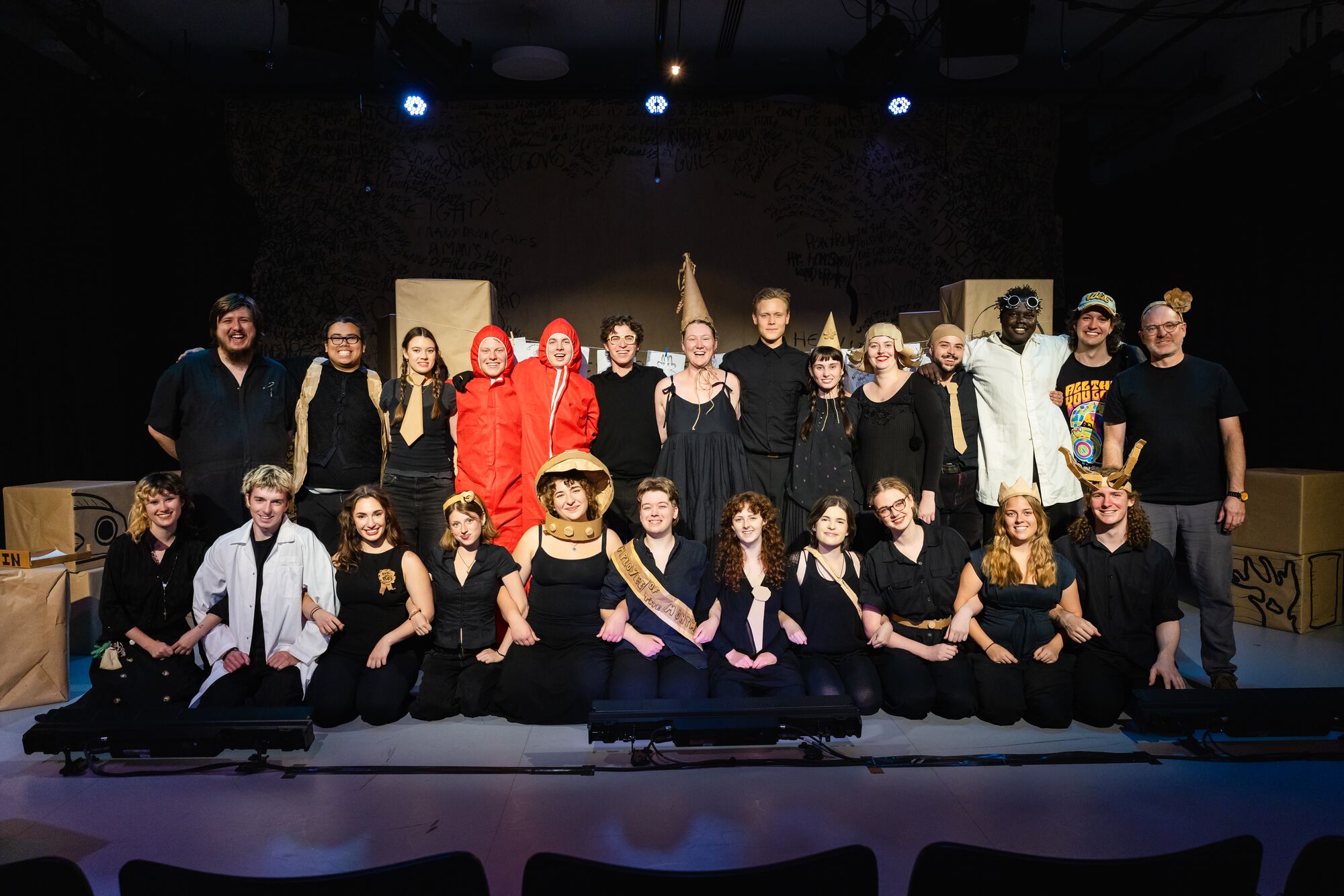
The company and creative team pose together on stage in costume, some in red suits and lab coats.
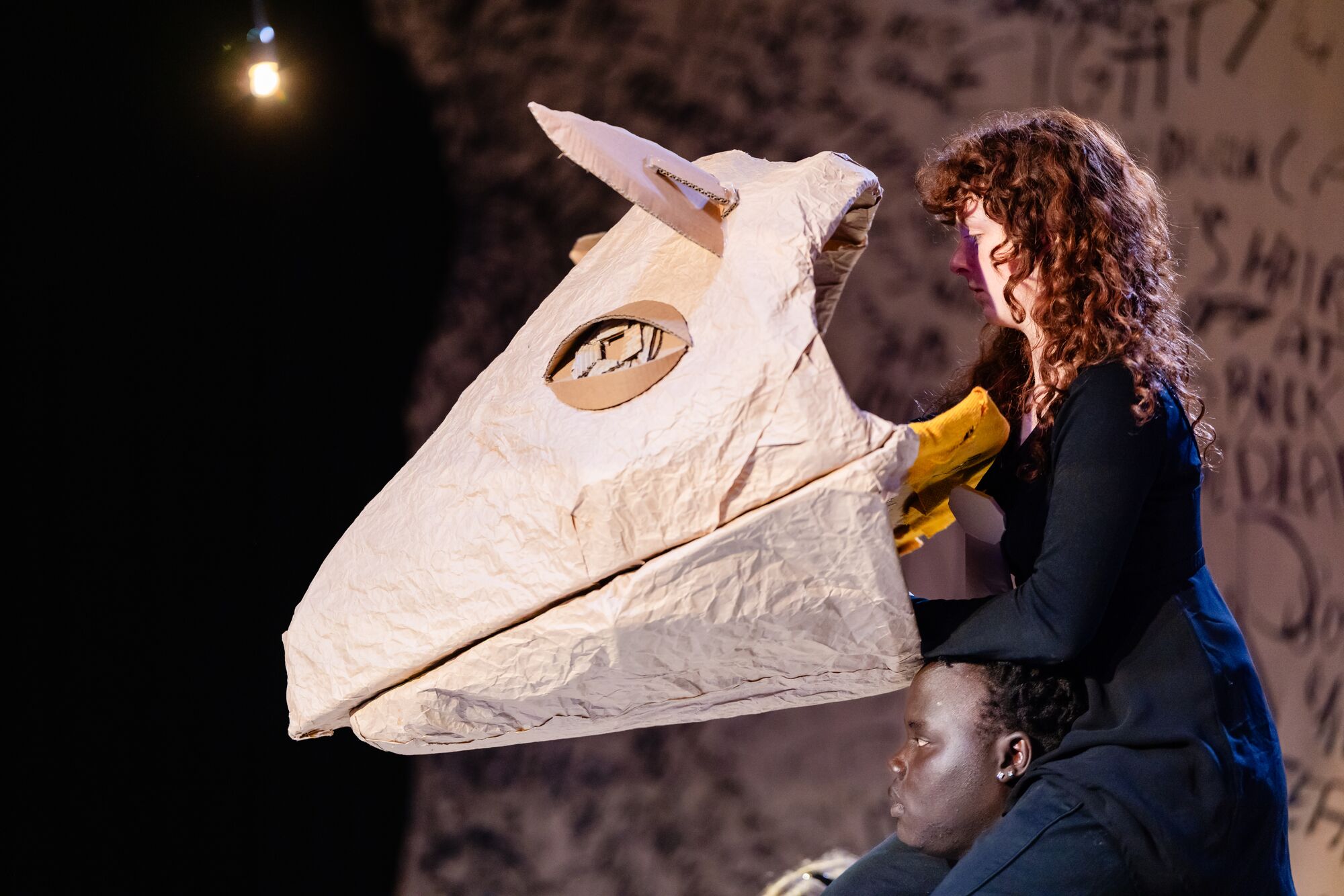
A performer in black guides a large horned head of crumpled paper, worn by a performer seated below.
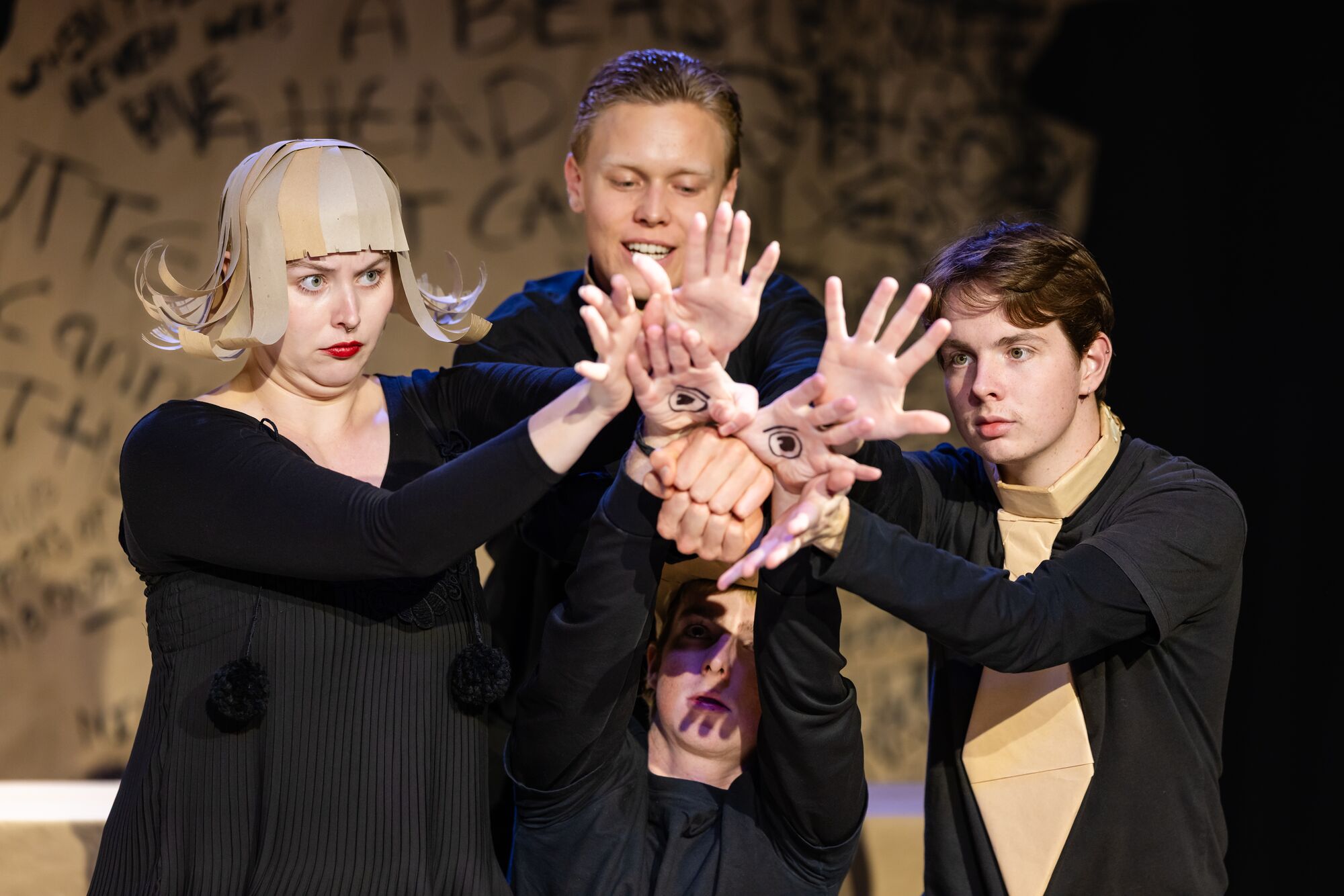
Three performers press together hands with eyes drawn on the palms, one in a paper wig, while a fourth peers up from below.
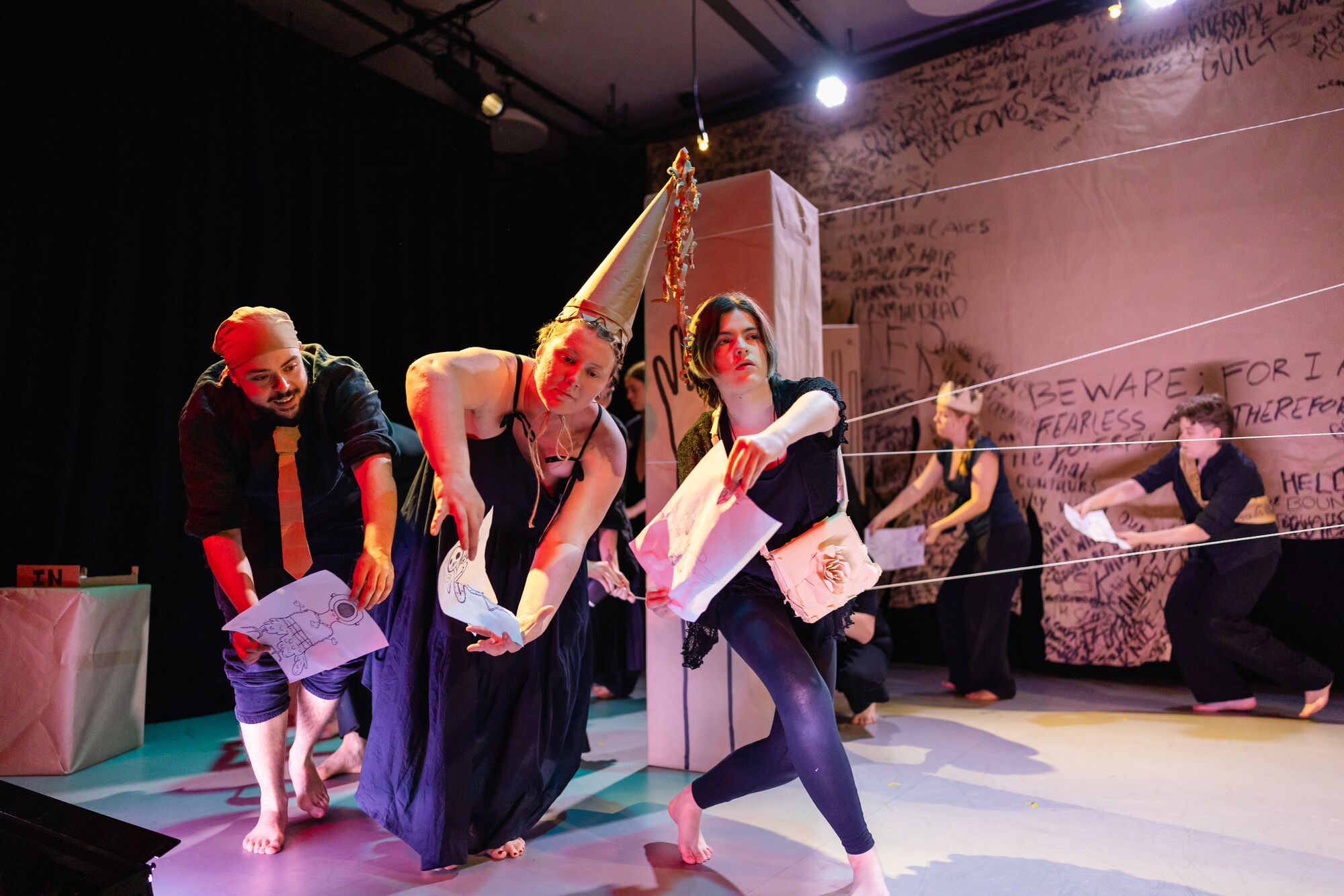
Performers bend through a web of white strings holding up drawings, one in a tall paper cone hat.

1 of 22

Photos: Kylie Plunkett (kylieplunkett.photography, @kylie.plunkett on Instagram)

About the BPA

The Bachelor of Performing Arts (Performance Making) is an incubator for future cultural leaders. Artists who are passionate about telling stories and driving change in the global performing arts landscape.

Our students have a diverse range of interests, from performing and directing, to writing plays, producing festivals, facilitating community-engaged arts projects, and collaboratively devising dynamic physical performance.

Their journey begins with the development of a strong skills base grounded in rigorous training in text-based acting, voice, movement, and theatre history. They then go on to deepen their practice by being introduced to devised, transcultural, and experimental approaches to making performance so that by the time they graduate, they have a full range of tools at their disposal to create new work that is distinctly their own.

The Performance Making program is centred around processes that are inclusive and reflexive, and our teaching is grounded in a work ethic designed to help you to become an independent and critically thinking artist.

Our graduates are well positioned to be the cultural leaders and innovators of tomorrow. They have the communication, collaboration, and project management skills to produce their own work as soon as they graduate and have a wide range of opportunities to build industry connections that help put them in the driving seat of their own careers.

Learn more about the Bachelor of Performing Arts (Performance Making) ↗
Last year's Visual Theatre Lab: Echolocation: Palimpsest of Echoes (2025), directed by Michael Barlow.